The most common cause of clutter in a small hallway is not a lack of space, but the mixing of three different categories of shoes: wet, everyday and those waiting for their season. When all of this stands in one row by the door, the passage narrows, the floor under damp pairs does not dry, and the morning exit turns into a search for the second shoe. So it is worth starting not with buying a new cabinet, but with assigning roles: where shoes dry, where they stand every day and where the rest is stored.
Next comes a sequence you can go through in one weekend. It requires no renovation, expensive furniture or special skills: a tape measure, masking tape and a readiness to part with a few pairs that have not been worn for a long time are enough.
- Count how many pairs you really need by the door
- Keep the passage and the door-opening zone clear
- Set up a place for wet shoes
- Where to put the drying zone
- How to dry properly
- Choose open or closed storage for dry pairs
- Find a separate place for tall boots and the seasonal reserve
- Check that it is convenient for all family members to maintain order
- Frequently asked questions
- Can wet shoes be dried in a closed cabinet?
- How many pairs should be kept by the door in a narrow corridor?
- What to do if there is no room in the hallway even for a tray?
- Is ventilation needed in a shoe cabinet?
- Can shoes be stored on the balcony?
- A short weekend algorithm
Count how many pairs you really need by the door
Walk through the hallway with a sheet of paper and write down everything that is currently standing on the floor. Then divide the list into three groups: shoes worn every day; shoes worn several times a week; and everything else — seasonal, festive, sports, children’s “room to grow”. A permanent place by the door should be left only for the first group, at most two pairs per person.
This is not asceticism for its own sake. Each pair on the floor takes up roughly 25–30 cm of passage width, and if the shoes stand with toes pointing in different directions, in fact even more. In a corridor 90–110 cm wide, typical of city apartments, two or three pairs in a row already force you to turn sideways with a bag in hand. The rule is simple: what lives by the entrance is what you will put on today or tomorrow.
Send the rest of the pairs to another zone — a pantry, a wardrobe in the bedroom, a mezzanine, flat containers under the bed. If you live in a rented apartment and have no extra furniture, containers under the bed or a tall narrow shelving unit in the room will do, rather than another pile in the corridor. It is important that this place be dry: a damp pantry or a cold balcony with rapid temperature swings will ruin leather faster than a tightly closed cabinet.
Separately, it is worth taking an honest look at the pairs you have not worn for a year. In a narrow hallway they take up space that is already in short supply, and they usually get in the way of everyday items. Giving them away, repairing them or passing them on is not a defeat, but a way not to turn the corridor into a warehouse.
Keep the passage and the door-opening zone clear
Before buying anything, check how the door moves. An entrance door that opens inward sweeps a quarter circle with a radius of about 80–90 cm. Any shelf or tray in this zone means either scratches on the door or constant rearranging of shoes, and over time the habit of throwing pairs on the floor, because “it will have to be tidied up anyway”.
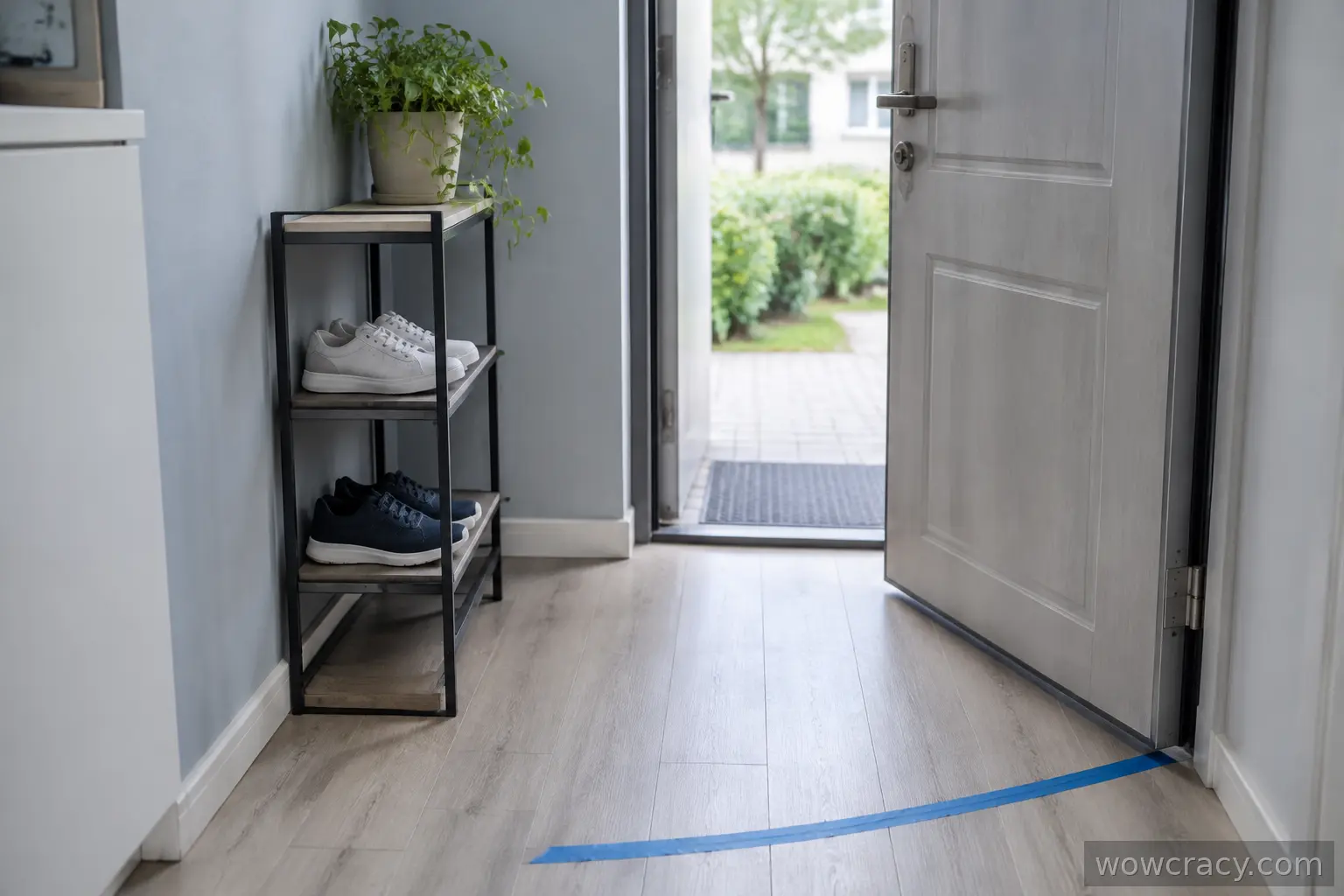
The simplest test: open the door fully and mark with masking tape the boundary beyond which nothing should stand. The tape stays on the floor for a few days while you get used to the new geometry, and leaves no marks on laminate or tile.
The second reference point is a clear strip for the passage. For one person 60 cm is enough, for two people passing each other — about 80–90 cm. If after installing a shoe cabinet this strip narrows, choose furniture that is taller and narrower rather than deeper. A depth of 20–25 cm suits most pairs except tall boots, and it is precisely this depth that allows a cabinet to stand along the wall without eating into the passage.
The third element, which is often ignored, is room for opening the cabinet doors themselves. Hinged doors in a narrow corridor almost always get in the way: to get a pair out, you have to step back or hold the door with your shoulder. Open shelves, pull-out drawers or a cabinet with folding or sliding doors win here. If you choose a variant with solid doors, check that they open no more than 90 degrees and do not bump into the clothes on the hanger opposite.
Set up a place for wet shoes
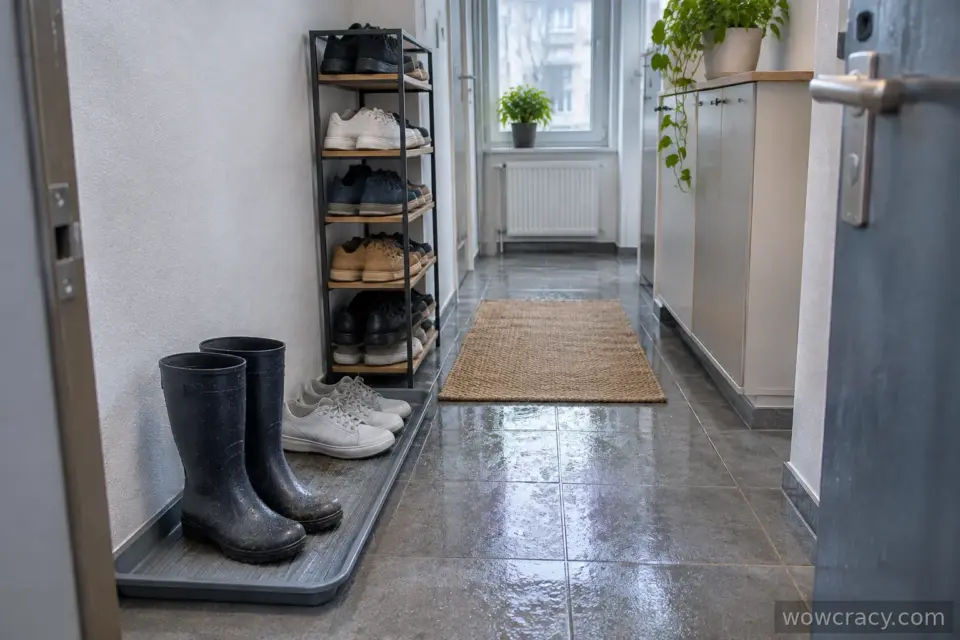
Wet shoes in the hallway are the main source of moisture, mould and unpleasant odour. You cannot put them straight into a closed cabinet: without air, moisture stays inside, and with it — odour and the risk of leather deforming. So a third, transitional zone is needed — a drying zone, which stands apart from permanent storage.
Where to put the drying zone
Ideally — near the entrance, but out of the passage: in the corner behind the door, to the side of the cabinet, on a small floor stand. If the hallway has a window, use the windowsill, but do not leave shoes in the sun there for long — dark leather fades. The main thing is that damp pairs do not stand in the way and do not touch dry ones.
If there is very little space, a folding dryer for two or three pairs will do, which is set up only in the rainy season and put away behind the cabinet in dry weather. Another compact option is a low stand that stands under the coat rack: it does not get in the way of opening the door and does not end up underfoot.
Under wet shoes, be sure to place a shoe tray with sides — not a mat and not a newspaper. A mat absorbs moisture and itself becomes a source of odour; newspaper soaks through and leaves marks on the floor. A tray made of plastic or metal is easy to wash, does not let water through to the floor and protects the surface. For a narrow hallway, long models for two or three pairs are convenient: they stand along the wall and do not protrude into the passage.
How to dry properly
- Remove the insoles and dry them separately — the most moisture accumulates under them.
- Stuff the pair with crumpled paper or special inserts: they hold the shape and absorb moisture from inside.
- Place the shoes on the tray without leaning them against the wall or cabinet, so that air blows around them from all sides.
- Do not dry on a hot radiator or heater — leather and glue can deform, and the sole can come unstuck.
- Change the paper inside every few hours while the shoes are damp.
- After drying, brush suede pairs, otherwise the nap will become coarse.
Usually leather shoes need from a few hours to a day to dry at room temperature. If the pair is soaked through — after slush or snow — it is better to leave it overnight in the drying zone rather than hide it in the cabinet. Not all materials tolerate prolonged drying the same way: rubber and textiles dry faster, while thin leather loses its shape from overheating. So follow the manufacturer’s instructions if there are any.
Winter shoes with fur lining need special attention. They should not be dried near hot appliances: the fur mats down and the glued seam becomes brittle. Room temperature and free air access are enough.
Choose open or closed storage for dry pairs
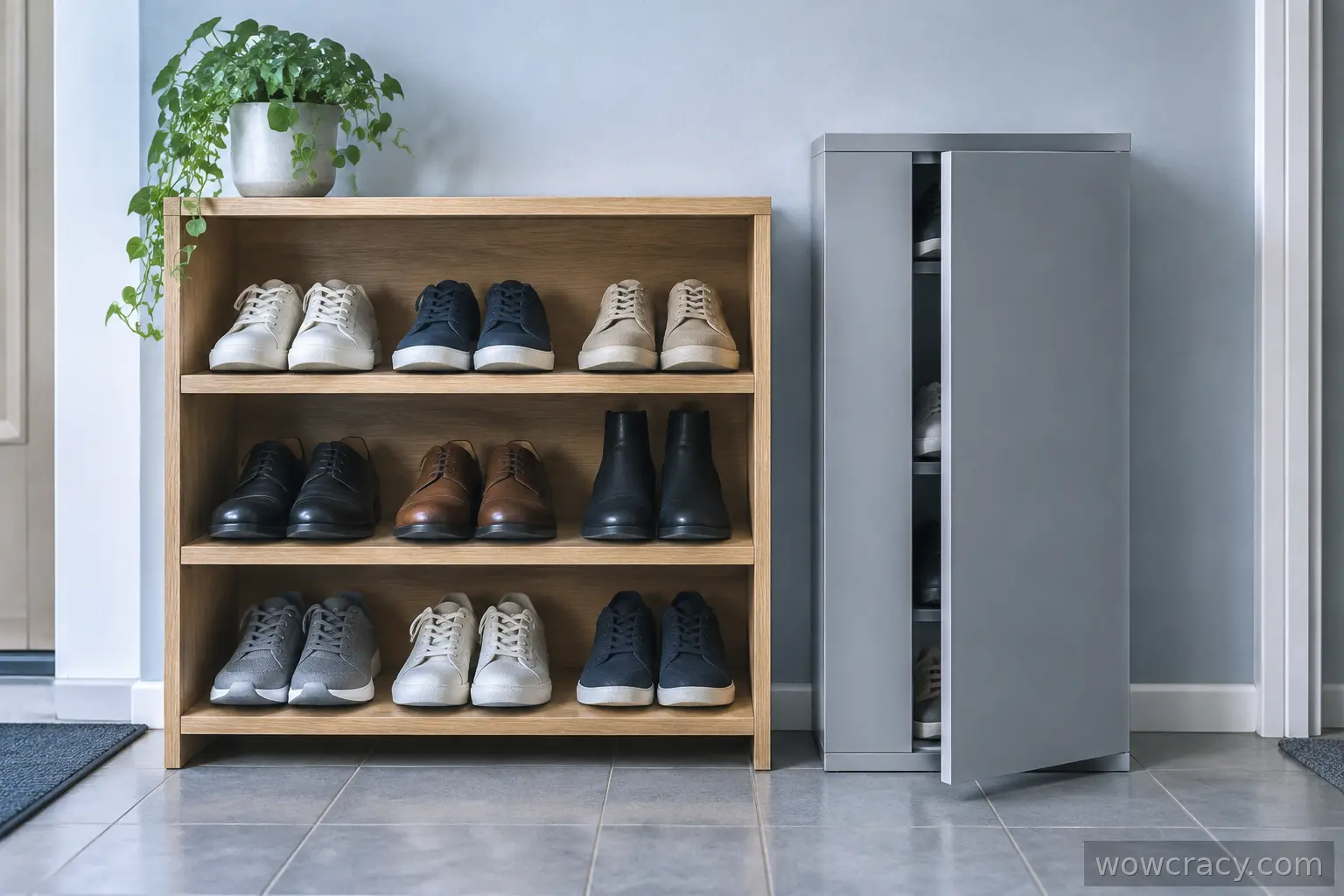
When wet shoes have their place, for dry ones you can choose between an open shelf and a closed shoe cabinet. The choice depends not on fashion, but on how much dust and moisture there is in your corridor and how ready you are for daily care.
| Option | When it suits | What to consider |
|---|---|---|
| Open shelf | Little space, quick access needed, shoes are dry | Dust settles faster, appearance depends on tidiness |
| Closed cabinet | Many pairs, children or pets, you want visual calm | Ventilation is needed, otherwise odour appears |
| Pull-out drawers | Narrow corridor, little depth | Not suitable for tall boots |
| Hanging pockets on the door | Rented housing, no room for furniture | Limited weight, not for heavy shoes |
If you choose a closed cabinet, make sure it has at least small air holes or a gap between the doors and the body. In a tightly closed space, even dry shoes eventually acquire a musty smell. Sometimes it is enough to keep the doors ajar for a few hours a day or air the cabinet together with the corridor once a week.
For an open shelf, height matters: everyday pairs — at eye level or slightly lower, so as not to bend over every time. Give the top shelves to rarely used shoes, the bottom ones to heavier ones, such as boots. If the shelf stands close to the door, add a low side or rubber stops: they will keep the pairs from sliding off when the door is opened sharply.
Another practical nuance is colour and material. In a narrow corridor a dark cabinet feels visually oppressive, while light fronts without handles or with thin profiles make the space calmer. But this is already a matter of decor, not order: first make sure the furniture does not get in the way of walking.
Find a separate place for tall boots and the seasonal reserve
Tall boots are a separate problem of a narrow hallway: they do not fit into a standard cabinet 25 cm deep and take up a lot of space if they stand in a row. The most practical solution is to hang them by the shafts on special clips inside the cabinet or put them in a corner on a stand with sides, having first inserted firm inserts inside so that the shafts do not crease.
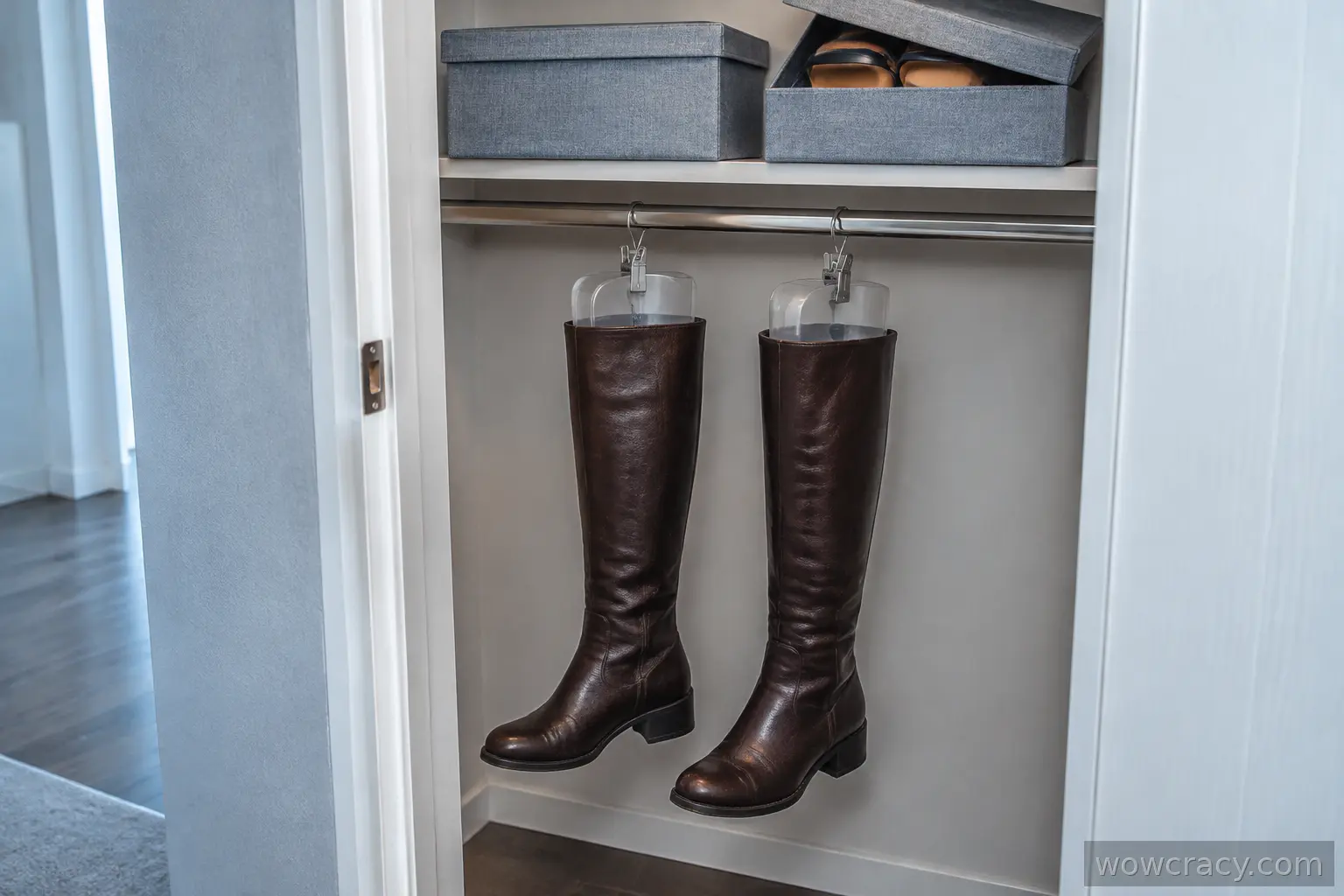
If there are no clips, an ordinary hanger with pegs fixed on the rod inside the cabinet at a level where the boots do not touch the floor will help. It is important that the leather be dry: damp boots on clips can stretch under their own weight.
The seasonal reserve is what is not needed every day: winter boots in summer, summer sandals in winter. Flat containers with lids that can be put away on a mezzanine, under the bed or in a pantry will suit it. The main thing is clean and completely dry shoes before closing. A damp pair closed in a container can be ruined in a few weeks: mould will appear and the leather will lose its elasticity.
Before seasonal storage, it is worth cleaning the pairs, drying them and, if the material allows, treating them with a protective product. This is not obligatory, but it noticeably prolongs the life of the shoes. Put a few desiccant sachets in the container if you store things in a cool place.
If there is no space for a seasonal reserve in the apartment at all, you will have to choose priorities. Some of the pairs can be given away, repaired or passed on — and free up space for what is actually worn.
Check that it is convenient for all family members to maintain order
The best storage system is the one that is carried out without reminders. Walk the route from the door to the storage place and ask yourself three questions: can you put the shoes away with one hand; can you see where wet is and where dry is; do you have to move other people’s pairs to get to your own.
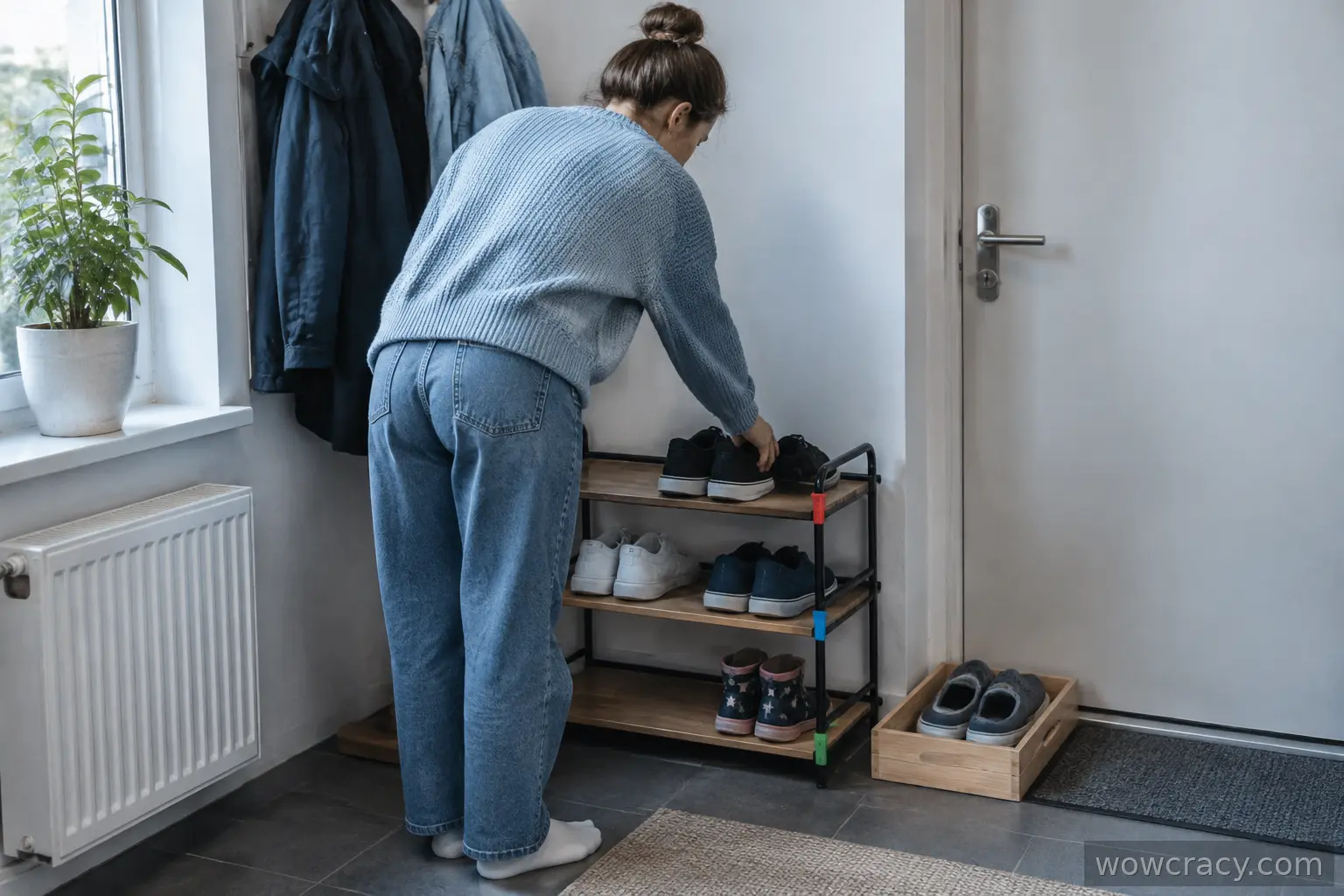
If the answers are negative, it is worth simplifying the system. For example, label the shelves for each person, leave only one pair per child by the entrance, and keep the rest higher up. It is more convenient for children when their shoes stand on the lower level, and for adults — when everyday pairs do not mix with children’s.
Another point that is often missed: the shoe place should also be convenient for guests. If there is no free corner in the hallway, put a small open tray for two pairs by the door — guests intuitively put their shoes there, and you will not have to tidy them up after every visit.
- One pair — one place, no “I’ll put it here temporarily”.
- Wet shoes always go on the tray, not in the cabinet.
- Once a week — a quick check: has anything extra accumulated.
- Seasonal items are put away together with the change of season, not “sometime later”.
- Children are shown their shelf right away, rather than having the rule explained every time.
Frequently asked questions
Can wet shoes be dried in a closed cabinet?
No, if there is no constant supply of air inside. Moisture stays in the enclosed space, and the shoes can acquire a musty smell. Dry on an open tray, and put only completely dry pairs in the cabinet.
How many pairs should be kept by the door in a narrow corridor?
Aim for one or two pairs per person for everyday wear. It is better to store the rest in another zone so as not to narrow the passage or create visual noise.
What to do if there is no room in the hallway even for a tray?
The tray can be placed not on the floor, but on a low stand by the wall, or a compact dryer can be hung on a hook. The main thing is not to leave wet shoes in the passage and not to hide them in the cabinet straight away.
Is ventilation needed in a shoe cabinet?
Yes, even minimal. Holes, gaps or periodically opened doors help avoid musty odour and mould, especially during the heating season.
Can shoes be stored on the balcony?
You can, but with caution: on a glazed balcony without sharp temperature and humidity swings — yes, on an open one — it is risky. Leather and suede crack from damp and frost, and the rubber of the sole becomes brittle.
A short weekend algorithm
- Open the door and mark the zone where nothing can be placed.
- Select the everyday pairs — no more than two per person.
- Place the tray for wet shoes out of the passage.
- Decide where the dry shoes will stand: an open shelf or a cabinet.
- Put tall boots and the seasonal reserve away separately.
- Check that it is convenient for everyone to get their pairs without rearranging.
If after this about 60–80 cm remain free in the passage and not a single pair stands on the floor without a tray, the system works. After that it is enough to put things back in place once a week — and the narrow hallway will stop being a problem.