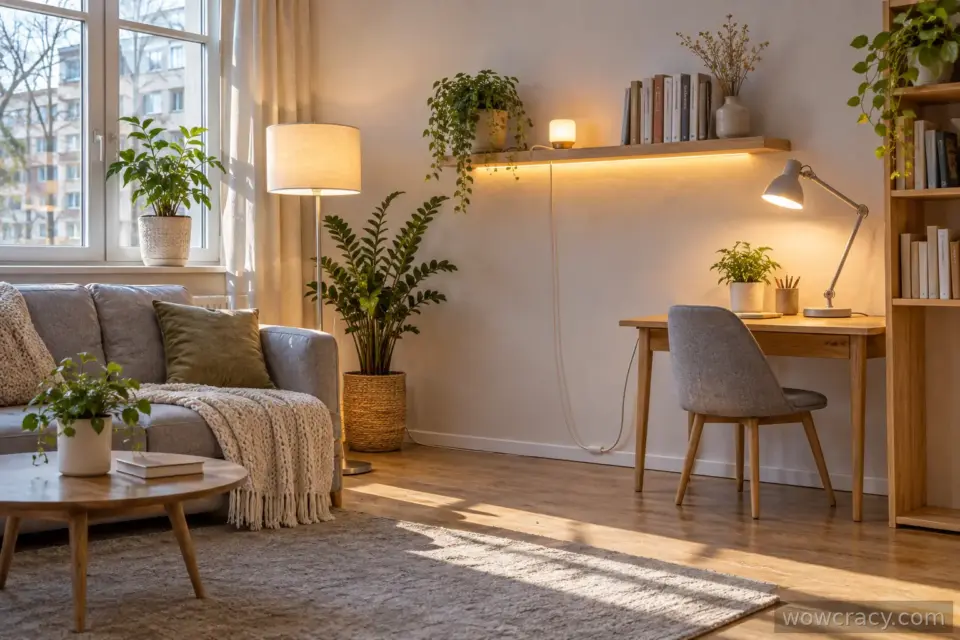
A small room does not have to rely on a single ceiling light. Even in a rented home, portable lamps can make lighting more flexible without changes to the wiring. Start by deciding where you need light, then choose suitable lamps and plan their cables.
This article uses a 12–18 m² room as an example, with ideas for lamp placement, bulb selection, glare control and cable routing. Floor area is only a starting point: the number and brightness of lamps depend on the layout and what you do in the room.
- Plan general, task and accent lighting
- Where to place portable lamps
- Floor lamp near the sofa or armchair
- Table lamp on the desk
- Plug-in or rechargeable wall lights
- LED strip on a shelf or behind the headboard
- How to avoid glare and harsh shadows
- A lighting plan for a 12–18 m² room
- How to route cables without renovation
- Choosing bulbs for a small room
- Frequently asked questions
- Can I add lighting if the room has only one socket?
- Can a wall light be mounted without drilling?
- How many lamps does a small room need?
- Can string lights provide the main lighting?
- What to do first
Plan general, task and accent lighting
Before buying lamps, identify where you read, work, eat or entertain. These activities benefit from different light levels and directions. A single ceiling light may leave the desk or reading spot in shadow.
Start by considering four possible lighting zones:
- General lighting — for moving around and everyday activities. Use the existing ceiling light or a floor lamp that provides diffused light.
- Task lighting — for a desk or reading spot. Place a writing lamp opposite your writing hand; check reflections when using a screen.
- Relaxation — light beside a sofa, armchair or bed, kept out of your direct line of sight.
- Accent lighting — optional light on a shelf, picture or other feature.
It is not necessary to set up all zones at once. Start with general light and the workspace, and later add an evening accent. The main thing is that each scenario has a separate source that can be turned on independently.
Where to place portable lamps
Portable lamps are the basis of lighting without renovation. They do not require cutting into walls or ceilings, are easy to move and allow experimentation. But it is important not just to place them randomly, but to tie them to zones and furniture.
Floor lamp near the sofa or armchair
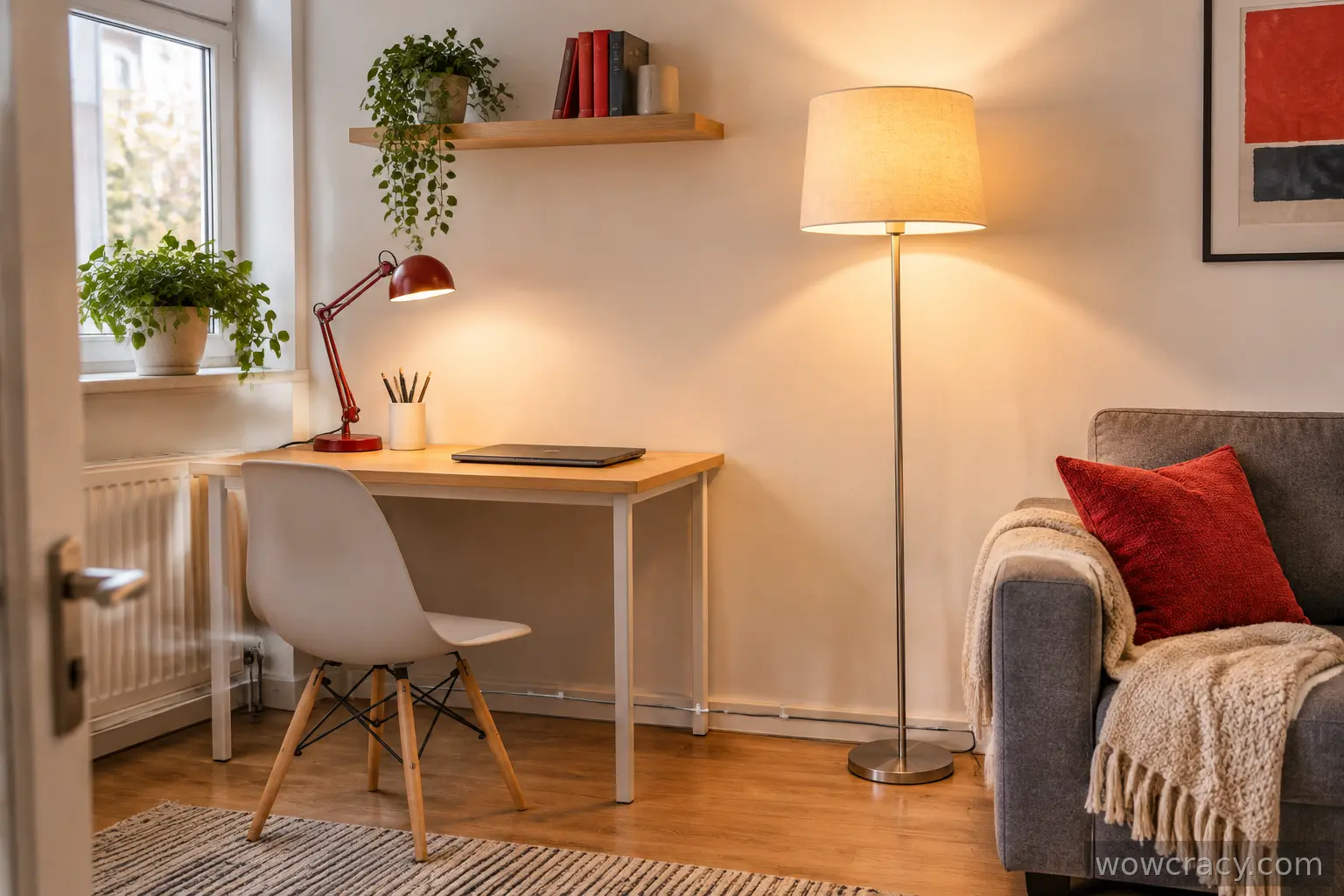
A floor lamp with diffused warm light, such as 2700–3000 K, can work well beside a sofa or armchair. For reading, direct the light onto the book and keep the bright bulb out of your direct line of sight. There is no universal 30–50 cm clearance: placement depends on the lamp’s height and design. Keep its base stable and follow the instructions for clearance from fabrics.
Table lamp on the desk
For handwriting, place the lamp opposite your writing hand: on the left for a right-handed person, or on the right for a left-handed person. For screen work, check reflections from your normal seated position. Adjustable direction and brightness are useful; 4000 K is one neutral-white option, rather than a requirement. Wattage measures consumption, so a universal “8–12 W for a desk” rule cannot establish whether the surface is well lit.
Plug-in or rechargeable wall lights
Plug-in or rechargeable wall lights can avoid new wiring if their design allows the intended mounting method. Use adhesive or magnetic mounts only with models and surfaces expressly permitted by the manufacturer; a magnet needs a suitable base. Check weight limits and removal instructions. Even removable fittings can damage paint, so agree on the method with the landlord in a rented home.
LED strip on a shelf or behind the headboard
An LED strip can provide accent lighting on a shelf or behind a headboard. A complete low-voltage kit with a compatible power supply is a straightforward option. Follow its limits for voltage, length, power and heat dissipation. Not every strip can run from a battery, and a 5–10 W-per-metre figure alone cannot tell you whether it provides enough light.
Another technique is a clip-on lamp or a compact lamp on a stand that can be moved from the desk to the shelf. They take up no floor space and easily change the lighting scenario.
How to avoid glare and harsh shadows
Even good lamps can spoil the impression if light reflects off the screen or creates harsh shadows. In a small room this is especially noticeable: any light source is close to surfaces.
Here are a few rules to help avoid this:
- Do not place the lamp opposite the screen. If you see a reflection on the monitor or TV, move the lamp aside or change the angle of the shade.
- Use diffusers. Matte shades, fabric lampshades and milky glass covers soften the light and reduce shadow harshness.
- Avoid point sources without a shade. An open incandescent or LED lamp without a diffuser can create bright reflections on walls and furniture.
- Combine upper and lower light. If the light source is only from above, faces and objects cast deep shadows. Add a floor lamp or sconce to fill in shadow areas.
- Watch for reflections on glossy surfaces. Glass tables, mirrors and lacquered fronts can reflect light. Position the lamp so that the glare does not get into your field of view.
In the evening, assess brightness, light direction and reflections first. Colour temperature describes a warm or cool appearance, not brightness. Warm light is a common choice for relaxation; choose a comfortable setting rather than basing it on the number of windows.
A lighting plan for a 12–18 m² room
Adapt this plan to your room using the existing general lighting and portable plug-in or rechargeable lamps.
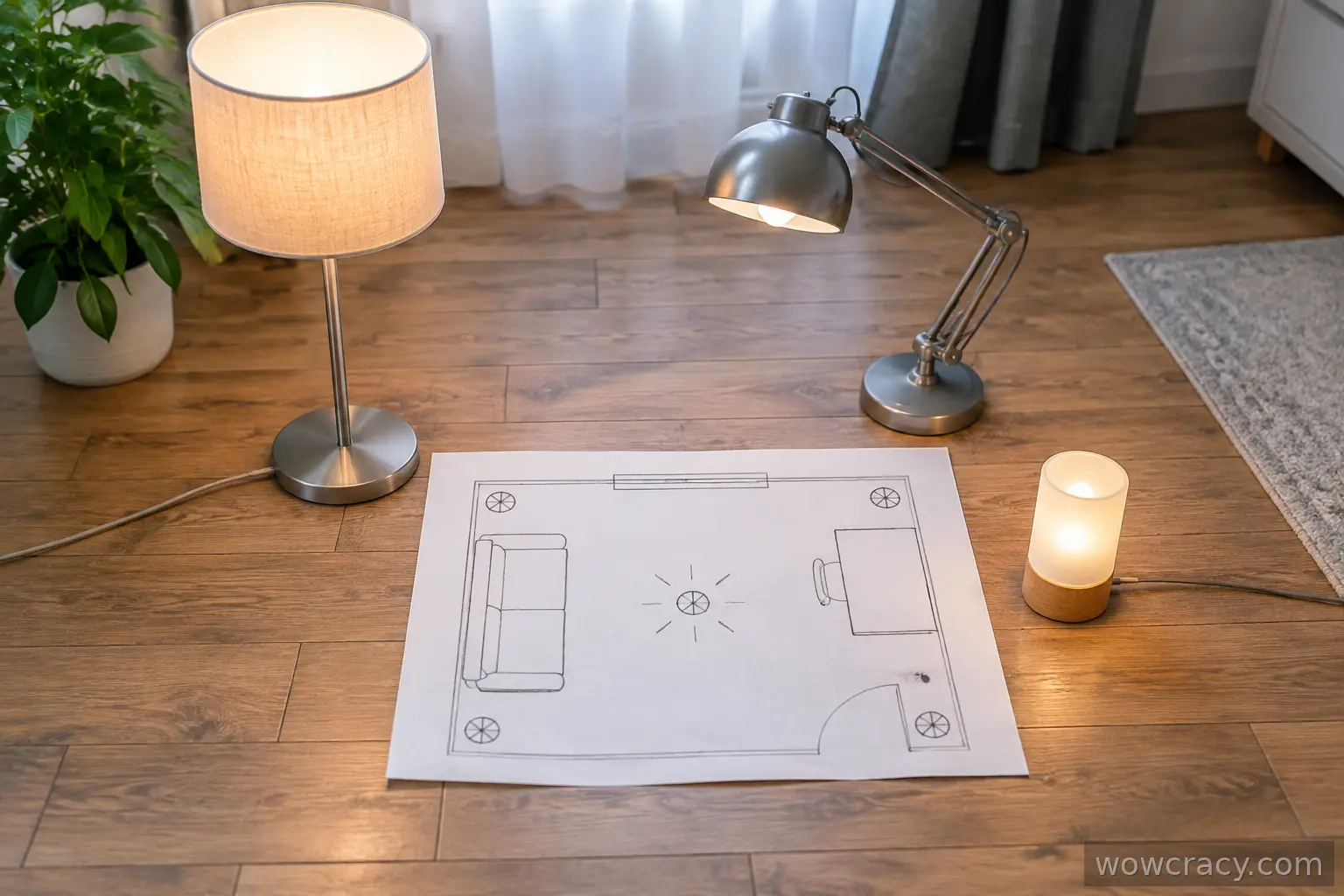
- Draw a room plan. Mark the furniture, window, doors and existing sockets.
- Identify activities. Where do you work, read and relax? Begin where light is most needed.
- Choose lamps. Keep the existing general lighting and add a desk lamp, floor lamp or compatible accent-lighting kit.
- Compare colour temperatures. Try 2700–3000 K for relaxation or 4000 K for work as starting points, then assess your own comfort.
- Check the load. Compare the total watts or amps of all connected devices with the lead’s rating and circuit capacity; do not connect extension leads in series.
- Plan the cables. Keep them out of walkways, protect them from pinching and check that fittings suit the finish.
For clarity, compare the options of light sources for different zones:
| Zone | Light source | Possible colour temperature | Placement |
|---|---|---|---|
| General | Existing ceiling light or floor lamp | 2700–3000 K | Diffused light across the room |
| Task | Adjustable desk lamp | 4000 K | Opposite the writing hand; check reflections |
| Relaxation | Floor or table lamp | 2700–3000 K | Onto the book, without direct glare |
| Accent | Complete LED-strip kit or compact lamp | To suit the setting | Onto a shelf or object |
You do not need to replace the existing ceiling light. First add a compact lamp where light is missing, then check whether the sources are convenient to use independently.
How to route cables without renovation
Keep cables out of walkways and away from furniture pressure and hot surfaces. In a rented home, check whether removable fittings are suitable for the finish: damage-free removal is not guaranteed.
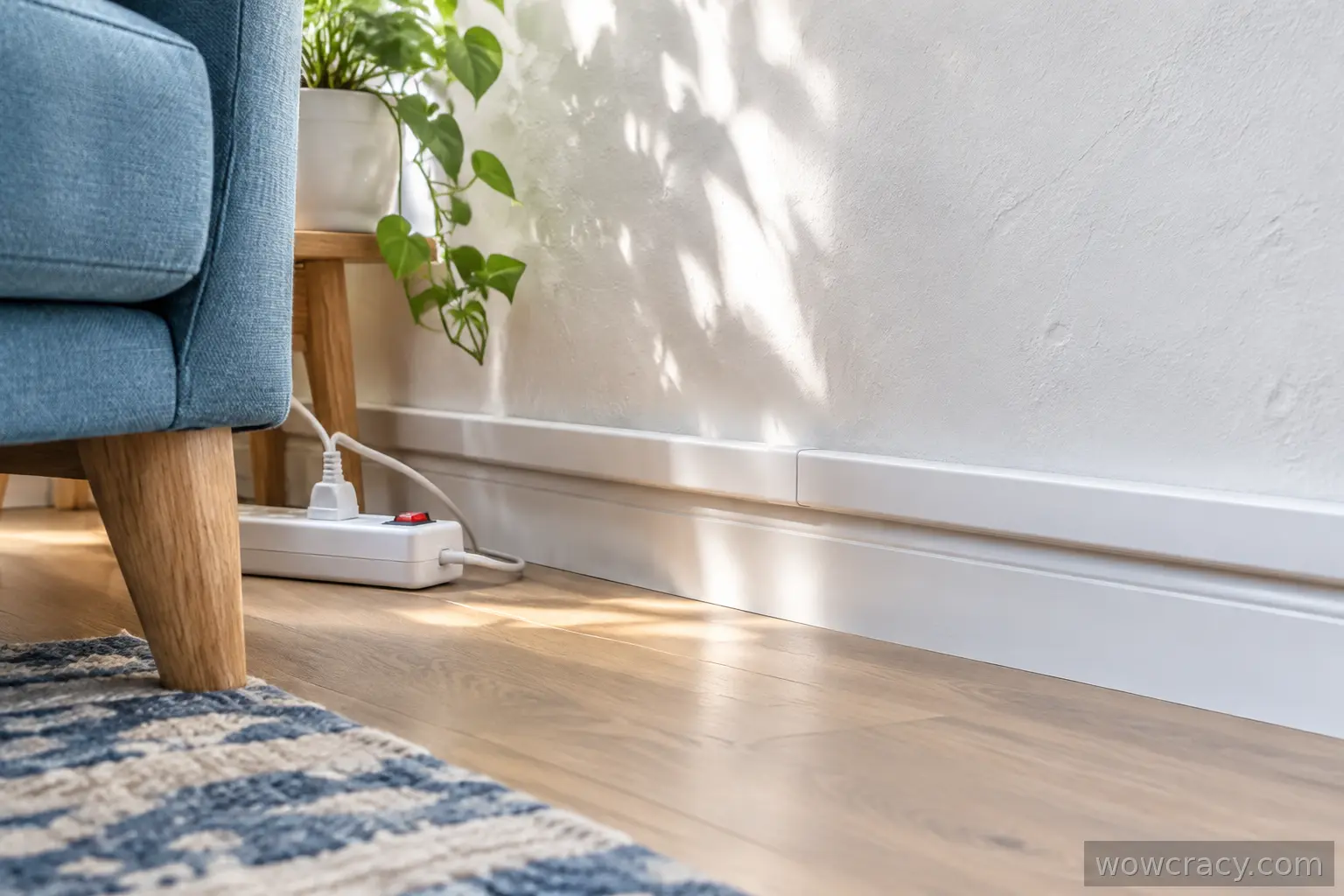
Plan cable routes around the instructions for your lamps and fittings:
- Cable trunking. Choose the right size and mounting method for the surface, and do not overfill it. Adhesive can damage the finish when removed.
- Cable clips. Use purpose-made fittings that do not crush or pierce the insulation.
- Routes around the room’s edges. Avoid walkways, doorways and places where furniture could trap the cord.
- Extension leads and power strips. Keep them accessible, uncovered and out of walkways. Do not run cords under rugs. Check their rating and condition.
Do not run cords under rugs, beneath furniture legs or through doorways where they can be pinched. Moving the lamp nearer an existing socket and routing its cable around the edge of the room is preferable. If a walkway must be crossed, use a solution designed for that purpose; ordinary wall trunking is not a floor cable protector.
Cable trunking should remain accessible for opening and inspection. Do not overfill it or hide power supplies and power strips in closed decorative boxes unless their manufacturer allows it: they need appropriate heat dissipation.
Choosing bulbs for a small room
LED bulbs offer a range of brightness levels and colours, and usually use less electricity than incandescent bulbs with similar light output. However, bulbs and power supplies can still become hot. Follow the light fitting’s requirements for bulb type, wattage and use in an enclosed shade.
Compare light output in lumens and electricity consumption in watts, as the FTC explains. A universal wattage-per-room-area rule ignores the shade, mounting height, surface colours and lamp positions. Check the following for each zone:
- General lighting: enough light to move around, without an exposed bulb causing glare.
- Task lighting: adjustable direction and enough light on the work surface, without screen reflections.
- Evening lighting: a comfortable warm appearance, such as 2700–3000 K; dimming only where the bulb and dimmer are compatible.
- Accent lighting: light on the intended object without a bright source in your line of sight.
The colour rendering index, or CRI, describes how faithfully a source renders object colours compared with a reference. It is separate from colour temperature. A low CRI does not automatically mean cool-coloured or dim light; compare it separately when textile colours or colour-sensitive work matter.
Plug-in and rechargeable lamps are convenient in rented homes. Have mains wiring work carried out by a qualified electrician and agree on it with the landlord. The landlord’s permission alone does not make a homemade electrical connection safe.
Frequently asked questions
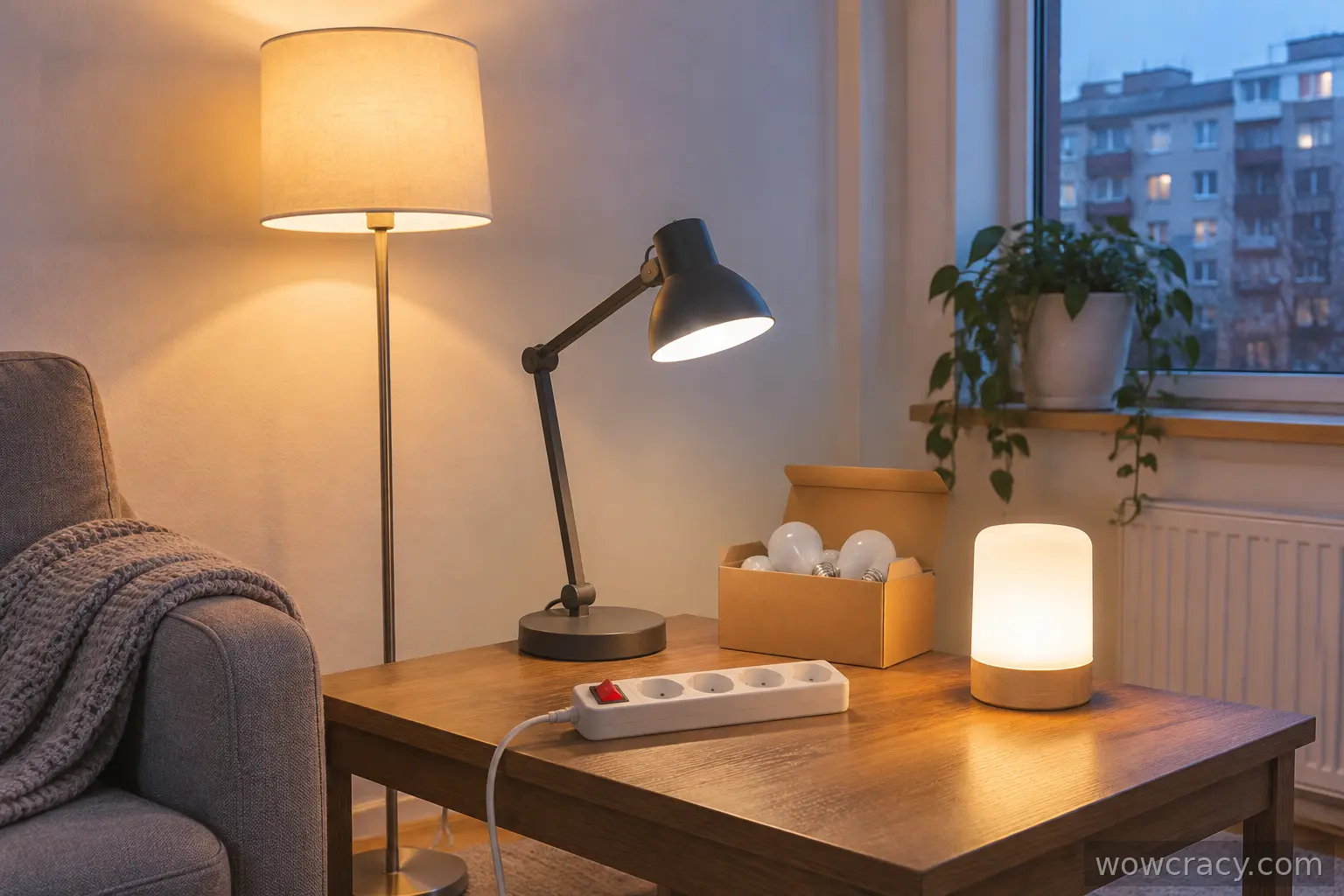
Can I add lighting if the room has only one socket?
You can add portable or rechargeable lamps, but first check what already draws power from that socket. When using an extension lead or power strip, the combined load must stay within its rating and the circuit’s capacity. Protective devices do not remove that limit; do not connect extension leads to one another. The CPSC advises checking cord ratings and condition and treating extension cords as a temporary solution. If sockets are persistently inadequate, consult an electrician.
Can a wall light be mounted without drilling?
Only if that specific model allows mounting without drilling. Follow its requirements for the surface, weight and installation, and agree on the method with the landlord in rented accommodation. If no suitable mounting option is available, choose a table or floor lamp.
How many lamps does a small room need?
There is no fixed number. Start with the existing general light and one lamp for a particular activity, then add light where it is missing. Three or four sources are one possible arrangement, rather than a rule for every room.
Can string lights provide the main lighting?
Decorative string lights usually provide ambience rather than enough light for reading or work. Combine them with suitable task lighting.
What to do first
Start by identifying the main activities in your room and adding light where it is needed most. A desk lamp for work and a floor lamp for evening reading may be enough to begin with. Check screen reflections, glare and access to switches. Route cables out of walkways and agree on wall fittings with the landlord if you rent. Separate controls make it easier to adjust the room for different activities.