
You applied sunscreen, and a few minutes later small balls appeared on your cheeks, as if your skin had rejected the product. Sometimes it looks like white flakes, sometimes like sticky clumps that gather under your fingers or under a sponge. Before changing the sunscreen itself, it is worth understanding what exactly is happening: the product is not absorbing, it is conflicting with the previous layer, it was applied in too large an amount, or it is being applied to skin that is flaking.
Next comes a step-by-step check that will help you find the cause in your own morning routine. The logic is simple: first we separate a skin problem from a product problem, then we check layer compatibility, then application technique, and only at the end do we decide whether to simplify the routine and whether to change the product. You should not reduce the amount of sunscreen for the sake of a nice texture — that directly weakens protection.
- Pilling or flaking: how to tell them apart by the first signs
- Checking layer compatibility: what exactly conflicts with SPF
- Typical conflicting pairs
- How to check compatibility without chaos
- Application technique: amount, pause, and hands
- A workable order of steps
- Makeup over SPF: where conflict most often occurs
- When it is better to change the SPF format
- When it is worth simplifying the routine or replacing the product
- Frequently asked questions
- Can I simply reduce the amount of sunscreen so it does not pill?
- Why does SPF pill only on the cheeks?
- Does a primer under SPF help?
- What should I do if the cream pills only in winter?
- Can I apply SPF over makeup?
- A short diagnostic algorithm
Pilling or flaking: how to tell them apart by the first signs
This is the most important step, because it determines where to look next. Pilling is the behavior of a product on the surface of the skin. Flaking is the condition of the skin itself, when the top layer of cells comes off in uneven patches.
With pilling, the balls usually appear immediately after application or during blending, are easy to remove with a finger, and have the uniform texture of the product itself. They tend to concentrate where you rubbed the cream the most: on the cheeks, along the jawline, near the temples. If you remove such a ball and rub it between your fingers, it behaves like a cream or gel.
With flaking, the flakes are denser, drier, sometimes with slight yellowing or redness underneath. They can appear even without sunscreen — after washing, applying toner, or a regular moisturizer. If the skin is flaking, the problem is not the SPF but the skin barrier or the active ingredients you are using.
- Balls appear only after SPF — most likely this is pilling.
- Flakes are visible even before SPF — this is flaking, and sunscreen only highlights it.
- Redness, tightness, burning — a sign of irritation; here you need a break from active products, not a change of SPF.
- Pilling only in a certain area — check what exactly you apply locally (for example, a spot acne treatment).
If the skin is indeed flaking, it is worth paying attention to moisturizing and avoiding aggressive peels for a few days. If it is pilling, read on — the cause is almost always in the combination of layers or in the technique.
Checking layer compatibility: what exactly conflicts with SPF
Sunscreen almost never pills “on its own.” Most often it reacts to the previous layer: a serum with a gel texture, a moisturizer with silicones, a primer, a facial oil, or a product with a high concentration of polymers. When two layers have different bases — water-based and oil-based or silicone-based — they may not mix and can form balls under mechanical influence.
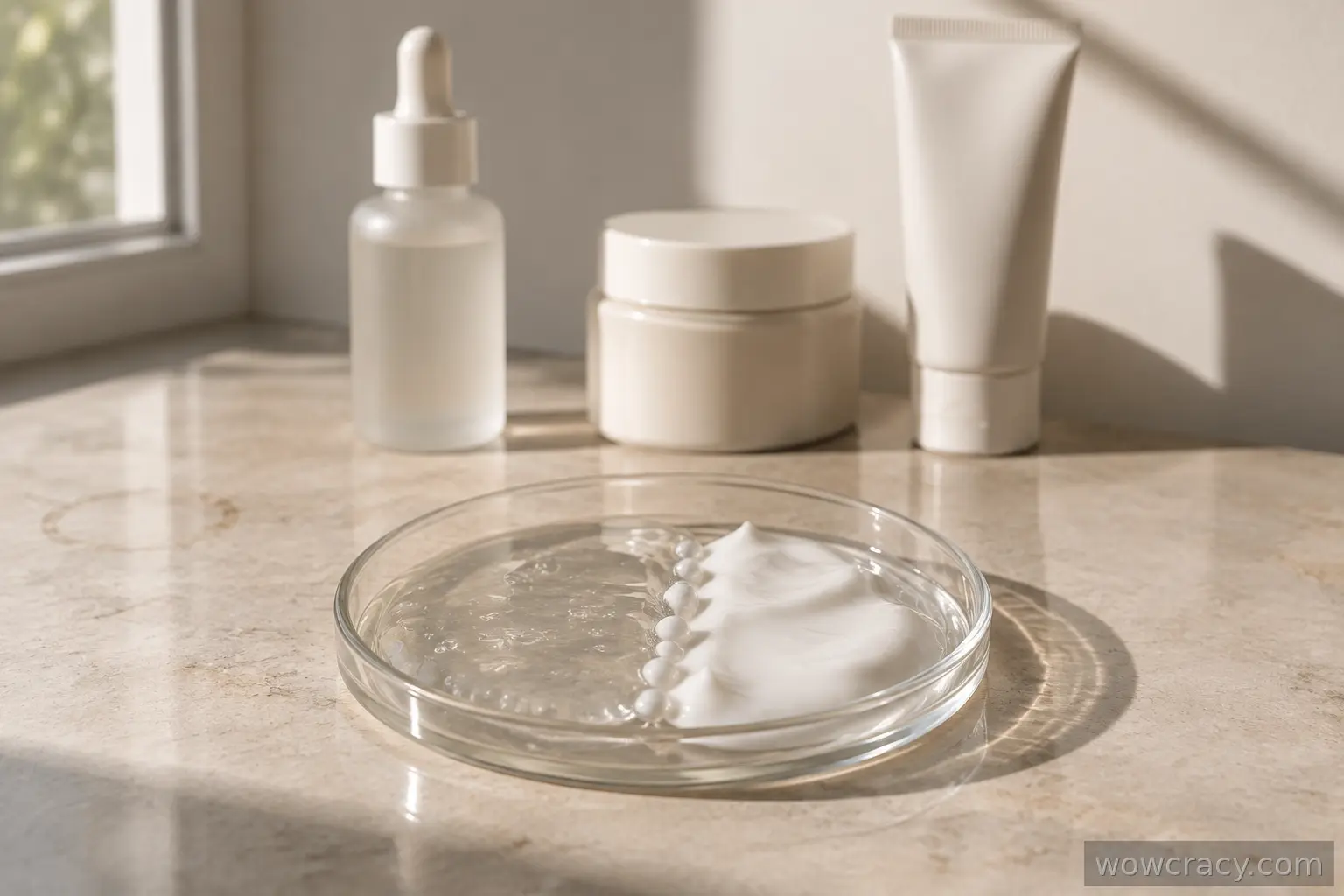
The simplest way to check is a half-face test. Apply your usual morning routine to one side and only SPF to the other. If pilling occurs only where the full set of layers was applied, the problem is compatibility, not the cream itself. Then remove layers one by one, starting with the least necessary.
Typical conflicting pairs
- A gel serum with a high polymer content under a dense mineral SPF.
- A moisturizer with silicones under a water-based gel SPF.
- A primer with a “velvet effect” under a cream-like sunscreen.
- An oil serum or cosmetic oil before a water-based SPF.
- Two products with a high silicone content in a row.
It is important not to draw conclusions based on one day. Let the layer absorb completely — this usually takes 1–2 minutes, sometimes more for dense textures. If you apply SPF onto a damp previous layer, the risk of pilling increases even with compatible products.
How to check compatibility without chaos
- Reduce your morning routine to a minimum: cleansing, one moisturizing product, SPF.
- Add layers one at a time, starting with the most important for your skin.
- Pause between layers and check whether balls appear under your fingers.
- Write down the combinations that work: this way you will quickly find a stable morning routine.
If you use a product with acids or a retinoid, it is better to move it to the evening. This not only reduces the risk of irritation but also removes one of the most common sources of conflict with SPF.
Application technique: amount, pause, and hands
Even perfectly compatible products pill if applied incorrectly. The most common mistake is rubbing sunscreen for a long time and with pressure, as if working it into the skin. SPF does not need to be “forced” into the pores: it should form an even film on the surface. Prolonged rubbing lifts the previous layers and gathers them into balls.
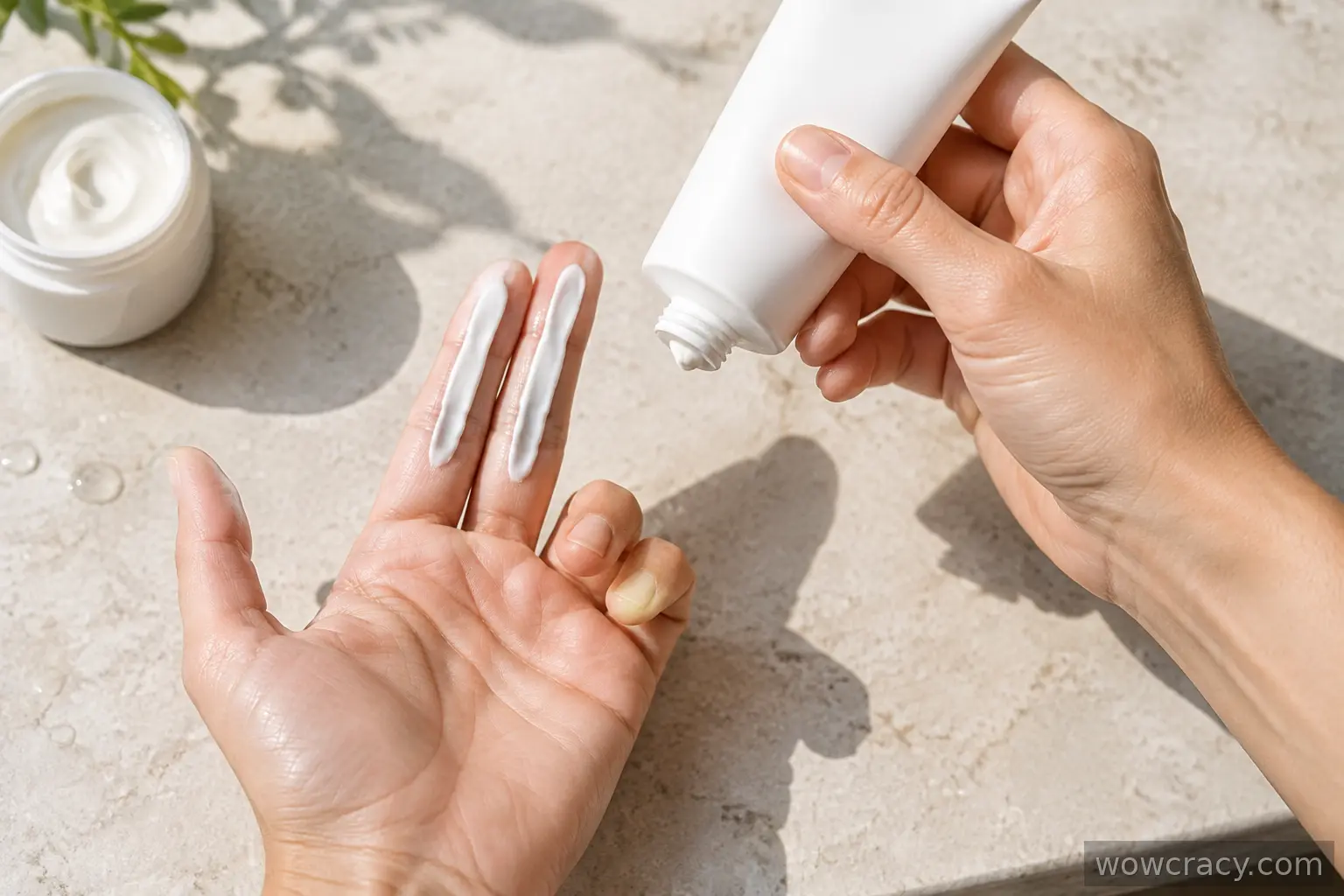
The second mistake is applying too much at once. The recommended amount for the face and neck roughly corresponds to two fingers laid along the index and middle fingers, or about a quarter teaspoon. This is a guide, not an exact formula: it is important to cover the entire face evenly, including the ears, jawline, and neck. If you apply the entire amount at once in a thick layer, the product takes longer to absorb and pills more often.
A workable order of steps
- Apply your moisturizing product and wait until it absorbs.
- Squeeze the SPF onto your palm and distribute it between your fingers.
- Apply with light movements from the center of the face outward, without rubbing.
- Do not rub for long: two or three passes over an area is enough.
- Wait 2–3 minutes before makeup.
If you apply SPF over a serum, let it dry completely. Moisture is the main catalyst for pilling. Also check whether any remnants of your nighttime routine remain on the skin: sometimes the cause is not in the morning layers but in the fact that in the evening you applied a rich cream that did not have time to absorb by morning.
A separate note about the sponge and brush. If you distribute SPF with a sponge, it can remove part of the product and gather it into balls. For sunscreen, it is better to work with your fingers and apply makeup on top afterward.
Makeup over SPF: where conflict most often occurs
Makeup over SPF is a separate risk zone. A silicone-based foundation applied over a dense mineral SPF can pill under a sponge. The same happens with a primer that contains polymers: it seems to “drag” the sunscreen layer along with it.
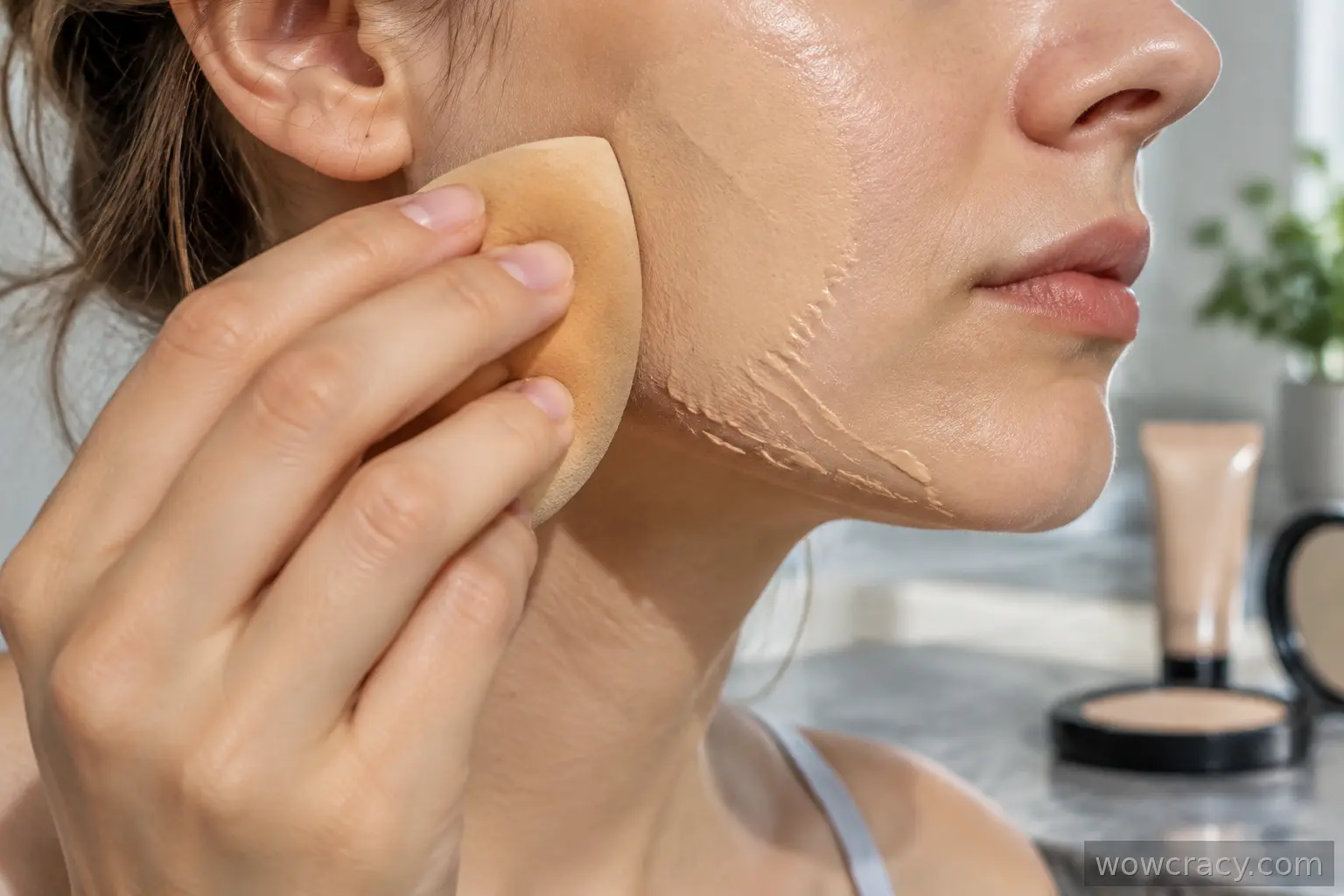
A practical rule: the denser the SPF, the easier it is to apply makeup with a damp sponge and minimal pressure. If the foundation pills, try applying it not with rubbing movements but by pressing the sponge against the skin. Sometimes it is enough to change the type of foundation — for example, switch from a matte dense one to a lighter fluid.
You should not apply SPF over foundation in the hope of “adding protection”: this way you rub the makeup and get uneven coverage. Sunscreen should come before makeup, not after. If you need to refresh protection during the day, use a spray or powder format, or gently blot the face and apply the cream with light movements over minimal makeup.
When it is better to change the SPF format
If you wear dense makeup every day and constantly encounter pilling, it is worth considering a lighter sunscreen format: a fluid, gel-cream, or milk. They usually sit better under makeup, although they require more careful application in a sufficient amount. Do not sacrifice protection for texture — it is better to choose a format that is convenient for you to apply every day.
When it is worth simplifying the routine or replacing the product
Sometimes all the checks show that the layers are compatible, the technique is correct, and the cream still pills. Then the cause may be in the formula itself: a high polymer content, a dense silicone base, or a large amount of mineral filters. In that case, replacing the product is a reasonable decision.
Simplifying the routine also works. If your morning set consists of five products, try leaving two or three. It often turns out that the skin needs only one moisturizing product and SPF, while the rest is excess that only creates conflicts.
| Symptom | Probable cause | What to do |
|---|---|---|
| Balls only after the full routine | Layer incompatibility | Remove layers one by one, pause between applications |
| Balls over the entire face area | Too much product or prolonged rubbing | Reduce the amount per application, apply with light movements |
| Flakes even before SPF | Skin flaking | Increase moisturizing, stop active products for a few days |
| Pilling under makeup | Conflict between SPF and foundation | Change the application method or the SPF format |
| Redness and burning | Irritation | Stop using the questionable product, consult a doctor if needed |
If you have sensitive skin or a tendency to allergic reactions, it is better to test a new product on a small area. Constant burning, itching, or pronounced redness is a reason to consult a dermatologist rather than experiment further.
Frequently asked questions
Can I simply reduce the amount of sunscreen so it does not pill?
No. Protection depends on even coverage with a sufficient layer. If the cream pills, it is better to change the technique, remove the conflicting layer, or replace the product, but not reduce the amount.
Why does SPF pill only on the cheeks?
Most often that is where there are the most layers — moisturizer, serum, possibly an anti-redness product. Also, the skin on the cheeks may be drier and flaking. Check the local products and the condition of the skin in that area specifically.
Does a primer under SPF help?
Sometimes yes, but more often a primer creates an additional conflict. If you use one, check whether balls appear specifically after it. For most people, it is simpler to remove the primer from the morning routine.
What should I do if the cream pills only in winter?
In winter, the skin is more often drier and flaking, and in heated rooms layers take longer to absorb. Increase moisturizing in the evening, give the morning layers more time to absorb, and check whether you now have too many products.
Can I apply SPF over makeup?
Better not: this way you rub the makeup and get uneven coverage. To refresh protection during the day, use a spray or powder with SPF, or carefully apply the cream with light movements.
A short diagnostic algorithm
Start with something simple: check whether this is pilling rather than flaking. Then do a half-face test with a minimal set of layers. If the balls disappear, gradually bring the layers back and find the conflicting one. If the balls remain, check the technique: less at a time, no prolonged rubbing, with a pause between layers. If that does not help either, simplify the routine or replace the product with a lighter format. And most importantly: do not reduce the amount of sunscreen — it is better to find the cause than to lose protection.
