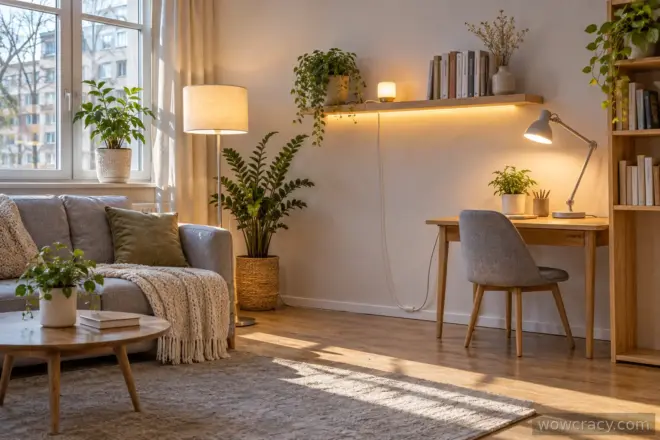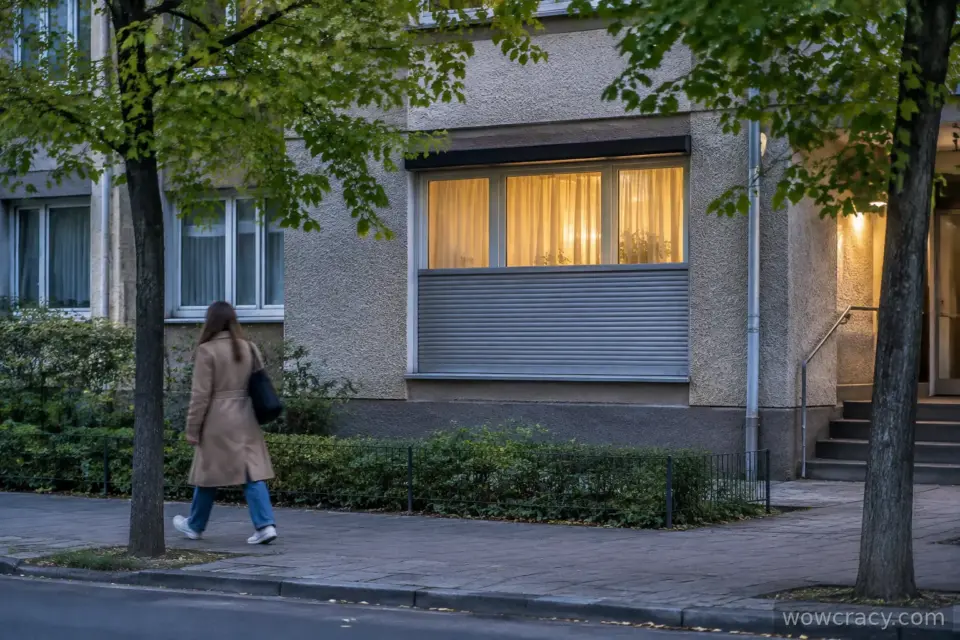
In the evening, when the light is switched on in the room, a first-floor window starts to look like a shop display: from the street you can clearly see both the furniture and the people. During the day it is the opposite — the thick fabric that saves you from stares turns the living room into a half-dark room where you have to switch on a lamp at lunchtime. It is this conflict between private space and daylight that determines the choice of textiles more than colour or fashion.
Tulle, roller blinds and pleated blinds solve this task differently, and no option is universal. Below is a comparison based on specific everyday situations: when passers-by walk beneath the windows, when there is a neighbouring building opposite, when the room is dark anyway, and when privacy is needed only in the evening.
- Why daytime and evening privacy are two different tasks
- Tulle: diffused light without full protection from stares
- How to choose tulle density by touch
- Roller blinds: how to take fabric transparency into account
- What to do if the window opens inwards
- Pleated blinds opening from the top and bottom: when this is convenient
- Top and bottom opening: what the difference is in practice
- Which combinations suit the bedroom, kitchen and living room
- What to check at your own window before buying
- Frequently asked questions
- Can you manage with tulle alone on a first floor?
- What darkens a room better — roller blinds or pleated blinds?
- Does sun-control film on the glass help?
- How often should blinds on a first floor be washed?
- Can ordinary long curtains be hung instead of roller blinds?
- Does the colour of the walls affect visibility from the street?
- A short selection algorithm
Why daytime and evening privacy are two different tasks
During the day the street is brighter than the room, so from outside you mostly see the reflection of the glass rather than what is happening inside. This is not the magic of tinted glass — it is how the difference in light levels works. A light semi-transparent fabric is enough for faces and silhouettes to stop being readable from the pavement.
In the evening the ratio flips. The room becomes brighter than the street, and then even a fabric that looks thick starts to “glow through”. A thin white voile that worked perfectly at lunchtime turns into an almost transparent screen at night. So the question “tulle or roller blinds” actually sounds like this: what do I need during the day, and what do I need after six in the evening.
Hence the main conclusion: for a first floor you almost always need two layers, or one that can be adjusted. A single layer of textile rarely covers both scenarios at once.
It is worth considering one more detail that is mentioned less often. Privacy depends not only on the density of the fabric but also on the angle from which you are being looked at. A person standing directly opposite the window sees more than one passing by at an acute angle. If there is a neighbouring building opposite, the most vulnerable area will be the zone facing its windows, not the whole pane of glass. Sometimes it is enough to cover one part of the window to change the situation significantly.
Tulle: diffused light without full protection from stares
Tulle is the cheapest and most familiar way to soften street eyes. It does not take away daylight, looks light and needs no complex installation. But it is worth honestly understanding the limits of its capabilities.
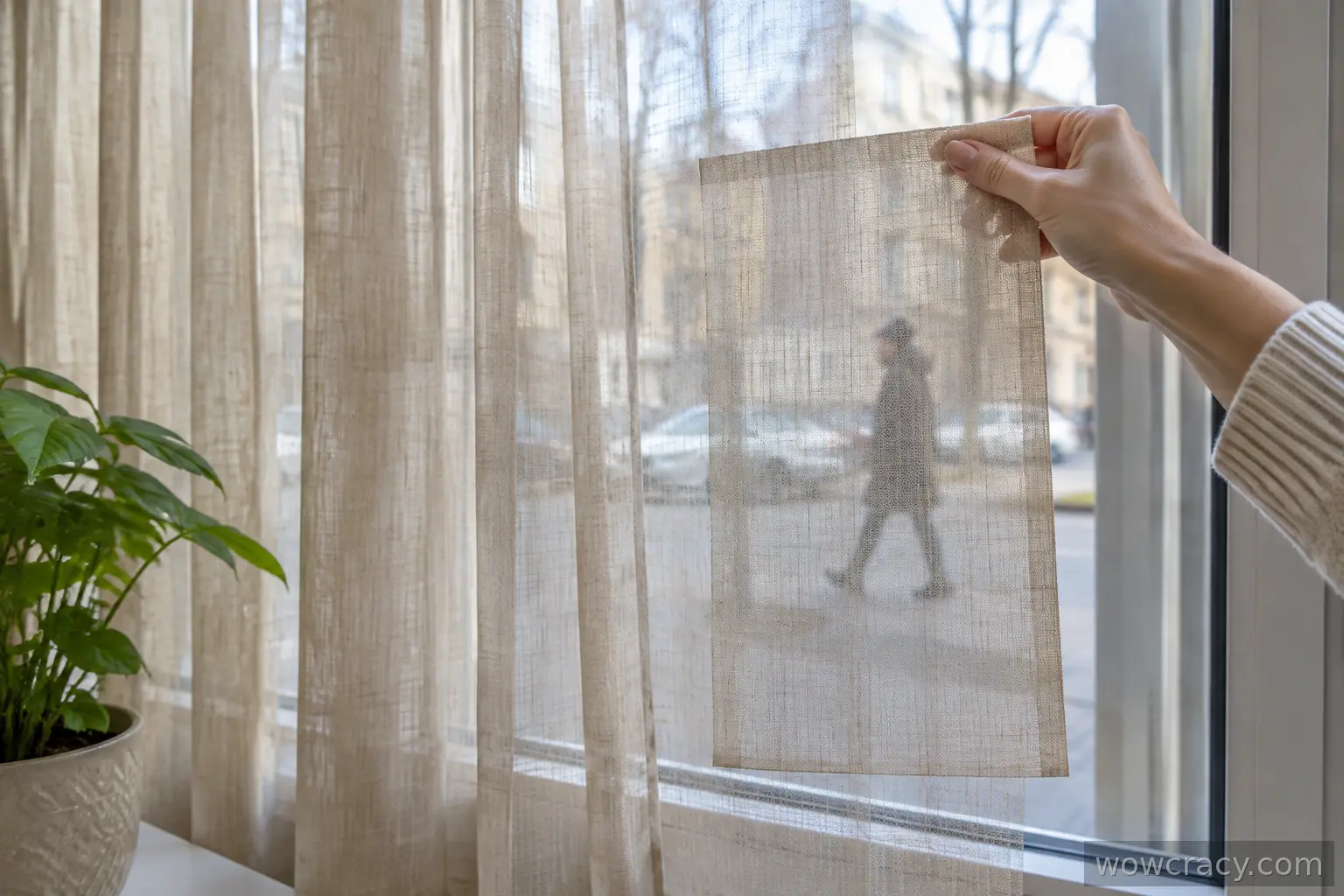
During the day a dense voile with a fine texture really does hide the outlines of people, especially if the window is set slightly back from the pavement. In the evening the same tulle gives almost nothing: silhouettes are readable, and with bright light in the room even movements can be seen. If neighbours’ windows are opposite at a distance of a few metres, tulle alone will not solve the task.
What to consider before buying:
- Density: thin synthetic voile is almost transparent; cotton or linen tulle with a fine weave is denser.
- Colour: light beige and grey hide better than pure white, which glows through most noticeably in the evening.
- Length: floor-length tulle with a small allowance in the folds covers more area than a short one.
- Folds: a denser gather on the curtain rail gives more layers of fabric and a better diffusing effect.
Tulle works well as a first layer in combination with thicker curtains or as a standalone solution where the window faces a quiet courtyard rather than a busy street.
Worth mentioning separately is the so-called “daytime” tulle with a combined weave — denser at the bottom and more transparent at the top. It looks neat and covers the lower part of the window, where people usually are, a little better, but it does not fundamentally solve the task of evening privacy. It should be treated as a convenient compromise, not as a replacement for a dense layer.
How to choose tulle density by touch
In a shop the fabric is usually folded in two or four, and it seems denser than it will be on the window. The simplest check is to hold the piece against a shop window or a window and look through it at the street. If the outlines of passers-by blur but do not disappear, that is roughly the level that works during the day. If you see clear silhouettes, such tulle will give little during the day.
Roller blinds: how to take fabric transparency into account
Roller blinds for a first floor are convenient because they can be raised exactly as much as needed. During the day it is enough to lower the fabric by a quarter or a half — and the room stays bright while prying eyes see only the top of the window.
The main trap is the inconsistency of fabrics. Fabric marked “semi-transparent” lets light through and gives decent privacy during the day, but in the evening with the chandelier on it works roughly like tulle. Dense fabrics (blackout or close to it) close completely, but during the day they darken the room almost like night curtains.
A practical solution for a first floor is a combination of two roller fabrics on one window: a light one at the top for daylight and a dense one at the bottom or separately for the evening. An alternative is a medium-density roller blind plus tulle, which takes on the main load during the day.
It is worth thinking separately about mounting. Fabric installed flush against the glass leaves gaps at the sides through which the room is clearly visible at an angle in the evening. Blinds installed on the wall or in a recess with a small overlap onto the frame cover more area. Sometimes it is enough to add side guides or a profile to remove these gaps without replacing the fabric.
Another small thing that affects the result: the mechanism. Cheap chain systems loosen over time, the fabric skews and starts catching on the frame, leaving a gap on one side. For windows that open every day, it is worth choosing models with a spring or strap mechanism that keep a level position longer.
What to do if the window opens inwards
On a first floor you often want to air the room without opening it to prying eyes. A roller blind mounted on the sash lowers together with it, but when opened it may catch on the windowsill. In that case it is better to choose a system that attaches to the frame with minimal offset, or to combine it with a top pleated blind that does not interfere with the movement of the sash.
Pleated blinds opening from the top and bottom: when this is convenient
Pleated blinds are a folded fabric that gathers like an accordion and moves along tensioned cords. Their advantage for windows opposite neighbours is that the fabric can be fixed in any position: open from the bottom, leaving the upper part visible, or, conversely, close the bottom and leave light coming from above.
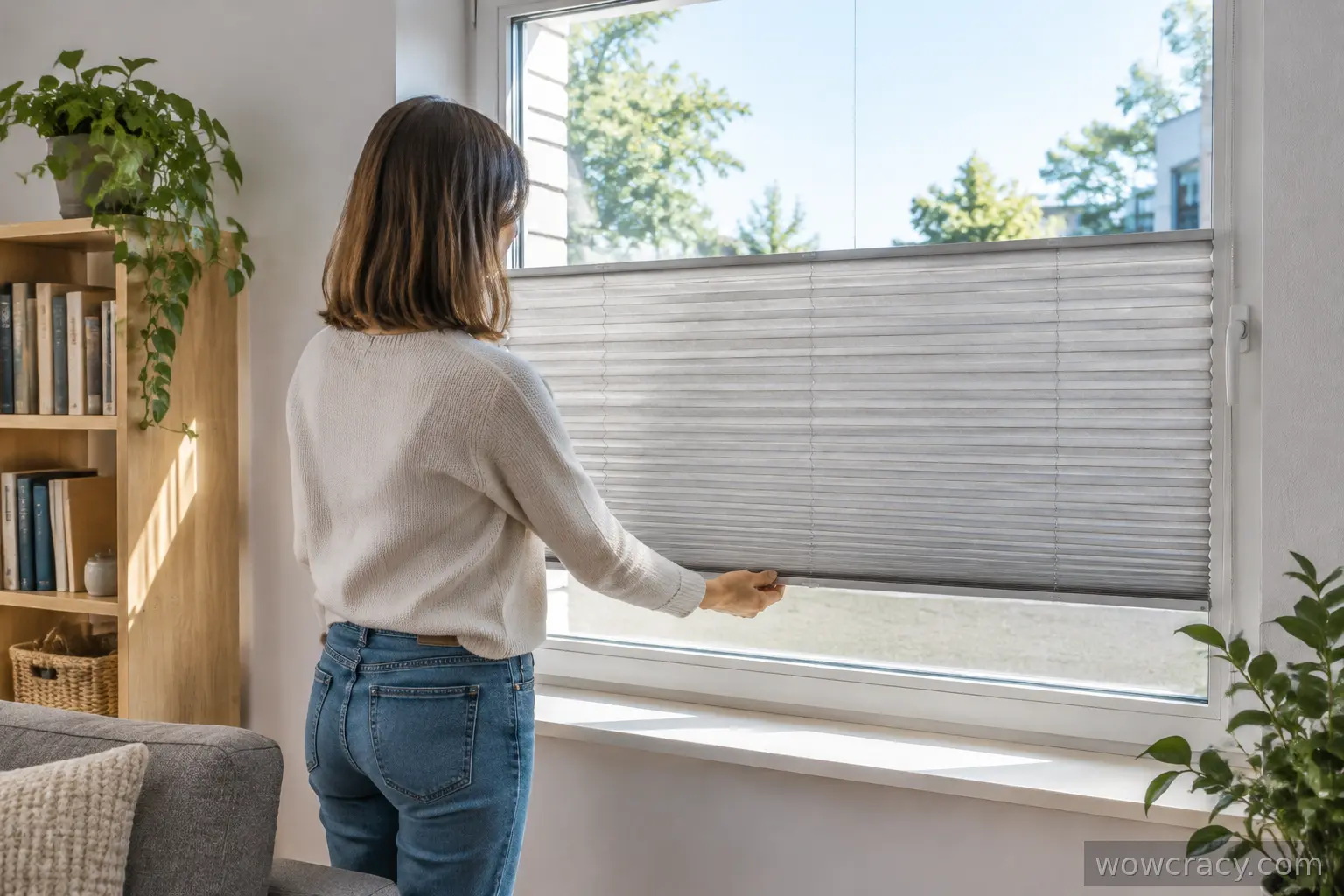
This is especially appropriate when the window faces the pavement: passers-by mostly see the lower part of the room, while the ceiling and the upper part of the window remain open to light. The same technique works in flats where a neighbouring building opposite has windows at the level of your floor covering.
There are limitations too. A pleated blind made of semi-transparent fabric looks neat during the day, but in the evening, like any thin fabric, it glows through. Dense options with fixation in the “bottom closed” position give a good result, but cost more than ordinary roller blinds and require careful installation — the cords must be tensioned evenly, otherwise the fabric skews.
Pleated blinds are well suited to windows of non-standard shape — roof windows, arched, sloped. For a first floor this is often the only way to cover a complex window without bespoke tailoring.
Pleated blinds are also valued separately in families with small children: most models do not have a long free cord hanging down to the floor. This does not make the structure completely safe — the mounting strength should still be checked — but it removes one of the typical risks.
Top and bottom opening: what the difference is in practice
A “bottom-up” pleated blind rises from the windowsill, opening the lower part of the window. This is convenient when you want more light and a view of the street, but privacy suffers precisely in the area that is most visible from the pavement. A “top-down” pleated blind lowers from the ceiling and covers the top — this option is useful if there is a tall building opposite and you are visible from the upper floors. Combined models allow the fabric to be fixed in the middle and both vulnerable zones to be covered at once, leaving a strip of glass for light.
Which combinations suit the bedroom, kitchen and living room
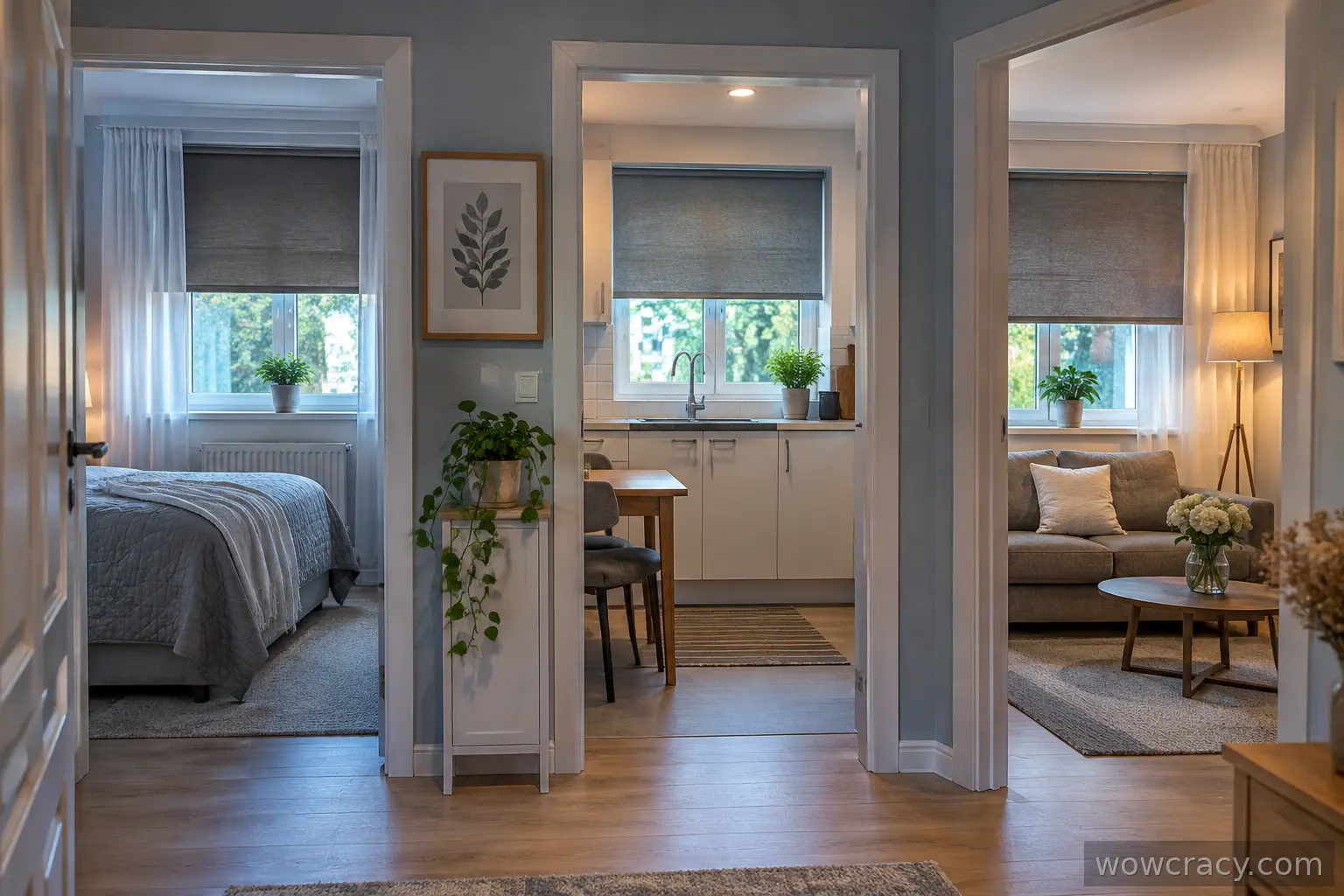
The choice depends not only on the distance to the street but also on how the room is used. In the bedroom, evening privacy and the ability to darken the space for sleep are more important. In the kitchen — daylight and easy cleaning. In the living room — a balance, because guests come there and the light is often switched on.
| Room | What matters | Appropriate solution |
|---|---|---|
| Bedroom | Privacy in the evening, darkening for sleep | Tulle plus dense roller blinds or pleated blinds with fixation |
| Kitchen | Daylight, resistance to moisture and grease | Roller blinds made of washable fabric or pleated blinds made of semi-transparent fabric |
| Living room | Flexibility throughout the day | Tulle plus medium-density roller blinds |
| Children’s room | Safety, absence of long cords | Roller blinds or pleated blinds without a free cord |
For windows facing a busy street with pedestrian traffic, it is worth adding another layer of protection — sun-control film on the glass or a denser voile. For windows onto a quiet courtyard, one adjustable fabric is enough.
In a bedroom where you like to wake up with the first light, dense blackout may turn out to be excessive. Then it is better to choose a medium-density roller blind for the evening and leave tulle for the day. If, however, the bedroom faces a lit courtyard with street lamps, a dense layer is indispensable — otherwise you will have to wake up from outside light every time.
In the kitchen the main enemy of textiles is grease and steam. Tulle will have to be washed often, while roller fabric with a treatment only needs wiping with a damp cloth. Pleated blinds with a fine fold accumulate dust in the bends, so for the kitchen it is better to choose models with a wider fold pitch or to settle on a roller blind altogether.
What to check at your own window before buying
Before ordering fabric, it is worth spending half an hour observing. This will help avoid an expensive mistake when the blinds are installed but do not solve the problem.
- Go to the window during the day and see how well the room is visible from the pavement. If passers-by come closer than a few metres, tulle alone will not be enough.
- In the evening, switch on the light and go outside. See whether silhouettes are visible, whether the furniture is readable. This is the most accurate test of evening privacy.
- Check at what angle you are visible from the neighbouring building. Sometimes it is enough to cover only part of the window to hide the most vulnerable zone.
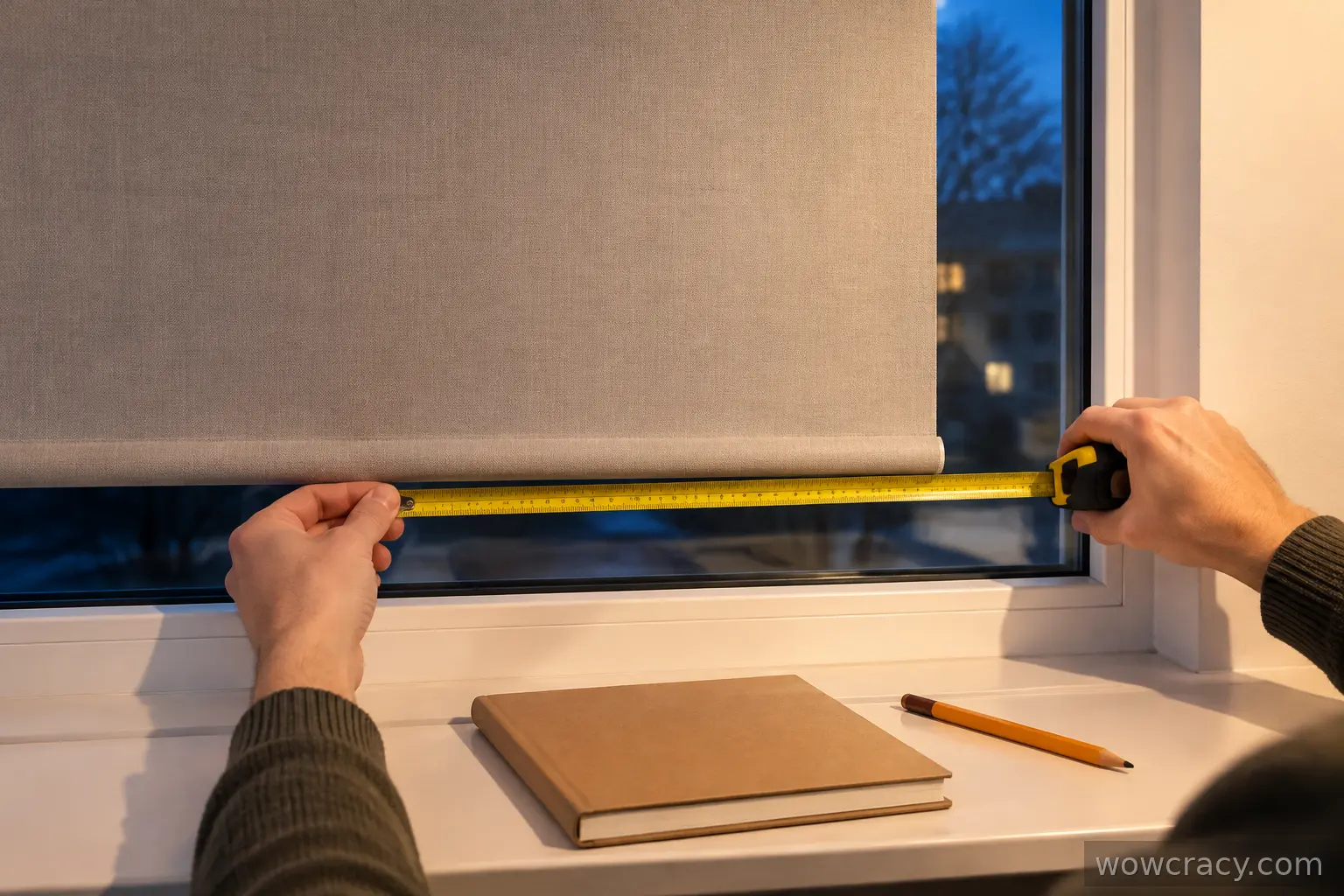
- Measure the depth of the window opening and the distance to the wall — this determines whether the fabric can be installed with an overlap or will have to be fixed flush against the glass.
- Assess how much daylight you are prepared to lose. If the room is dark anyway, dense blinds will make it gloomy even at lunchtime.
- See how the sun falls throughout the day. A window that is flooded with direct rays for several hours in a row needs a different approach from one that is in shade all day.
Also pay attention to the orientation of the window. The southern sun is so bright during the day that even dense fabric will not hurt, whereas a northern window is better left as open as possible and relying on light tulle plus evening darkening.
Another point is plants on the windowsill. Tall planters themselves partly block the view from below, and this is worth taking into account before choosing a very dense fabric. Sometimes it is enough to move the pots closer to the glass so that the lower zone stops being visible from the street.
Frequently asked questions
Can you manage with tulle alone on a first floor?
If the window faces a quiet courtyard and there are no neighbouring windows opposite, dense tulle with a fine weave may be sufficient during the day. In the evening it will not protect you, so it is worth providing for at least one denser layer.
What darkens a room better — roller blinds or pleated blinds?
It depends on the fabric, not on the type of construction. Dense blackout fabric gives a similar result in both cases. Pleated blinds are more convenient to adjust in height, roller blinds are easier to wash.
Does sun-control film on the glass help?
During the day it reduces visibility from the street and protects against overheating. In the evening, when the light is on in the room, the film does not prevent silhouettes from being seen, so it should be combined with textiles.
How often should blinds on a first floor be washed?
Windows close to the street get dirty with dust and exhaust fumes faster. Roller blinds made of washable fabric only need wiping with a damp cloth once every few weeks; tulle should be washed as needed, judging by appearance and smell.
Can ordinary long curtains be hung instead of roller blinds?
You can, and they will give good evening privacy if the fabric is dense. But during the day long curtains are usually gathered to the side, and then the window is again open to view. For a first floor they work better in combination with tulle or roller fabric.
Does the colour of the walls affect visibility from the street?
To some extent. Light walls and furniture reflect more light, so the room seems brighter from outside. Darker surfaces make silhouettes less noticeable, but this is more of an auxiliary factor than a replacement for textiles.
A short selection algorithm
First determine what exactly is bothering you: passers-by during the day, neighbours’ windows in the evening, or both factors. If the problem is only daytime light and a quiet street — dense tulle is enough. If you are visible from outside in the evening — you need a dense layer that can be lowered. If the room is small and dark, choose adjustable pleated blinds or a combination of a light voile with a medium-density roller blind.
The most reliable option for a first floor is two layers: a light one for the day and a dense one for the evening. It costs a little more, but it lets you avoid choosing between light and privacy every time it starts to get dark outside the window.
Before ordering, it is worth going through a short checklist: measure the window, check the depth of the opening, look at the room from the street during the day and in the evening, confirm the density of the fabric on a sample. These half an hour of work usually save more than any consultation in a shop.