After washing, fine hair looks good for maybe the first few hours. Then the strands lose their springiness, lie flat against the head, and the ends feel like straw to the touch. Many people in this situation give up conditioner — and for no good reason. The problem is usually not the product itself, but its texture, the amount used, and where it is applied.
Let’s figure out how to use conditioner so that hair stays soft and manageable but doesn’t lose volume by evening. And at the same time — how to tell a natural property of fine hair from the consequences of improper care, and what exactly to change if the roots are oily and the ends are dry.
- When hair lacks volume, and when product is left on it
- How to choose a conditioner texture for fine hair
- How much product to apply and whether to step back from the roots
- How to distribute and rinse out conditioner
- What to change if the roots are oily and the ends are dry
- How to adjust care one step at a time
- Frequently asked questions about conditioner for fine hair
- Can you skip conditioner altogether if your hair is fine?
- Should you rinse out conditioner with cold water?
- What to do if hair gets oily quickly after conditioner?
- A short algorithm for fine hair
When hair lacks volume, and when product is left on it
Before changing your conditioner, it’s worth taking an honest look at your hair a few hours after washing. This will help distinguish a natural property of fine hair from the consequences of improper care — and therefore understand what exactly to adjust.
If the strands look heavy already near the roots and feel slightly sticky or cool to the touch — most likely, the product wasn’t rinsed out completely or too much was applied. Sometimes it’s enough to thoroughly rinse the roots under the shower and dry the hair without heavy styling products to restore volume. If hair takes longer than usual to dry or you feel a slight film under your fingers, this is almost always product residue.
A different picture: the roots are clean, but the strands quickly lose their shape and go flat within a few hours. This may be a characteristic of fine hair that holds volume poorly, or the result of a conditioner that’s too heavy. In that case, it’s worth reconsidering the texture of the product rather than giving it up entirely: without conditioner, fine hair tangles and breaks more often.
The third option — dry, rough ends with clean and light roots. Here conditioner is essential, but it should be applied precisely, only to the lengths and ends.
There is also a fourth, less obvious scenario: hair seems weighed down not because of the conditioner, but because of a combination of steps — drying that’s too hot, a large amount of oil on the ends, a tight hat, or buildup of styling products over several days. So before blaming the conditioner, it’s worth recalling the whole morning ritual.
How to choose a conditioner texture for fine hair
On the labels of conditioners for fine hair you usually see markings like “light,” “volume,” “weightless.” But you shouldn’t rely on the label alone: what matters more is how the product behaves on your hair.
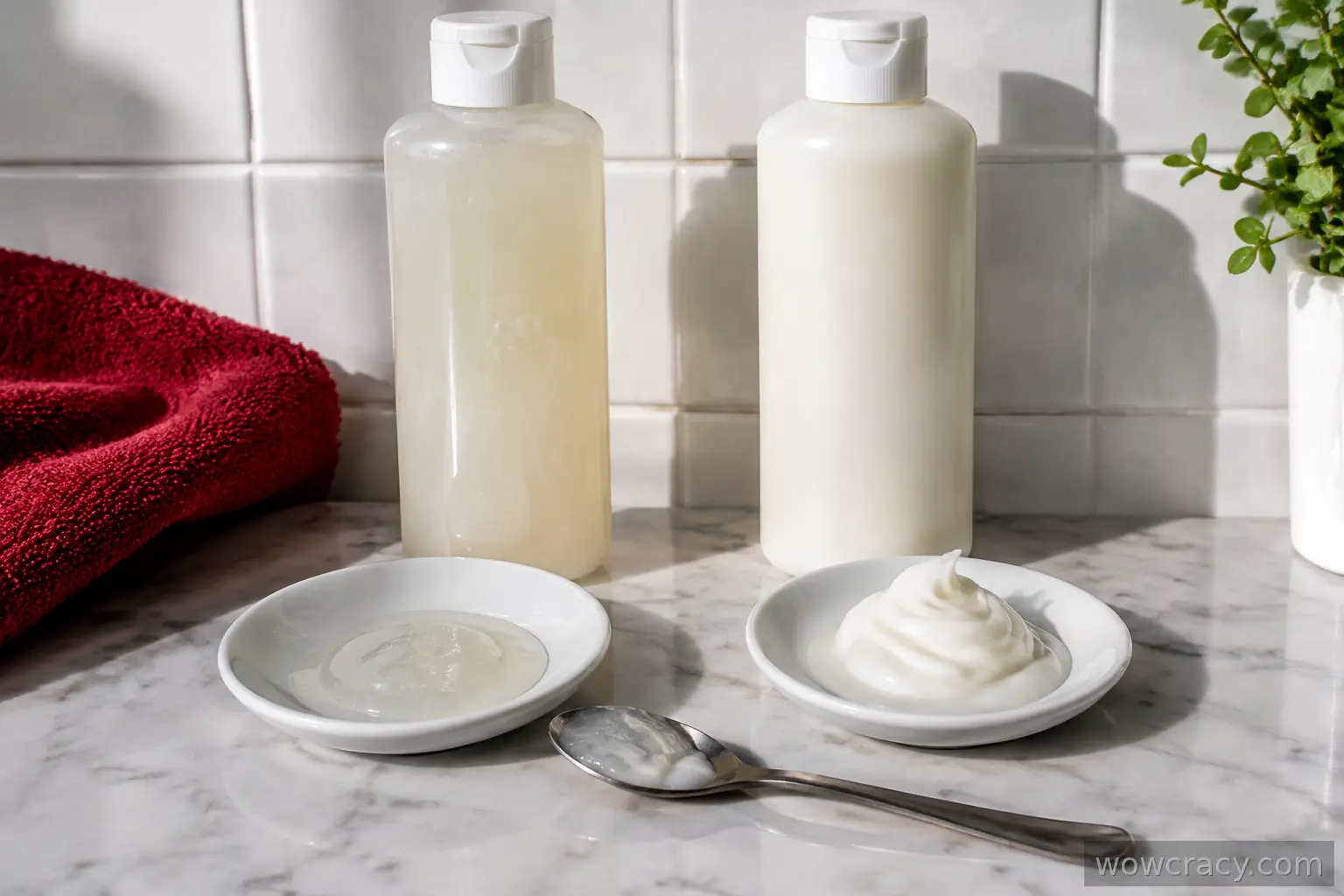
Light conditioners have a liquid or gel-like texture, distribute well, and rinse out quickly. They usually don’t contain large amounts of heavy oils and silicones in high concentration. Thicker, creamier products are better suited for dry ends, but they need to be applied in very small amounts and only to the lower third of the length.
If your hair is fine but prone to dryness at the ends, you can try two products: a light conditioner for the roots and mid-lengths, and a small amount of a richer balm or mask only on the ends. The main thing is not to apply the heavy product above ear level.
It’s also worth paying attention to the ingredients. Silicones are not “bad” in themselves: they make combing easier and add smoothness. But for fine hair, it’s better to choose products where silicones are closer to the end of the ingredient list rather than in the first positions. If your hair becomes heavy already during application after conditioning, that’s a signal that the texture isn’t right.
Another practical criterion is the consistency when rubbed between the palms. A light product almost immediately dissolves in water, while a thick one remains a dense patch. For fine hair, it’s better if the conditioner quickly “dissolves” under your fingers: this means it’s easier to distribute evenly and rinse out.
A separate note about leave-in spray conditioners. They can be a convenient addition for the ends, but they don’t replace a regular conditioner after washing: a spray doesn’t soften hair during combing the same way a rinse-out product does. For fine hair, it’s better to apply the spray to dry ends or to the lengths before styling, not to all the hair.
How much product to apply and whether to step back from the roots
There is no universal number: the amount depends on the length, density, and texture of the hair. But for fine hair a simple rule applies — better less than more. Start with a pea-sized amount for shoulder-length hair and increase the dose only if needed.

It really is worth stepping back from the roots. The scalp produces sebum, and it’s near the roots that hair loses freshness fastest. Conditioner isn’t needed there: it doesn’t cleanse, it only softens and makes combing easier. Apply the product from mid-length or from ear level, and then distribute it toward the ends.
If the hair is very short, conditioner may only be needed on the ends. If it’s long and thick — increase the dose, but still distribute it gradually rather than pouring the whole blob onto one section at once. Imagine spreading a thin layer of cream over a large surface: excess forms a film, while an even thin layer works better than a thick one.
Approximate amounts for fine hair of different lengths:
- very short (up to 5 cm) — an amount on the fingertip, only on the ends;
- shoulder length — a pea-sized amount;
- to the shoulder blades — a small nut-sized amount, divided into two or three applications;
- longer than the shoulder blades — two small portions applied gradually.
These guidelines are only a starting point. If your hair is thick or very porous, the amount may be too little, and that’s normal: the main thing is that the product doesn’t remain on the roots.
How to distribute and rinse out conditioner
After washing with shampoo, gently squeeze the hair with your palms so that excess water drains off. On wet hair from which water is dripping, conditioner distributes unevenly: some simply rinses off immediately, and some remains on a single strand.
Apply the product with your palms, moving from mid-length to the ends. Don’t rub it into the scalp. Then comb the hair with a wide-toothed comb or simply run your fingers through it to distribute the product evenly. Work the ends especially thoroughly — they are the ones that most need softening.
Rinse with warm, not hot water. Hot water can overdry the ends and increase the feeling of tightness. If the conditioner is light, 30–60 seconds is enough for it to work. Heavier balms may need a little more time, but leaving them on the hair for a long time without need isn’t worth it.
After rinsing, check a strand by touch: it should be smooth, but not slippery or sticky. If you feel a film, rinse again or reduce the dose next time. Also pay attention to the water: in regions with hard water, the product may rinse out worse, and then it’s worth either increasing the rinsing time or occasionally using a milder conditioner option.
Don’t comb wet fine hair from roots to ends — in this state it is especially vulnerable. It’s better to start from the ends and gradually work upward, holding the strand with your hand.
What to change if the roots are oily and the ends are dry
This is one of the most common situations: the scalp is oily, and the lengths and ends are dry. In this case you don’t need to choose just one thing — separate your care.

Wash the roots with a shampoo designed for oily scalp, and apply conditioner only to the lengths, stepping back from the roots by at least a palm’s width. If the ends are very dry, use a richer balm or mask once a week, but again only on the lower part of the hair.
Don’t try to “wash away” the oiliness of the roots with an aggressive shampoo every day: this can overdry the scalp and make it produce even more sebum. It’s better to wash your hair as it gets dirty and rinse the conditioner thoroughly from the lengths. If you wash your hair every day, choose a mild shampoo for frequent use and don’t apply it to the ends — the foam that runs down is enough there.
Sometimes the problem isn’t the scalp, but that the conditioner gets onto the roots during rinsing. Tilt your head so that the water with conditioner runs down the lengths and not past the roots, or rinse the product while holding your head at an angle. It’s also worth checking whether product remains at the back of the head — that’s where it’s most often missed.
If the ends are constantly dry, even after a nourishing balm, it’s worth looking at other causes: frequent use of a flat iron, a hairdryer without protection, sun or wind. In that case, not only conditioner but also a drop of light oil or serum on the ends before styling will help.
How to adjust care one step at a time
Don’t change everything at once. If your hair loses volume, try adjusting one parameter at a time and observe for a few days. That way you’ll understand what exactly worked and what doesn’t matter.
- Reduce the amount of product. If you previously applied a walnut-sized amount, try half.
- Step back from the roots. Apply conditioner no higher than ear level, and if the hair is short — only on the ends.
- Change the texture. Switch to a lighter conditioner or a product marked “for fine hair.”
- Rinse longer. Add another 30 seconds under the shower if you feel that the product remains on the hair.
- Separate your care. Use a light conditioner for the whole length and a separate nourishing product only for the ends.
If after several attempts your hair still looks weighed down, it’s worth checking whether conditioner remains on the scalp, whether you rinse the shampoo well, and whether you use too many styling products. Sometimes the problem isn’t the conditioner, but the combination of steps.
It’s also worth remembering that fine hair can change depending on the season, hormonal background, stress, or a change in water. What worked in summer may turn out to be too heavy in winter, when the indoor air is drier. Therefore, care is not a one-time selected scheme, but several parameters that are worth reviewing from time to time.
Frequently asked questions about conditioner for fine hair
Can you skip conditioner altogether if your hair is fine?
You can, but then the hair tangles more often, and the ends dry out and break faster. If the conditioner seems too heavy, try a lighter option or apply it only to the ends — that’s better than giving it up entirely.
Should you rinse out conditioner with cold water?
Cold water doesn’t make hair more voluminous for long, but it can reduce frizz and make strands smoother to the touch. For fine hair, warm water during rinsing is enough, and cool water at the end, if you like.
What to do if hair gets oily quickly after conditioner?
Check the application area: the product shouldn’t get onto the scalp. Also reduce the dose and rinse the conditioner more thoroughly, especially at the back of the head.
A short algorithm for fine hair
Wash the roots with shampoo, and apply conditioner from mid-length to the ends. Take the minimum amount, distribute with a comb or your fingers, and rinse thoroughly with warm water. If the roots are oily and the ends are dry — don’t apply conditioner near the roots and use a separate product for the ends. If your hair loses volume, first reduce the amount of product, and then change its texture.
These steps don’t require special tools or expensive products. It’s enough to pay closer attention to the application area and the amount — and fine hair can stay soft, manageable, and at the same time light.