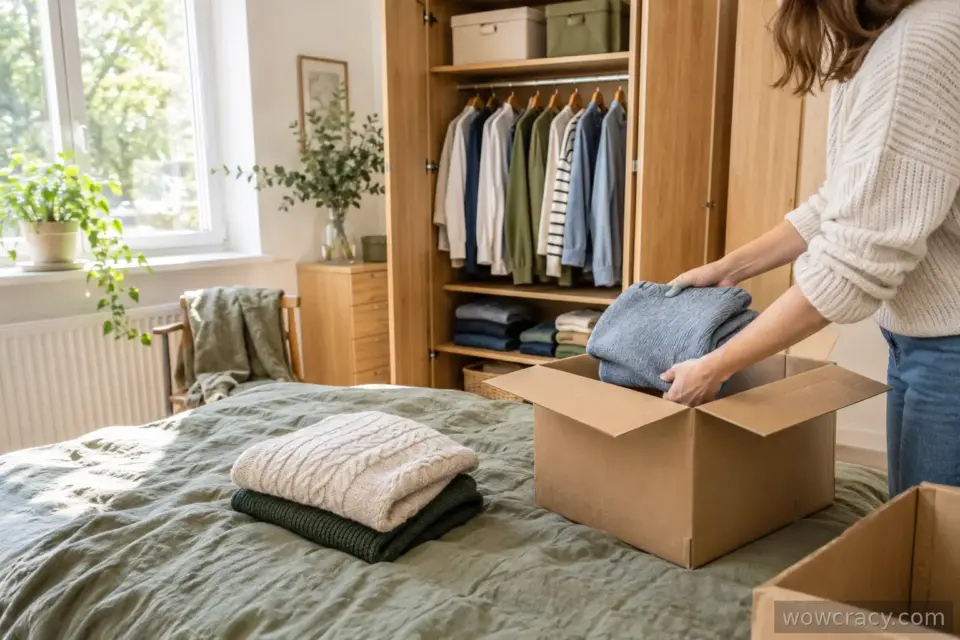
If you struggle to find things in your wardrobe, consider both its capacity and the way it is organised. Start with one small clothing category, then arrange items by how often you use them. A weekend can be enough to improve the system without buying organisers or hangers in advance; the amount you finish will depend on the wardrobe and your pace.
- Preparation: why you shouldn’t start by buying organizers
- Step 1. Sort through things in small groups
- Step 2. Zone the wardrobe by frequency of use
- Step 3. Use deep shelves rationally
- Step 4. Storing seasonal items: how to free up space without harming clothing
- Step 5. Introduce a short routine for maintaining order
- Frequently asked questions
- How much time does it take to reorganize a wardrobe in one weekend?
- Can vacuum bags be used for storing clothes?
- How can I sort clothing I feel attached to?
- Do you need to buy special hangers?
- Final weekend algorithm
Preparation: why you shouldn’t start by buying organizers
Ordering a set of containers and dividers is not always the best first step. Until you have sorted your clothes, it is difficult to know how many containers you need or which sizes will fit. Identify the categories that need separate storage and measure the shelves. Boxes you already own may be enough.
For the work you’ll need only a few things: a free surface (bed or floor), a few large bags or boxes for sorting, a cloth for wiping shelves and, if desired, a notebook for notes. If you have a vacuum cleaner with a narrow attachment, prepare it — dust accumulates in the wardrobe quickly. Don’t try to do everything in an hour: a realistic plan for the weekend includes breaks, otherwise fatigue will lead to chaotic decisions.
Step 1. Sort through things in small groups
To avoid being left with an overwhelming pile, work on small categories: T-shirts, jumpers, trousers, underwear or accessories. Try a 15–20-minute session and reassess your energy afterwards. This is a suggested pace, not a deadline for every category.

Ask whether you use each item, whether it suits your current needs, and whether it serves a specific event or season. A year without wear is a reason to reconsider its purpose, not an automatic disposal rule. Occasion wear, size changes and sentimental clothing deserve individual decisions. Sell or donate usable items according to the recipient’s requirements; consider repair or available textile recycling for damaged pieces.
You do not need to decide immediately what to do with sentimental clothing. Give it a separate box and decide how much space you want to set aside. This keeps it out of the way of everyday clothes without forcing a rushed decision.
Step 2. Zone the wardrobe by frequency of use
The basic rule of ergonomic storage: what you wear most often should be at eye and hand level, without bending down or standing on tiptoes. Imagine the wardrobe from top to bottom:
- Upper shelves — light seasonal items and occasional accessories that you can retrieve safely.
- The accessible middle area — everyday clothing within your own comfortable reach.
- Lower storage — heavier items and shoes; place other categories according to how often you actually use them.
Labelled boxes make seasonal clothing easier to find. Put only items you can safely retrieve on high shelves, and keep heavy suitcases and containers lower down. Stay within the shelves’ load limits.
Step 3. Use deep shelves rationally
Small pull-out boxes can make deep shelves easier to use. Fold T-shirts into rectangles and stand them upright in a box like index cards, so each one is visible. On an open shelf, upright folding needs support; soft jumpers may be easier to keep in low stacks.
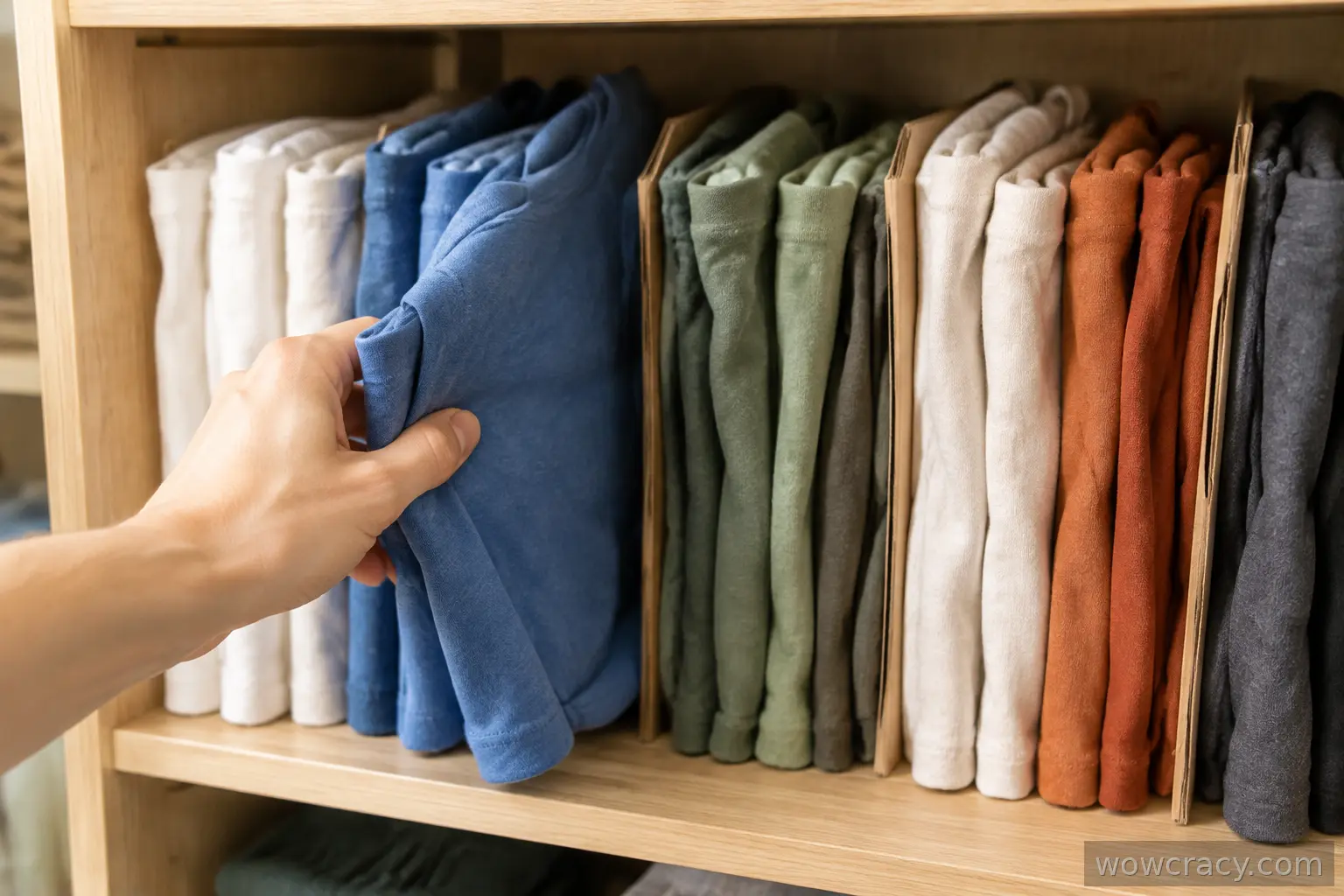
Use clean, dry boxes or containers you already own for socks, underwear and belts. Smooth, firm cardboard can make compartments. Avoid sharp edges, staples and surfaces that snag fabric.
On a deep shelf, keep everyday items at the front and less-used items behind them. Group the back row in a labelled box that is easy to pull out. Use stable boxes or smooth-edged dividers to support stacks; cut plastic bottles are unnecessary.
Step 4. Storing seasonal items: how to free up space without harming clothing
Store seasonal clothing somewhere clean and dry, away from dust and direct sunlight. Choose packaging to suit the material and the manufacturer’s guidance. A fabric cover keeps dust off but does not guarantee protection from insects. Sealed bags and containers do not create mould by themselves; the key is not to trap moisture inside.
Before long-term storage, clean each garment as its care label permits and let it dry completely. Woolmark recommends folding knitted wool garments and hanging woven ones on suitable shaped hangers; clean wool clothing can be protected from moths in airtight bags or containers. Check the manufacturer’s compression guidance separately for down jackets and other insulated clothing. Clean and dry shoes according to their material.
If the space under the bed is dry and accessible, use flat containers that fit. Consider vacuum packing only where the garment manufacturer permits it; fabric thickness alone is not enough to decide. Avoid compressing shaped clothing where doing so could distort it.
Step 5. Introduce a short routine for maintaining order
A brief, regular check helps maintain the system. Try spending a few minutes putting clothes away, with a longer review weekly or when needed:

- One-item rule: when returning an item to its place, immediately hang or fold it rather than throwing it on a chair.
- Morning check: spend 30 seconds to make sure the items on the shelves are lying evenly, and straighten what has shifted.
- Weekly review: once a week (for example, on Sunday evening) for 5 minutes review the wardrobe: whether items you haven’t worn have appeared, whether piles have formed on deep shelves.
- Seasonal review: at the beginning of each season, go through the corresponding category so as not to keep what has become irrelevant.
Such a routine doesn’t require heroic efforts, but helps maintain the system. If you live with family, involve others in the rule «every thing in its place». You can show children how to fold T-shirts vertically and turn it into a game.
Frequently asked questions

How much time does it take to reorganize a wardrobe in one weekend?
The time needed depends on the amount of clothing and the decisions involved. Plan manageable sessions with breaks: sort first, then clean the shelves and put things away. If one day is not enough, finish a single category and leave the bed and walkways clear.
Can vacuum bags be used for storing clothes?
Sometimes, if the garment manufacturer permits it. Check the filling, trim and construction, as well as the bag’s instructions. There is no rule that all thick fabrics can be compressed. Pack only clean, completely dry clothing; moisture, rather than the mere presence of metal trim, creates a corrosion risk.
How can I sort clothing I feel attached to?
Try a “decide later” box and choose a convenient review date. Not opening it for six months gives you information, not an obligation to discard everything. You can keep selected sentimental pieces within the space you have set aside and sell or donate others if you wish.
Do you need to buy special hangers?
Not necessarily. The right size and shape, sufficient strength and smooth edges matter more. Coats need adequate support, while knitted garments are often better folded. Matching hangers may look tidier, but one type will not automatically suit every garment.
Final weekend algorithm
Here’s a short action plan that will help you stay on track:
- Clear a surface and prepare sorting boxes.
- Work on small categories at a manageable pace, without an automatic disposal deadline.
- Keep everyday clothing accessible, light seasonal items higher up, and heavy items lower down.
- Use pull-out boxes and smooth dividers on deep shelves.
- Pack clean, dry seasonal clothing according to its material and manufacturer’s guidance.
- Maintain the system with brief checks at a frequency that suits you.
The main thing is not to strive for perfection from the first time. It’s enough to take the first step, and you’ll see how much easier daily life becomes. Remember: order is not a one-time event, but a habit that’s easy to maintain if the system is convenient for you.