A towel that turns rough after washing is rarely permanently damaged. Most often, somewhere in the chain of “label → loading → dose → rinsing → drying” an error has occurred, and the fabric has simply lost the softness that can be restored. The temptation to buy a new product or replace the entire set is strong, but first it’s worth understanding what exactly is happening to the terry.
Below is a step-by-step check that requires no special tools or homemade mixtures. The logic is simple: find the most likely cause, change one parameter, and observe the result after the next wash.
- What actually makes a towel rough
- Start with the label: what it actually says
- A separate note on new towels
- Dosing and loading: the two most common causes
- How much detergent is actually needed
- Loading the drum
- Rinsing and fabric softener: where the problem most often hides
- When to reconsider rinsing
- Drying towels: how it changes the feel of the fabric
- How to change care one parameter at a time
- When changing the product is truly justified
- Frequently asked questions
- Does vinegar help soften towels?
- Why are towels rough after washing in cold water?
- How many towels can be washed together?
- Can a towel that has become permanently rough be restored?
- A quick checklist before going to the store
What actually makes a towel rough
Terry fabric is soft not because it is “fluffy by nature,” but because the individual loops stand freely and do not stick together. Once they cling together or harden from detergent residue or minerals, the towel starts to feel like thin cardboard, even though the fibers are intact.
There are several typical mechanisms:
- excess detergent is not fully rinsed out and settles between the loops;
- an overloaded drum prevents the laundry from tumbling freely, and the loops get matted;
- hard water leaves mineral deposits that “cement” the fibers;
- a large amount of fabric softener coats the terry with a film, and it loses its volume;
- too hot or too long drying over-dries the fabric.
Each of these points can be checked separately. That is why changing the product “just in case” often doesn’t help: the cause may not have been the product at all.
Start with the label: what it actually says
The label is the only source of information that pertains specifically to your towel, not to terry products in general. The manufacturer specifies the maximum temperature, whether machine washing and drying are allowed, and sometimes separate warnings about bleaching or ironing.

What to pay attention to:
- the washtub symbol with a number — this is the maximum, not a recommendation to wash exactly at that temperature; for cotton, 40 °C is often sufficient;
- a crossed-out triangle means no bleaches, even oxygen-based ones;
- a square with a circle allows tumble drying, and with a horizontal line — only a delicate cycle;
- a crossed-out square — tumble drying is prohibited, and this should be respected;
- a separate line about “do not use fabric softener” appears on towels with enhanced absorbency.
If the label has worn off or been cut off, rely on the composition: cotton and bamboo usually tolerate 40–60 °C well, while blends with synthetics require lower temperatures. In any case, do not exceed the mark on the label: hot water does not “disinfect better” but accelerates the wear of the loops.
A separate note on new towels
The first wash of a new terry towel often feels stiff due to sizing — a technological finish applied by the manufacturer for presentation. This is normal: after two or three washes without fabric softener, the fabric usually softens on its own. Don’t rush to return the item to the store after one cycle.
Dosing and loading: the two most common causes
Rough towels after washing are very often the result of a double mistake: too much detergent and too much laundry in the drum. Both factors act together, and neither is visible to the eye.
How much detergent is actually needed
The dose on the package is calculated for a certain water hardness and level of soiling. For towels that have no stains, only sweat and dust, the lower limit of the recommended amount is usually sufficient. If the water in your region is soft, excess foam is not fully rinsed out — and that is exactly what settles in the terry.
Practical guidelines:
- measure liquid detergent in capsules or gel with a measuring cap, not “by eye”;
- for soft water, reduce the dose by a quarter of the recommended amount;
- concentrated gels require less than regular powders;
- do not add detergent “just in case” for fear that the laundry won’t get clean — it’s better to pre-soak heavily soiled items.
If a sticky residue remains on the towels after washing or they get stiffer with each cycle, the first thing to do is reduce the dose and add an extra rinse. This is the cheapest check of all possible.
Loading the drum
Terry towels are heavy, especially when wet. A drum filled “to the brim” does not allow items to tumble — they rub against each other, the loops flatten, and water with detergent does not penetrate evenly. It is optimal to load the drum to about two-thirds of its volume: the towels should fall freely during rotation.
The opposite extreme — washing a single towel separately — is also not ideal: without sufficient friction, washing is less effective, and spinning may distribute the fabric unevenly. It is best to wash towels together, of approximately the same size and color.
Rinsing and fabric softener: where the problem most often hides
Fabric softener is not a universal helper for terry. It coats the fibers with a thin film that makes the fabric feel softer to the touch, but this very film reduces absorbency. For towels that need to absorb water well, excess softener is a direct path to the “repelling” effect.
What to check:
- whether you are exceeding the softener dose specified by the manufacturer;
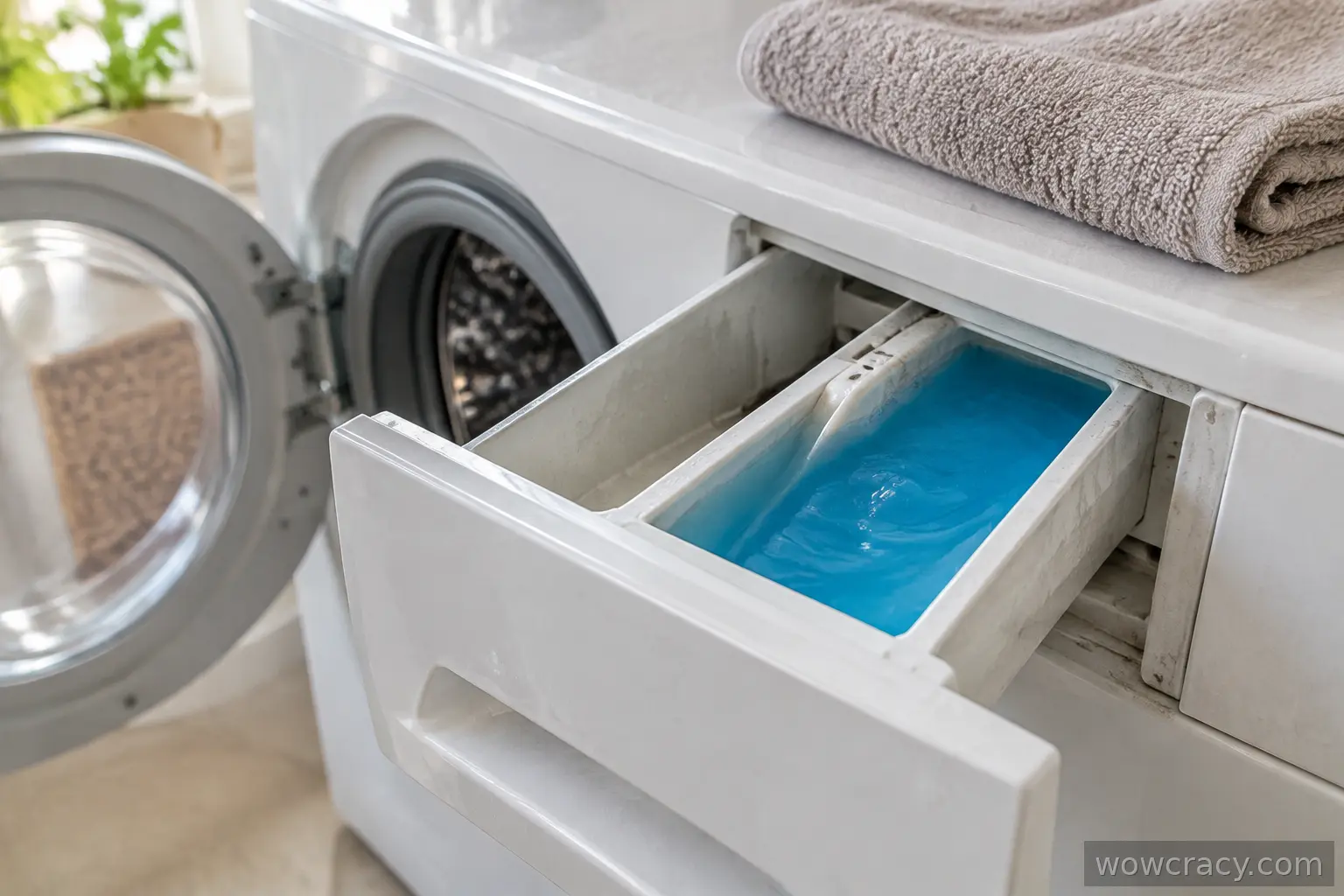
- whether it gets directly onto dry towels — it’s better to pour it into the special compartment;
- whether the product accumulates in the softener compartment (this happens with thick formulas and cold water);
- whether you add softener to every wash — sometimes once every two or three cycles is enough.
If in doubt, try several washes without any softener and add an extra rinse. Towels that become softer after this were most likely suffering from the film, not from “bad fabric.”
When to reconsider rinsing
An extra rinse is not a waste of water if you have hard water or washed towels together with items that foam heavily. It helps wash out detergent and mineral residues. But if you have already reduced the dose and the towels are still rough, it’s worth checking the machine itself: the filter, the condition of the compartments, and, according to the manufacturer’s instructions, whether descaling is needed.
Scale and dirt in the filter do not make fabric rough directly, but they worsen the quality of washing and rinsing. Do not disassemble the machine yourself unless you are confident in your actions: it is enough to clean the accessible filter according to the instructions and wipe the detergent compartments.
Drying towels: how it changes the feel of the fabric
Even a properly washed towel can become rough during drying. The most common cause is over-drying. When the terry loses residual moisture, the loops become brittle and stick together. In a tumble dryer, this happens faster than in the air.
A few practical rules:
- in a tumble dryer, choose a cotton cycle with moderate temperature and remove the towels as soon as they are dry;
- do not dry towels together with heavy items like jeans — they mat the terry;
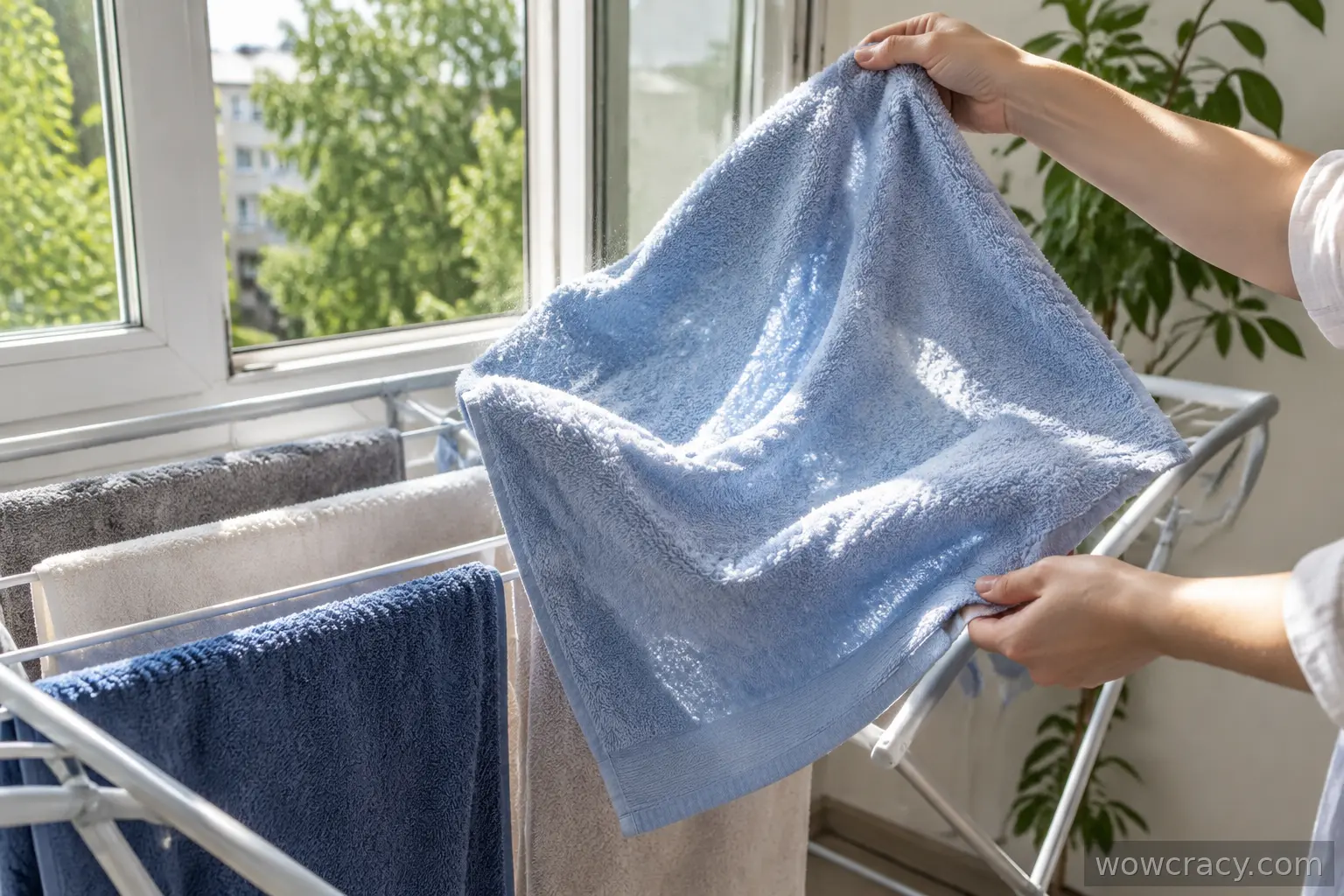
- when air-drying, hang towels freely, straightened out, in a well-ventilated place;
- avoid drying on a hot radiator — sudden overheating makes the fabric rougher;
- shake the towel vigorously before use — this fluffs up the loops.
Sometimes it is enough to change only the drying method to restore softness without any additional products. This is especially relevant for towels that dry outdoors in winter or in rainy weather: they can stay damp for a long time and acquire a “woody” feel.
How to change care one parameter at a time
The most common mistake is to change everything at once: a new product, a different temperature, a different drying mode. Then it is impossible to understand what exactly helped and what harmed. It is better to act consistently and note what you changed.
An approximate order of checks:
- Check the label and make sure you are not exceeding the temperature and not tumble-drying the towels if it is prohibited.
- Reduce the detergent dose to the lower limit of the recommendation and load the drum to two-thirds.
- Add one extra rinse.
- Skip fabric softener for two or three washes.
- Change the drying method: less heat, free hanging, shaking before use.
After each step, let the towels dry and assess them by touch. If it got better after changing one parameter, keep it and move on to the next. If not, revert and try another.
When changing the product is truly justified
Sometimes the cause is in the product itself, but not in its “quality” — rather in its mismatch with the conditions. For example, powder dissolves poorly in cold water and leaves granules in the terry. Or a gel with a high soap content foams too much for your type of machine.
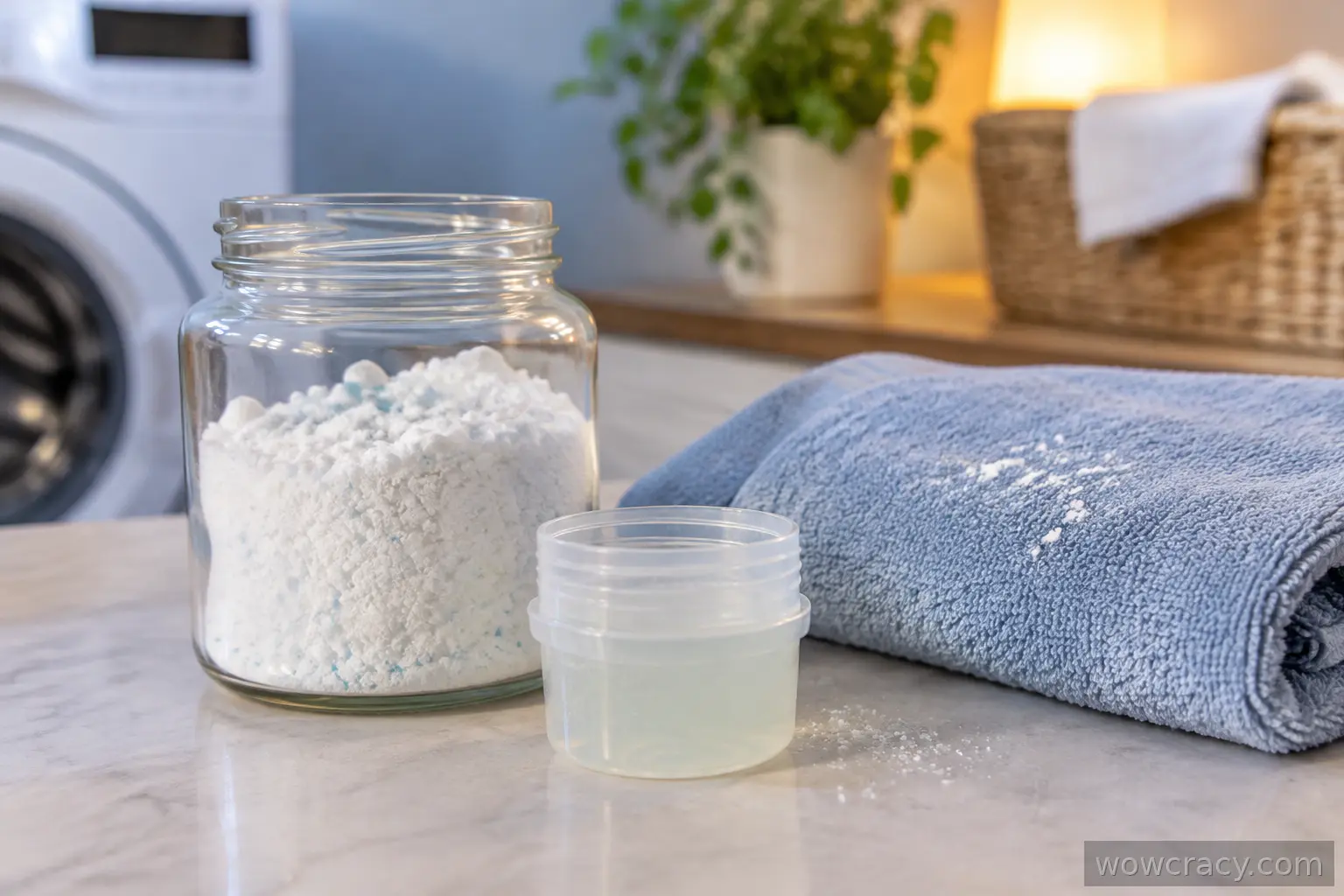
Changing makes sense if you have already checked the label, dosing, loading, rinsing, and drying, and the towels are still rough. In that case, try a different format — for example, liquid gel instead of powder or a product for sensitive skin without strong fragrances. Do not mix several new products at once.
Frequently asked questions
Does vinegar help soften towels?
Vinegar is sometimes mentioned as a remedy against mineral deposits, but its effect depends on the water, fabric, and concentration, and an excess can damage the machine’s rubber parts. It is safer to first check dosing, rinsing, and drying, and regarding vinegar, consult the washing machine instructions.
Why are towels rough after washing in cold water?
In cold water, powder may not dissolve completely, and greasy soiling is washed out less effectively. If the label allows, try 40 °C and make sure the product is intended for low temperatures.
How many towels can be washed together?
As many as will fill the drum to about two-thirds and allow the items to tumble freely. The exact volume depends on the machine model — follow the manufacturer’s instructions.
Can a towel that has become permanently rough be restored?
If the fibers are not mechanically damaged, softness usually returns after adjusting washing and drying. If the terry has lost loops due to excessive friction or over-drying, full restoration may not be possible — then the towel should be relegated to rags.
A quick checklist before going to the store
Before buying a new set, go through the list: label checked; detergent dose reduced; drum not overloaded; extra rinse enabled; fabric softener skipped for several washes; drying adjusted; machine filter and compartments cleaned according to instructions. If all points are done and the towels are still rough — then replacement truly makes sense.