The trickiest thing about a summer wardrobe isn’t the heat — it’s the moment when you’ve already left the house and notice that bra straps show through your blouse and the outlines of your underwear show through light-colored trousers. Indoors everything looked fine. The problem appeared outside, in direct sunlight, and that’s exactly when it’s hardest to fix.
Transparency is rarely absolute. More often it’s the interaction of three things: the density and color of the fabric, the lighting around you, and what you’ve put on underneath. Any of these components can be changed — and the cheapest place to start is usually the bottom layer, not buying a new dress.
- How to check whether a garment is see-through before you wear it
- Three things worth taking with you to a fitting
- Why white underwear isn’t always invisible under white clothing
- Briefly about colors under a light top
- What to choose under a thin blouse: a bra, a top or a T-shirt
- What usually doesn’t work under a thin blouse
- A slip dress and a petticoat: when they’re truly appropriate
- When a lining is better than a petticoat
- How to reduce the visibility of underwear under light trousers
- When to add a lining, and when it’s better to choose another garment
- A practical algorithm before going out
- Frequently asked questions
- Can you wear a transparent blouse without a top, only with a bra?
- Does a white tank top help under a white transparent dress?
- What to do if you don’t have seamless underwear at hand?
- Should thin garments with a lining be washed separately?
How to check whether a garment is see-through before you wear it
A test in the bathroom under artificial light shows almost nothing. Fabric that seems dense behaves differently in the sun: thin linen and viscose become semi-transparent, and white reflects light in a way that makes the outlines beneath it stand out more. That’s why a garment that looked flawless at home suddenly “gives away” everything underneath it outside.
Check the garment by a window on a clear day, not under a lamp. Stand so that the light falls on you from the front and look in the mirror from a few steps away — that’s the distance from which others see you. Then repeat the same thing with your back to the window: backlighting, when the light comes from behind you, is the harshest test and reveals the most.
Next — movement. Raise your arms, bend over, sit down. Fabric stretches across the back, shoulders and hips, and it’s in the stretched areas that transparency increases the most. If the garment is thin, also check it against your own palm: hold the fabric up to your hand and see whether the skin color and lines show through. This simple trick works well for sleeves and bodices, which most often fall into the field of view of the person you’re talking to.
It’s also useful to consider the color of what’s underneath. Dark underwear under light semi-transparent fabric produces a clear silhouette, light underwear under dark fabric produces gray patches, and a nude shade close to your own dissolves best. It’s worth remembering this at home rather than fixing it at work.
Three things worth taking with you to a fitting
- A phone with a flashlight — to look at the fabric against the light in a dark fitting room.
- A photo in daylight — photograph yourself from the front and back by a window, not deep inside the store.
- The bottom layer you plan to wear with this very garment — there’s no point assessing transparency without it.
Why white underwear isn’t always invisible under white clothing
The logic of “white under white” seems obvious, but it only works when the outer garment is dense. Under a thin white blouse, a white bra creates a contrast with the body: it’s brighter than the skin, so it reads as a separate light patch with clear edges. A nude shade in this situation is often less noticeable, because it doesn’t compete with the skin color.
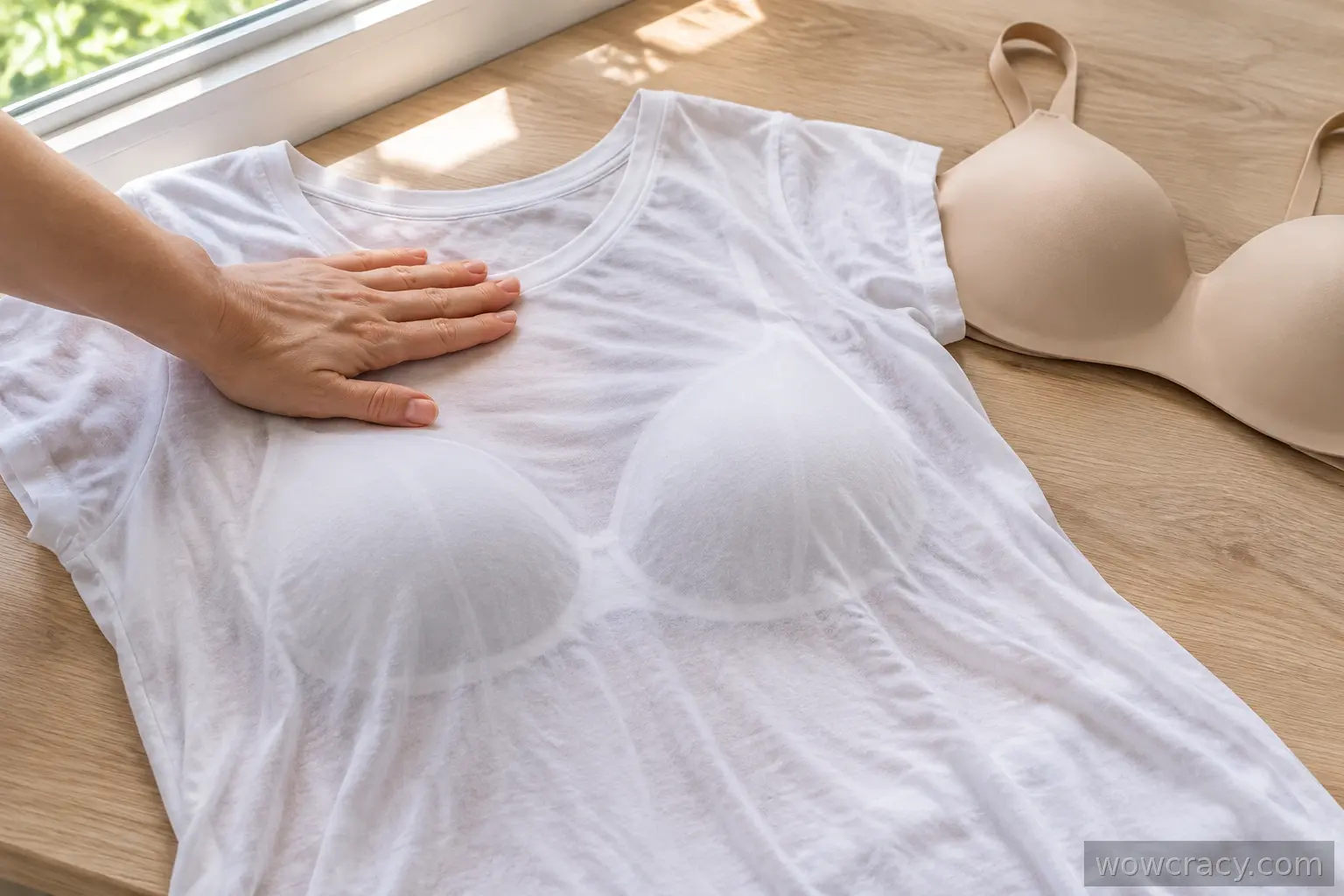
The second factor is texture. Smooth satin underwear under matte cotton reflects light and shines through the fabric. A matte, slightly grainy surface behaves more calmly. The third is seams and hardware: underwires, rings, sliders and shiny hooks show through even fairly dense fabric, because this is relief, not color. Relief is noticeable even when the shade of the underwear itself can’t be seen.
That’s why for light semi-transparent garments it’s more practical to focus not on “white or black” but on two criteria: a shade close to your skin tone and a smooth seamless cut without protruding details. If the bra is bright white and the blouse is thin, sometimes it’s enough to wear it under another garment and take something more neutral for this one.
Briefly about colors under a light top
- Nude and beige shades matched to your skin tone are the most universal option.
- White is noticeable under thin white fabric, but perfectly appropriate under dense fabric.
- Black and saturated colors produce a clear silhouette under any semi-transparent garment.
- Pastel tones sometimes work better than white if they match the undertone of your skin.
Underwear under light trousers and skirts deserves a separate mention: the thin seams of panties show not because of color but because of relief. Seamless models or models with flat seams solve this better than any color. And lace edges under tight fabric create a bumpy contour that’s noticeable even in a nude shade.
What to choose under a thin blouse: a bra, a top or a T-shirt
A thin blouse is the most common reason for the question of what to wear under see-through clothing. The choice depends on how transparent the garment is and what look you want to achieve. Sometimes it’s enough to replace one piece of underwear, and sometimes a full second layer is needed.
If the blouse is only slightly see-through in the sun, a nude bra without underwires and with smooth cups is enough. If the fabric is thinner and noticeably semi-transparent, but you don’t want to add a warm layer, a bra-top or a short top made of thin cotton or modal in the same tone as the blouse will work. It covers the neckline and doesn’t add volume. For a truly hot day it’s important that this be a breathable natural fabric, not dense shapewear-effect synthetics.
When the blouse is completely transparent — chiffon, thin linen with see-through, — it’s often worn as a top layer over a tank top or top. This is no longer hiding underwear but a deliberate layered composition: a white tank top under a black transparent blouse looks like an intention, not an oversight. It’s only important that the bottom layer be made of breathable fabric, otherwise it will become uncomfortable in the heat.
The neckline needs special attention. A deep neckline under a transparent blouse almost always shows the edge of the bra. If you don’t want this effect, choose a blouse with a closed neckline or a bra with low-cut cups that isn’t visible under the neckline. For blouses with an open back there are models with a transparent back — they don’t solve transparency completely, but they remove the most noticeable horizontal line.
What usually doesn’t work under a thin blouse
- A bra with lace and raised seams — the pattern shows through the fabric.
- A sports top with thick straps and elastic — it reads as a separate layer under the blouse.
- A push-up bra under very thin fabric — it adds volume and contrasting lines.
- Dark underwear under a light transparent blouse, if you don’t want a deliberate effect.
- Underwear with shiny hardware under matte fabric — the shine shows even in shadow.
A practical compromise is to keep one or two neutral bras and one thin top in the drawer specifically “for see-through.” It’s cheaper and calmer than sorting through the whole wardrobe every time before going out. Besides, such underwear quickly becomes a habit: you stop thinking about it and start choosing outer garments by mood rather than by risk.
A slip dress and a petticoat: when they’re truly appropriate
A slip dress is not an outdated item but a working tool for thin dresses, especially light-colored and linen ones. It solves two tasks at once: it removes see-through and prevents the dress from sticking to the body in the heat. The most practical options are short ones, made of thin breathable fabric, in a nude shade or the same color as the dress.
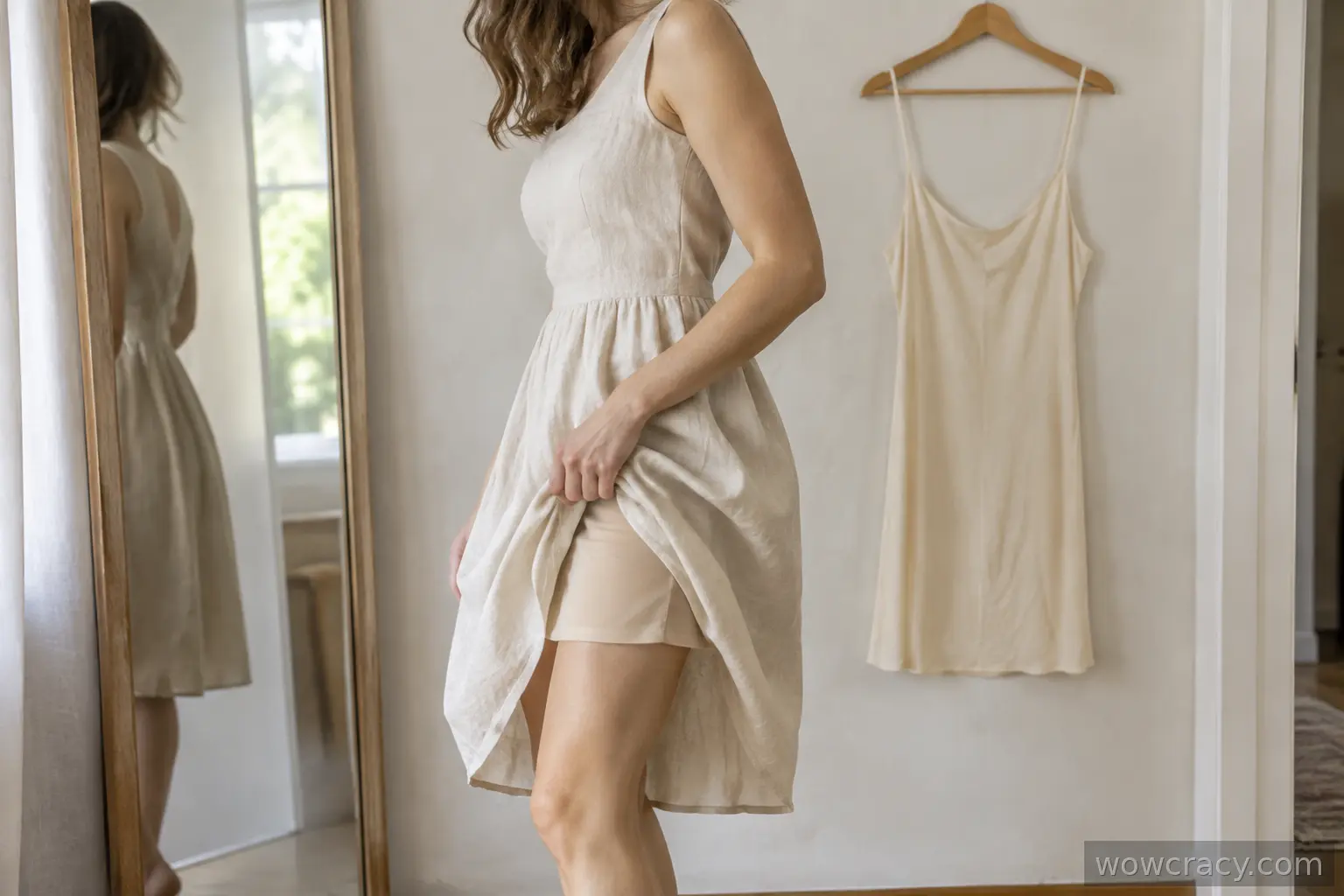
Length matters. If the slip dress is longer than the outer one, it will show from under the hem as a separate layer — sometimes this is a deliberate technique, but more often it’s simply an oversight. It’s optimal when it’s a few centimeters shorter or matches the length of the outer garment. Check this while sitting: the hem rides up, and it’s in movement that it becomes clear whether the bottom layer shows.
A petticoat is needed under thin linen, silk or viscose skirts, especially light-colored ones. It works as a second layer between the body and the fabric and at the same time reduces clinging. For narrow skirts it’s better to take an elastic model, for flared ones — a loose one, so as not to restrict your stride. Silk petticoats feel pleasant to the touch but slip, so under a tight cut they can shift to the side.
When a lining is better than a petticoat
A lining is a layer sewn or attached to the garment itself. It doesn’t shift, doesn’t add a separate line at the waist and often looks neater under a tight cut. But in the heat a sewn-in synthetic lining can be warmer than a separate cotton petticoat. That’s why for very hot weather a separate thin layer is sometimes better, and for a city with air conditioning — a lining.
| Solution | When it’s appropriate | Limitation |
|---|---|---|
| A nude bra | Slight see-through of a thin blouse | Won’t help if the fabric is completely transparent |
| A thin top or tank top | A transparent blouse as a top layer | Adds warmth; breathable fabric is needed |
| A slip dress | A thin light dress, a tendency to cling | You need to watch the length in movement |
| A petticoat | Thin linen and silk skirts | May shift under a narrow cut |
| A lining | A tight cut, a need for stability | Synthetics can be warm |
How to reduce the visibility of underwear under light trousers
Light linen trousers are see-through most often for two reasons: thin fabric and a loose cut that stretches across the hips when you take a step. The situation is made worse in the sun, when the fabric becomes almost semi-transparent against the light. At the same time, linen itself is an excellent summer material, so it’s not worth giving it up because of transparency.

The first step is seamless nude underwear. It removes the relief of seams, which is usually what gives underwear away under light fabric. The second is to check the fit: if the trousers are too tight at the hips, the fabric stretches and shows through more. Sometimes it’s enough to take a model one size looser or with a higher rise for the problem to disappear.
The third option is long shorts under trousers or thin bike shorts made of breathable fabric. They cover the underwear line and at the same time reduce friction between the legs, which is also a noticeable advantage in the heat. The main thing is to choose the thinnest possible material, otherwise the gain in transparency turns into extra warmth. Cotton shorts under linen trousers work better than synthetic ones, which heat up quickly.
If the trousers are very see-through, it’s more honest to admit: the garment isn’t meant for close summer wear without an additional layer. Sometimes it’s simpler to keep it for the evening or a cooler day than to put on several layers under it every time. Another way out is to wear them with a long untucked shirt or with a tunic that covers the hips and removes the question of transparency in the most noticeable area.
When to add a lining, and when it’s better to choose another garment
A lining is justified if the garment is dear to you, fits well and you’re ready to spend a little time at the tailor’s. Most often this concerns a favorite dress or skirt made of thin fabric that you want to wear in summer. In that case a lining made of natural fabric in a matching tone solves the problem once and for all, and at the same time makes the garment more pleasant to the touch.
But there are cases when adding a layer is inadvisable. Very thin synthetics with a strong sheen show through even with a lining and at the same time let air through poorly. Tight garments made of thin fabric become even warmer and less comfortable in movement with a lining. And if the garment is unevenly see-through — in patches, at the seams, — a lining can emphasize these areas.
Sometimes instead of a full lining a local solution is enough: sew a small patch of fabric into the area that shows through the most, or replace shiny buttons with matte ones. For thin plaid or striped skirts it’s sometimes better to take a lining in the tone of the main color rather than the tone of the light stripe — that way the pattern doesn’t “float” against the light.
In difficult cases it’s wiser to change the garment or its role in the wardrobe: wear it on top as a light layer, combine it with a top in a matching tone, keep it for evening outings. This isn’t a defeat but a sober calculation — comfort in the heat matters more than the desire to wear a particular new item.
A practical algorithm before going out
- Check the garment by a window in daylight, from the front and from the back.
- Raise your arms, bend over, sit down — look at the stretched areas.
- Assess what shows underneath: color, relief of seams, hardware.
- Choose the bottom layer: a nude bra, a thin top, seamless underwear.
- If that’s not enough — add a slip dress, a petticoat or a lining.
- If that doesn’t help either — keep the garment for another occasion.
The most useful thing you can do for yourself is to keep a small set of neutral items “for see-through”: an underwire-free nude bra, a thin top, seamless panties and a short slip dress. It takes up little space, costs moderately and removes most morning doubts at the mirror.

Frequently asked questions
Can you wear a transparent blouse without a top, only with a bra?
It depends on the situation and your readiness for a revealing look. For the office and business meetings a second layer or a denser blouse is usually more appropriate. For a walk or an evening out a transparent blouse with a bra can be a completely deliberate image — the main thing is that you feel confident.
Does a white tank top help under a white transparent dress?
Often not. A white tank top under thin white fabric produces a light patch with clear edges and a noticeable line at the waist. A nude or cream shade close to your skin tone usually dissolves better. If you want a deliberate contrast, though, a white tank top under a colored transparent dress is another story.
What to do if you don’t have seamless underwear at hand?
A denser outer garment or a looser cut that doesn’t stretch across the body helps temporarily. You can also put a light shirt or jacket on top that covers the problem area. This isn’t an ideal solution, but it gives you time to calmly choose the right underwear.
Should thin garments with a lining be washed separately?
Yes, especially if the lining is made of a different fabric. Different materials react differently to temperature and spinning, and the lining may shrink faster than the outer fabric. A delicate cycle and drying laid flat reduce the risk of deformation of both layers.