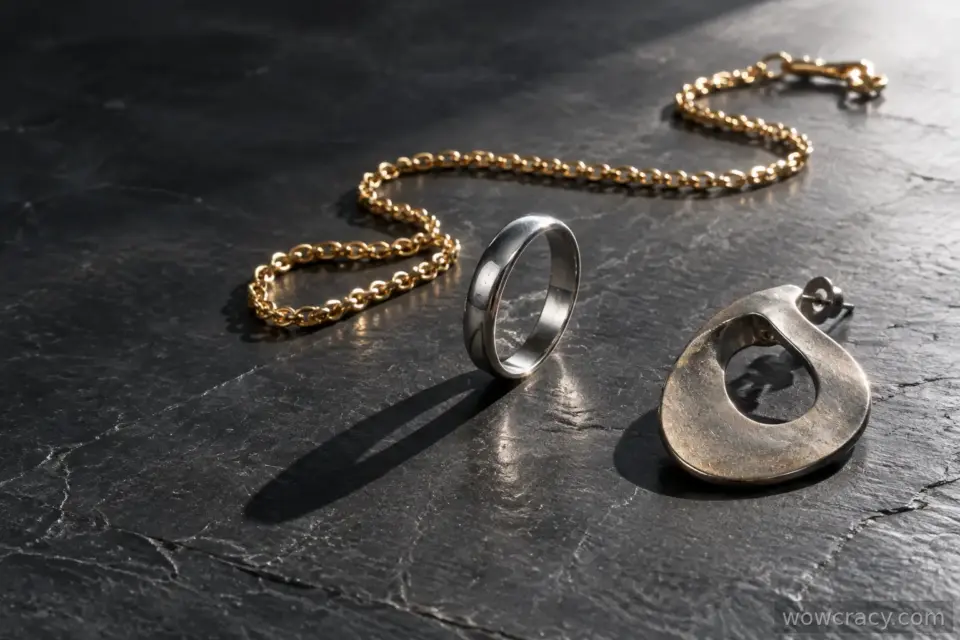
The most common mistake when choosing an everyday piece is looking only at the sparkle in the display window. After a month of active wear, a ring darkens, a chain loses color at the bends, and earrings leave a greenish mark on the skin. And the reason is usually not “poor quality” in general, but that the base material and the type of coating did not match your wear routine.
So the conversation should start not with what is more expensive or prestigious, but with two simple questions: what is the piece itself made of and what is it coated with. These two things behave differently, and confusing them is the source of most disappointments.
- Base and coating: two different things in one piece
- What the 925 hallmark means 925 and what it alone does not prove
- What actually determines how long gold plating lasts
- What is worth finding out about the composition of costume jewelry alloy
- How to match the material to your habits
- How much attention care actually requires
- What to ask the seller before buying
- A short selection algorithm
- Frequently asked questions
- Can a gold-plated piece be worn constantly without taking it off?
- Why does 925 silver 925 darken and is this a defect?
- Does the label “hypoallergenic” mean complete safety for the skin?
- Can worn gold plating be restored?
- Is costume jewelry suitable for everyday wear?
Base and coating: two different things in one piece
The base is the metal the item is physically made of: it holds the shape, the weight and the strength of the clasp. The coating is a thin layer on top that gives color, shine and partly protects the base from contact with skin and air. A gold-plated chain may have a silver, brass or other base, and it is this base that determines how the piece will behave when the coating wears off.
This matters for the following reason. The coating always wears out faster than the base — it is thinner and takes all the contact. When the top layer wears away at the most stressed areas, the base shows through. And then you see not “spoiled gold” but ordinary metal that was underneath all along.
Hence the practical conclusion: asking “is this gold?” is less useful than asking “what is inside and what is it coated with”. In names and descriptions you come across wording such as “gold plating”, “gold filled”, “PVD coating”, “rhodium plating” — each describes the method of application and the thickness of the layer, not a guarantee of durability for years. Thickness, wear conditions and care matter more than the name of the technology itself.
Separately, it is worth distinguishing decorative coating from so-called plating. In plated items, the layer of precious metal is thicker and more mechanically bonded to the base, so it lasts longer than ordinary electroplating. But it is not eternal either: on a ring you wear constantly, wear is still noticeable, it just comes later. For earrings or a pendant that hardly rub against objects, the difference between technologies is felt less.
What the 925 hallmark means 925 and what it alone does not prove
The number 925 on silver means the share of precious metal in the alloy: approximately 92,5% silver, the rest being additives that add hardness. Pure silver is too soft for everyday rings and thin chains, so it is always alloyed. It is largely the additives that determine how quickly the piece tarnishes and how it behaves on the skin.
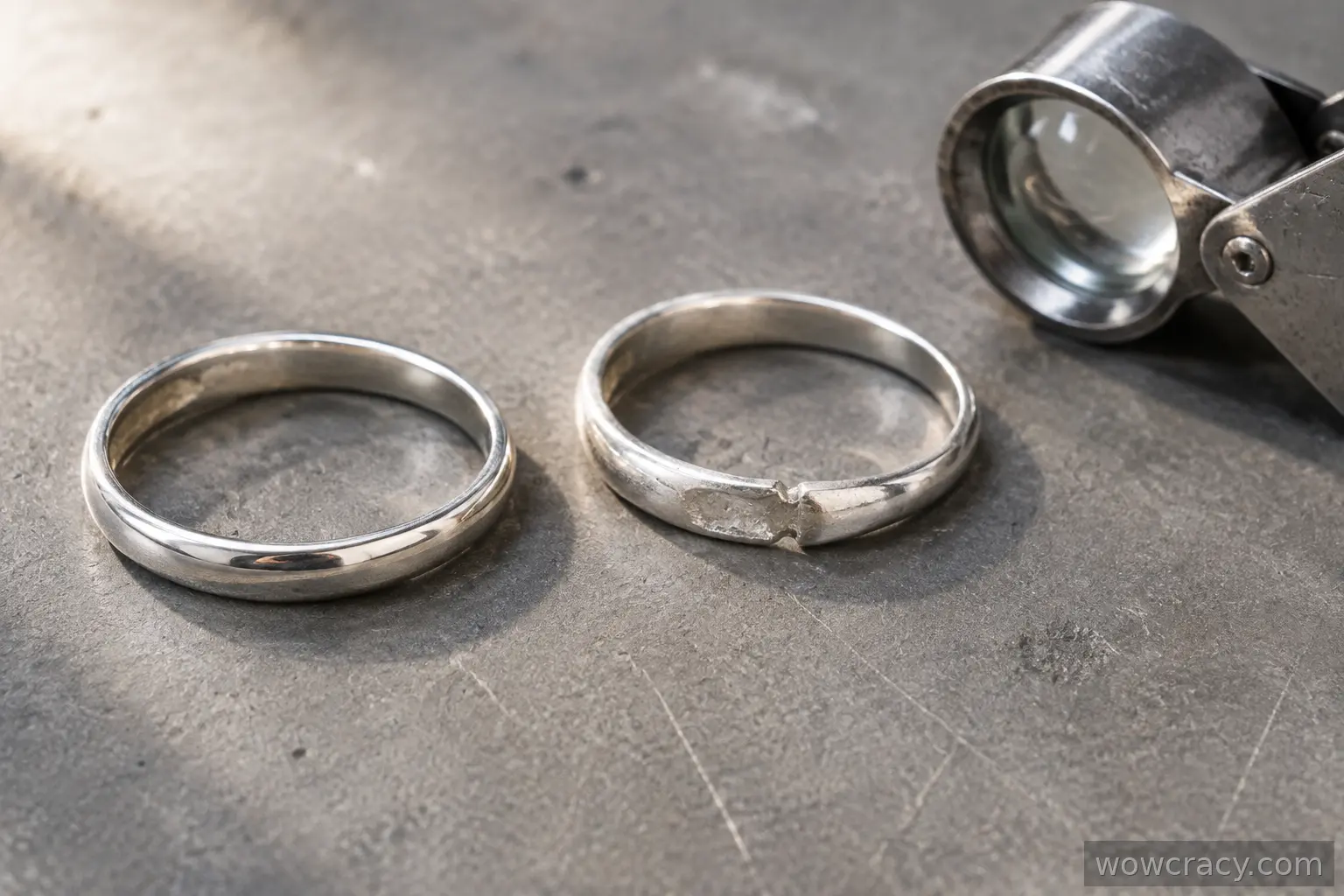
The hallmark is a declared alloy composition, not a conclusion about the quality of workmanship. It does not tell you whether the links are well soldered, whether the clasp is reliable, whether there are sharp edges, or whether the coating is applied evenly. Two items with the same 925 marking can differ noticeably in durability.
Separately, it is worth remembering a common confusion: 925 silver 925 is not the same as “silver coating” or “silver plating”. A silver-plated piece has a base of another metal and a thin layer of silver on top, and over time this layer behaves like any coating. If it is essential for you to have silver throughout the volume, this should be clarified directly.
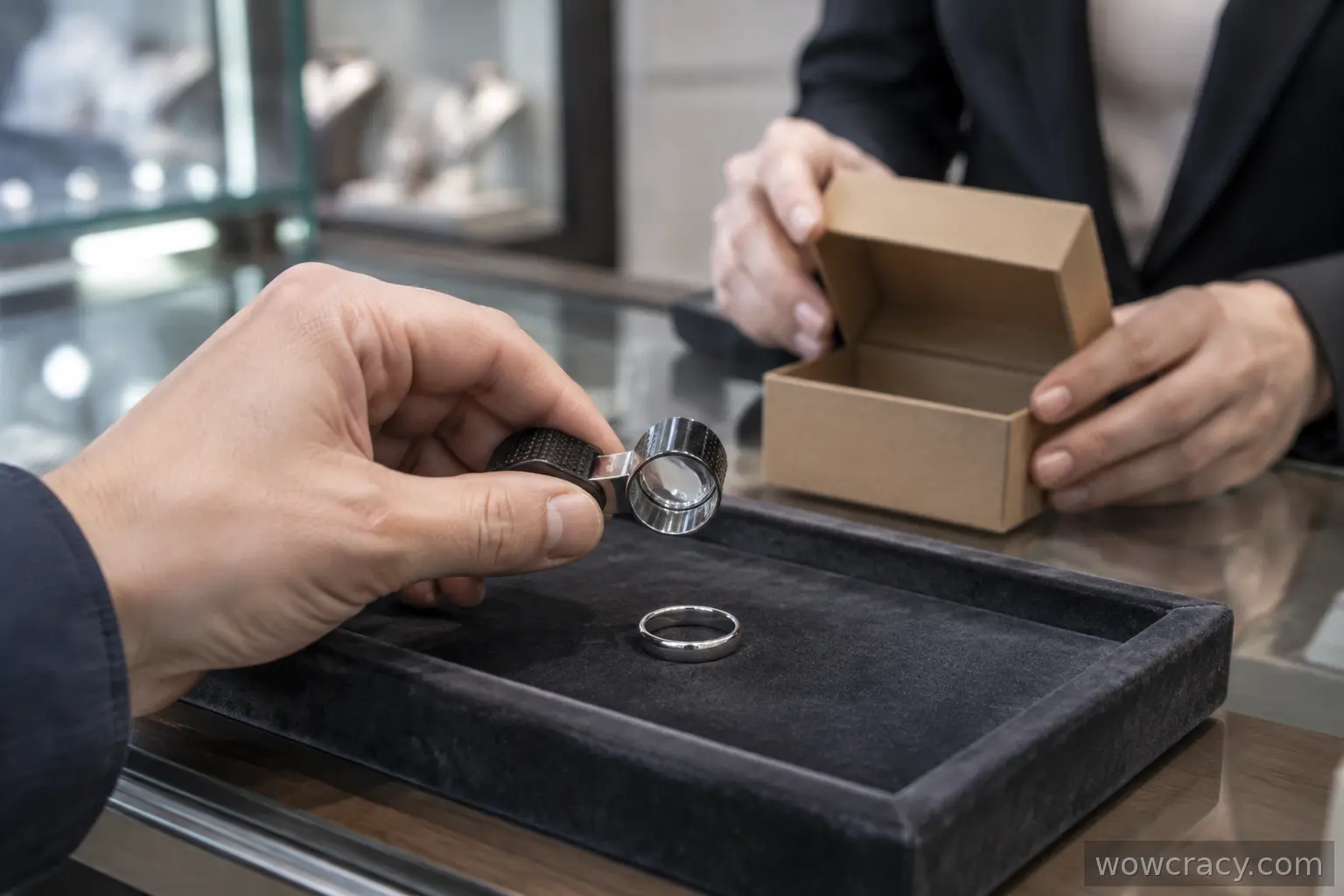
And one more boundary: the presence of a hallmark does not replace verification by a jeweler or an authorized laboratory if you are buying an expensive item in an unverified place. For an everyday piece of medium value this is rarely justified, but for large sums it is entirely reasonable.
It is also worth mentioning rhodium plating, which is often applied to white silver. Rhodium is harder and brighter, it protects silver from rapid tarnishing and gives a cool white shade. But this is also a coating: over time it wears off, and then the silver begins to darken in the usual way again. Some people notice that after the rhodium wears off the piece seems “different” — this is not a defect but a return to the natural color of the metal.
What actually determines how long gold plating lasts
Gold-plated pieces are a compromise that suits many: the look of precious metal at a more moderate price. But the service life of the coating depends on several factors, and none of them acts alone.
- Layer thickness. A thin decorative coating wears faster than a thicker one applied by electroplating or PVD. Sellers do not always state microns, but if they do, this is more specific information than the word “gold plating”.
- Place of contact. A ring on the hand you wash dishes with wears faster than earrings that hardly touch objects.
- The chemistry of daily life. Soap, shampoo, creams, sunscreens, perfumes, sweat and chlorine in the pool accelerate the breakdown of the top layer.
- Mechanical friction. Close contact with a bag, a watch strap, a pocket or another piece gradually wears the coating on the raised areas.
A typical picture: a gold-plated bracelet looks great for three months if you take it off before showering and sports, and loses color within a few weeks if you wear it constantly together with a watch. The difference is not in the brand but in how many times a day the piece came into contact with water and friction.
It is also important that gold plating is never eternal. The question is not “will it wear off” but “when and how noticeably”. If you are ready to treat such a piece as something for a season or two of active wear, it is entirely justified. If you want to put it on and forget about it for years, that is a different material.
A separate case is contact with sea water and sunscreens at the beach. Salt water and chemical filters act on the coating more aggressively than an ordinary shower, so a gold-plated piece withstands a beach holiday worse than city weekdays. If you do not want to think about this every day, it is simpler to leave such a piece at home during a trip.
What is worth finding out about the composition of costume jewelry alloy
Costume jewelry alloys are metals and their combinations from which inexpensive pieces are made: brass, copper, zinc alloys, sometimes with nickel additives. A costume jewelry alloy is not something bad in itself: it is light, holds its shape well and allows bold large forms at an affordable price. The question is what exactly is in the alloy and what it is coated with on the skin side.
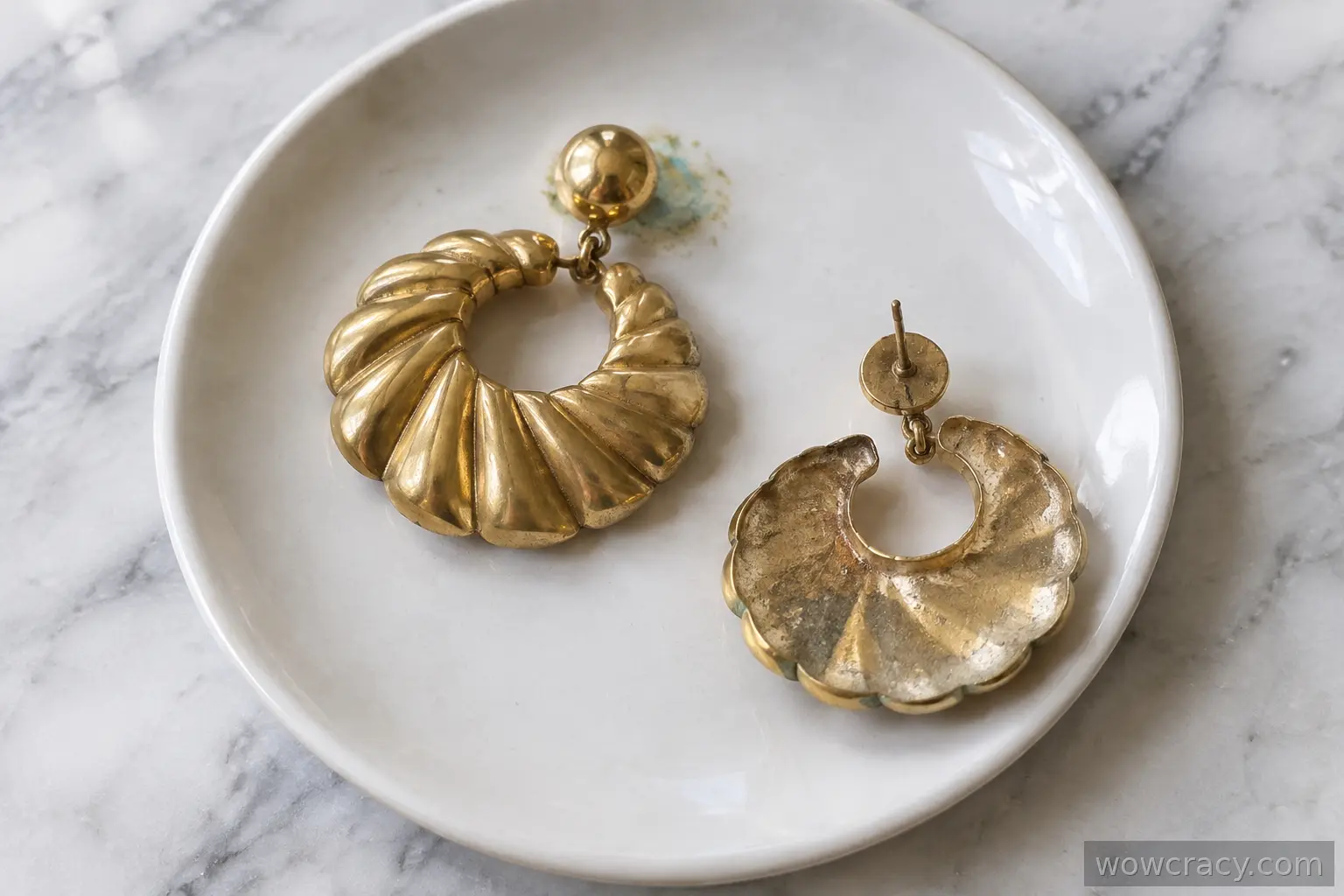
The most common practical problem is not strength but skin reaction. Nickel, which is often present in inexpensive alloys, causes contact irritation in some people: itching, redness, sometimes small rashes right under the piece. This is not “an allergy to metal in general” but a reaction to a specific component, and it may not appear immediately but after weeks of wear.
If your skin is sensitive, look for pieces marked “nickel-free”, with a coating that isolates the base from the skin, or with a base that is usually better tolerated — for example, titanium, stainless steel, silver. But even the label “hypoallergenic” is not a medical guarantee: it is a marketing term without a single standard, and tolerance can ultimately only be tested on yourself. If you have already had a pronounced reaction to metal, it is reasonable first to show your skin to a doctor and clarify what exactly your body reacts to, and only then choose a material.
The second feature of costume jewelry is rapid tarnishing and darkening. Copper and brass bases oxidize from moisture and air, sometimes leaving a greenish mark on the skin. This is not dangerous, but noticeable, and often it is this, rather than loss of shape, that makes you put the piece away in a drawer. Some manufacturers apply a clear protective varnish to the base — it slows oxidation but itself gradually wears off at bends and edges.
How to match the material to your habits
The most useful question before buying is: what will happen to the piece during a typical day? Not in an ideal scenario, but in a real one — with hand washing, commuting, working at a computer, the gym and an evening shower.
| Your wear routine | What suits better | What to pay attention to |
|---|---|---|
| I take it off before water, sports and sleep | Gold-plated pieces, costume jewelry with quality coating | Thickness and evenness of the coating, reliability of the clasp |
| I wear it constantly, rarely take it off | 925 silver 925, steel, titanium | Alloy hardness, ease of cleaning, weight |
| Sensitive skin, prone to irritation | Nickel-free bases, silver, titanium | Alloy composition, coating on the skin side, return policy |
| I often change looks, love large forms | Costume jewelry alloys, gold plating | Price per piece you won’t mind replacing |
| A piece “for going out”, a few times a month | Any material, including thin gold plating | Storage conditions so it doesn’t tarnish in the drawer |
This table is not a verdict but a guide. Reality is more complicated: someone with a gold-plated ring washes their hands ten times a day and wonders why the coating disappeared within a month. Someone wears silver for years and complains that it darkens — but silver darkening is a normal process that is removed by cleaning, not a sign of defect.
It is also worth considering that silver is softer than steel: thin chains can stretch, and rings can scratch. If you wear a piece while cleaning or working with your hands, a stronger base is often more practical than a precious one.
Another criterion that is rarely mentioned is weight. Large costume jewelry earrings made of zinc alloy can be quite heavy for the earlobes, and this is felt within a few hours. Titanium or hollow bases are lighter, so for everyday wear of large forms you should consider not only the composition but also how much the piece weighs in the ear or on the neck.
How much attention care actually requires
Care is not a half-hour ritual every week but a few habits that are easy to build into the day. The main rule is the same for all materials: the piece goes on last and comes off first. Perfume, cream and hairspray are applied before putting on earrings or a ring.
- Take off pieces before showering, the pool, cleaning with chemicals and sports.
- Wipe with a soft dry cloth after wearing — this removes sweat and makeup residue.
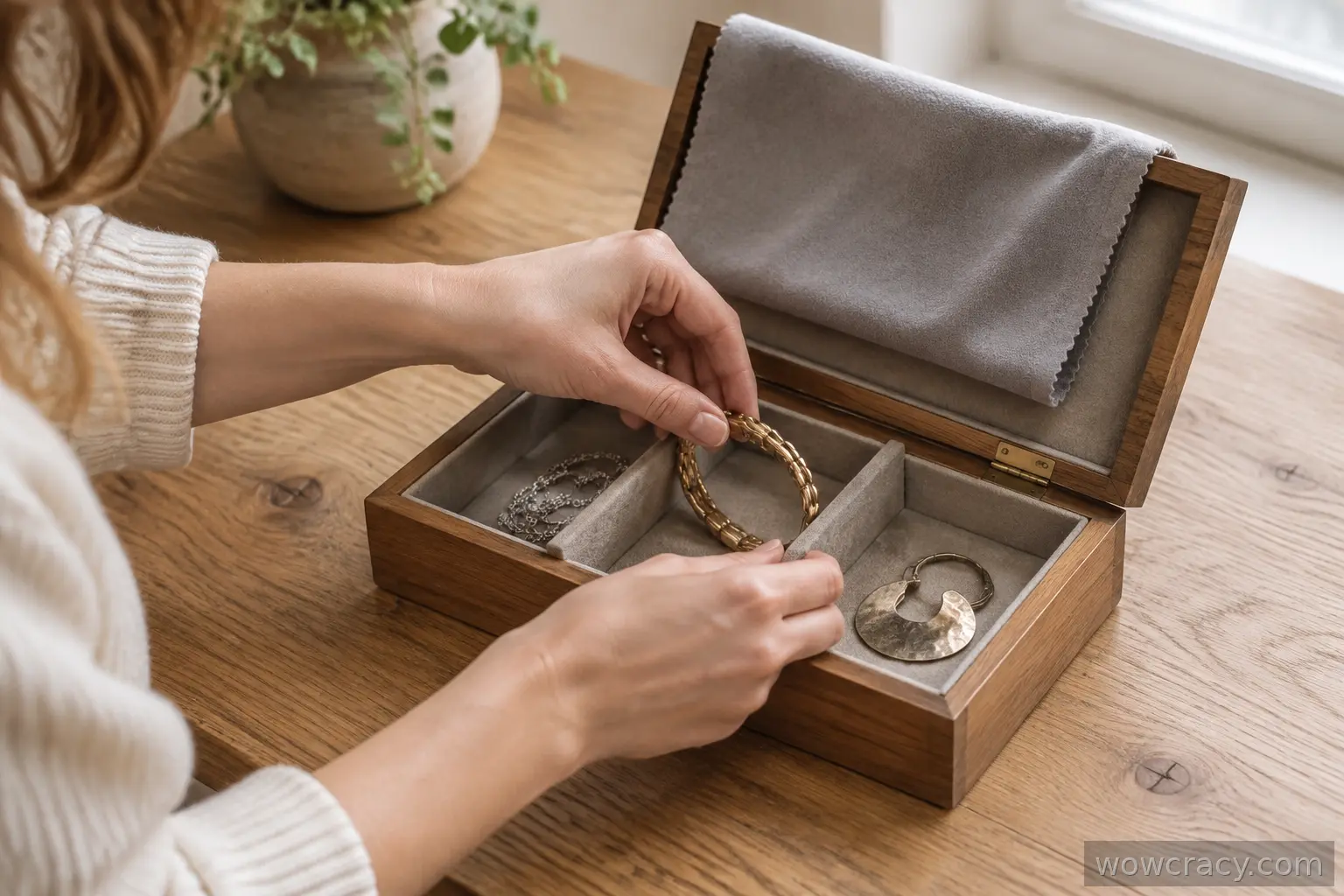
- Store separately, in a dry place, preferably in individual bags or jewelry box compartments to avoid friction and scratches.
- Clean silver periodically with a special cloth or a mild product; abrasives and aggressive chemicals can damage the surface.
- Do not polish gold plating intensively: you may remove what is still holding on.
Compared to this, costume jewelry usually does not require special care but does not forgive negligence either: moisture and sweat destroy it faster. Silver is more demanding in storage but can be restored. Gold plating is the most sensitive to everything at once, and that is why it should be treated as a piece with a limited resource.
Separately about storage: humidity in the bathroom is a bad neighbor for any metal. Even silver left on a shelf by the sink tarnishes faster than in a closed box in the bedroom. If you do not have a separate jewelry box, a small ziplock bag for each piece is enough — a simple way to reduce contact with air and friction against other items.
What to ask the seller before buying
A few specific questions will save you months of disappointment. Do not hesitate to ask them both in the store and in the online chat — the answers will show how well the seller understands their product.
- What metal is the base of the piece made of, not just the coating?
- By what method is the coating applied and is its thickness stated?
- Does the alloy contain nickel or other components to which sensitive people often react?
- Can the piece be returned if skin irritation appears?
- How should this specific item be cared for and is there a manufacturer’s instruction?
- Is there a hallmark on the item itself, not just on the tag?
- Can recoating be ordered separately at a workshop and how much does it cost?
If the seller avoids answering about the base or answers only with the word “gold”, that is a reason to be wary. An honest description is usually more specific. The answer to the question about recoating is equally telling: if the workshop does not take on such work or the price is comparable to a new piece, at least you know in advance that the item is disposable.
A short selection algorithm
First determine how much time the piece will spend on you and what it will come into contact with. Then clarify the base and coating — in that order, because coating without understanding the base says little. Next, compare this with your skin sensitivity and willingness to care for it. And only after that look at price and appearance.
The smartest choice is not the most expensive material but the one whose weaknesses you are ready to accept. Gold plating gives appearance and requires care; silver gives durability and requires cleaning; costume jewelry gives freedom of form and requires replacement. If you understand this compromise in advance, the piece will not become a disappointment two months later.
Frequently asked questions
Can a gold-plated piece be worn constantly without taking it off?
Physically yes, but the coating will wear off faster, especially on the hands and in places of friction. If you are not ready to take it off before water and sports, it is better to choose silver or steel.
Why does 925 silver 925 darken and is this a defect?
Darkening is the natural reaction of silver to sulfur and moisture in the air, not a defect. It is removed by cleaning, and this does not affect the strength of the item.
Does the label “hypoallergenic” mean complete safety for the skin?
No. There is no single standard for this term, and the reaction depends on individual sensitivity. If your skin reacts to metals, it is more important to find out the exact composition and to have the option to return the item.
Can worn gold plating be restored?
Yes, recoating at a workshop is possible, but it often costs comparable to a new piece. For inexpensive items this is rarely justified.
Is costume jewelry suitable for everyday wear?
It is suitable if you are fine with a shorter service life and are ready to monitor contact with the skin. The most common problems are darkening of the base and irritation from nickel, so sensitive people should choose other materials.