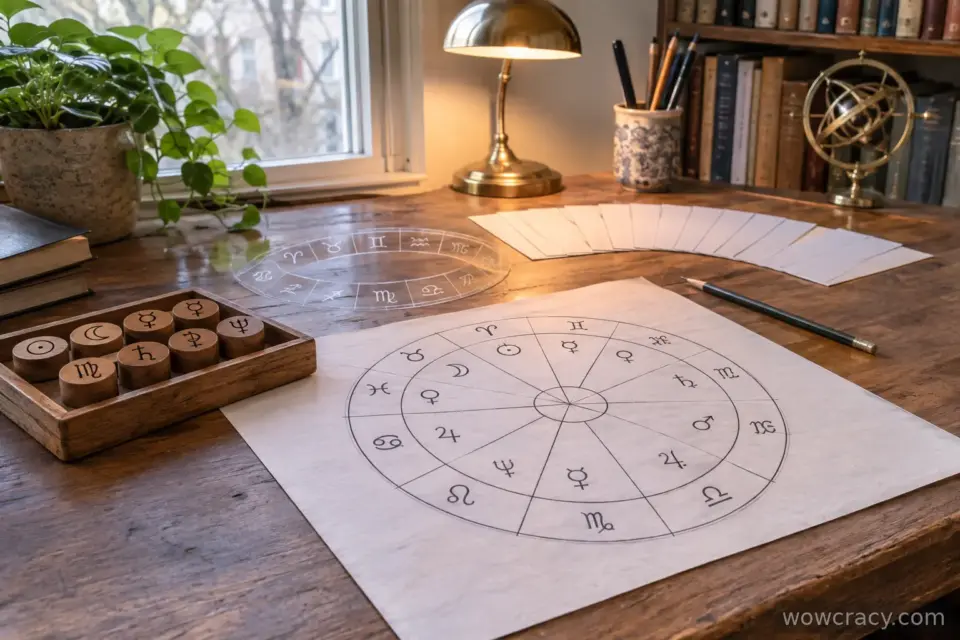
You opened an online calculator, entered your date, time and place of birth, and a circle with countless symbols appeared on the screen. Where do you start so as not to get lost? The first step is to understand that a natal chart (or birth chart) is not a verdict and not a scientific tool, but a symbolic scheme that astrologers use to describe inclinations, potential and inner conflicts. In this article, we will consistently break down what data is needed to build a chart, how to read planets, signs and astrological houses, in what order it is best to get acquainted with the chart, and which mistakes to avoid.
- What Data Is Used for a Natal Chart
- How Planets, Signs and Houses Are Connected
- In What Order to Examine the Chart
- Planets in Astrology: What They Mean
- Zodiac Signs: Style and Quality of Energy
- Astrological Houses: Spheres of Life
- Why a Single Placement Does Not Describe a Person Completely
- Practical Tips and Common Mistakes
- Frequently Asked Questions
- Can a natal chart be read without an exact time of birth?
- Which house system is better for a beginner?
- Can astrological forecasts be trusted?
- What to Do Next
What Data Is Used for a Natal Chart
Calculation requires the birth date, place and time, including the historical time zone and daylight saving rules. Without a known time, the ascendant and houses that depend on it cannot be determined reliably. The Moon and aspects also have timing uncertainty, although some signs and aspects between slower bodies may remain the same throughout the possible interval. A few minutes change coordinates, but do not necessarily change a sign.
Rectification means fitting an astrological chart to known life events to select a birth time. It does not recover a documented time and is not a scientifically validated way to determine one. If the time is missing, mark it as unknown, compare positions throughout the possible interval and do not interpret invented houses as established.
Choose a calculator that displays its inputs and settings: time zone, tropical or sidereal zodiac, and house system. Placidus, Koch and Whole Sign can produce different house boundaries. Use one system consistently while learning and record it in your notes; none is scientifically established as best for describing personality.
How Planets, Signs and Houses Are Connected
Think of the chart as three symbolic layers. In astrological tradition, Mercury is associated with thought and speech, Venus with relationships and values, and Mars with action and conflict. Signs supply an interpretive style: Mars in Taurus is described as persistent, Mars in Gemini as adaptable. Houses are associated with areas of life. These are conventions for reading symbols, not established causes of behaviour.
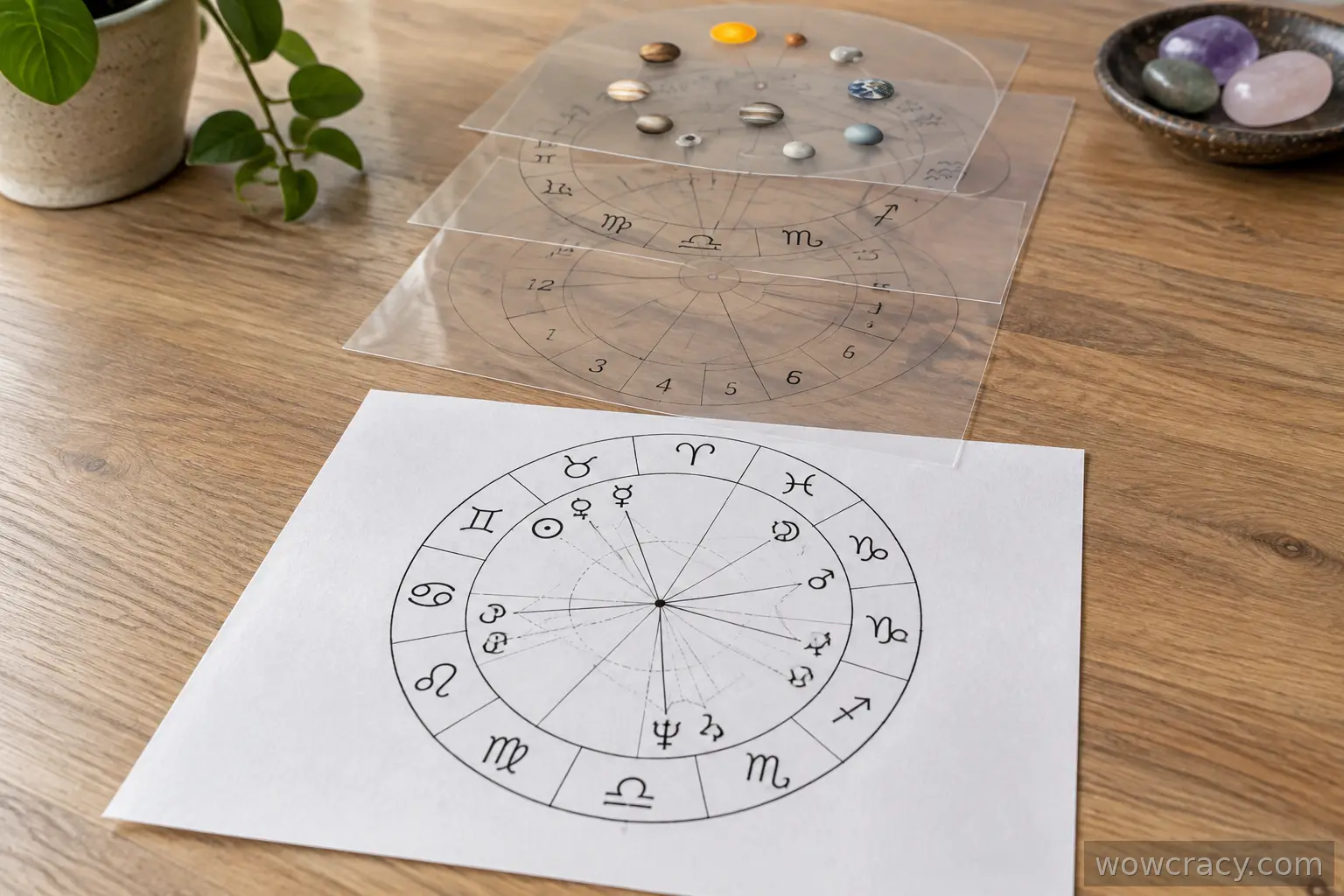
A planet, sign and house combine into an astrological interpretation. For example, an astrologer might associate Saturn in Virgo in the sixth house with order and daily duties. This does not establish personality traits or provide information about health.
Signs and houses remain parts of the coordinate scheme even when they contain no planets: an empty house does not mean that an area of life is absent. Introductory guides often cover ten bodies from the Sun to Pluto. “Planets” is a conventional label here: the Sun is a star, the Moon is Earth’s natural satellite, and Pluto is a dwarf planet.
In What Order to Examine the Chart
Chaotic reading of a chart often leads to confusion. We suggest the following algorithm for beginners:
- Sun, Moon and a known ascendant: traditionally called the big three and associated with self-expression, emotions and outward presentation.
- Elements and modalities: count signs using a stated rule rather than treating the total as a temperament assessment.
- Houses: examine positions only with a known time and stated system. Their themes are symbolic.
- Aspects: find ecliptic-longitude differences near 0°, 60°, 90°, 120° and 180°. An orb is a chosen tolerance, not a measure of psychological influence.
- Patterns: a grand trine and T-square are aspect configurations; a stellium is a cluster of bodies whose definition varies between schools.
Do not try to cover everything at once. Start with the Sun, Moon and ascendant, and then gradually add other planets. It is better to deeply understand one combination than to understand all of them superficially.
Planets in Astrology: What They Mean
The table lists traditional symbols and their associated astrological themes, not established effects of celestial bodies on people:
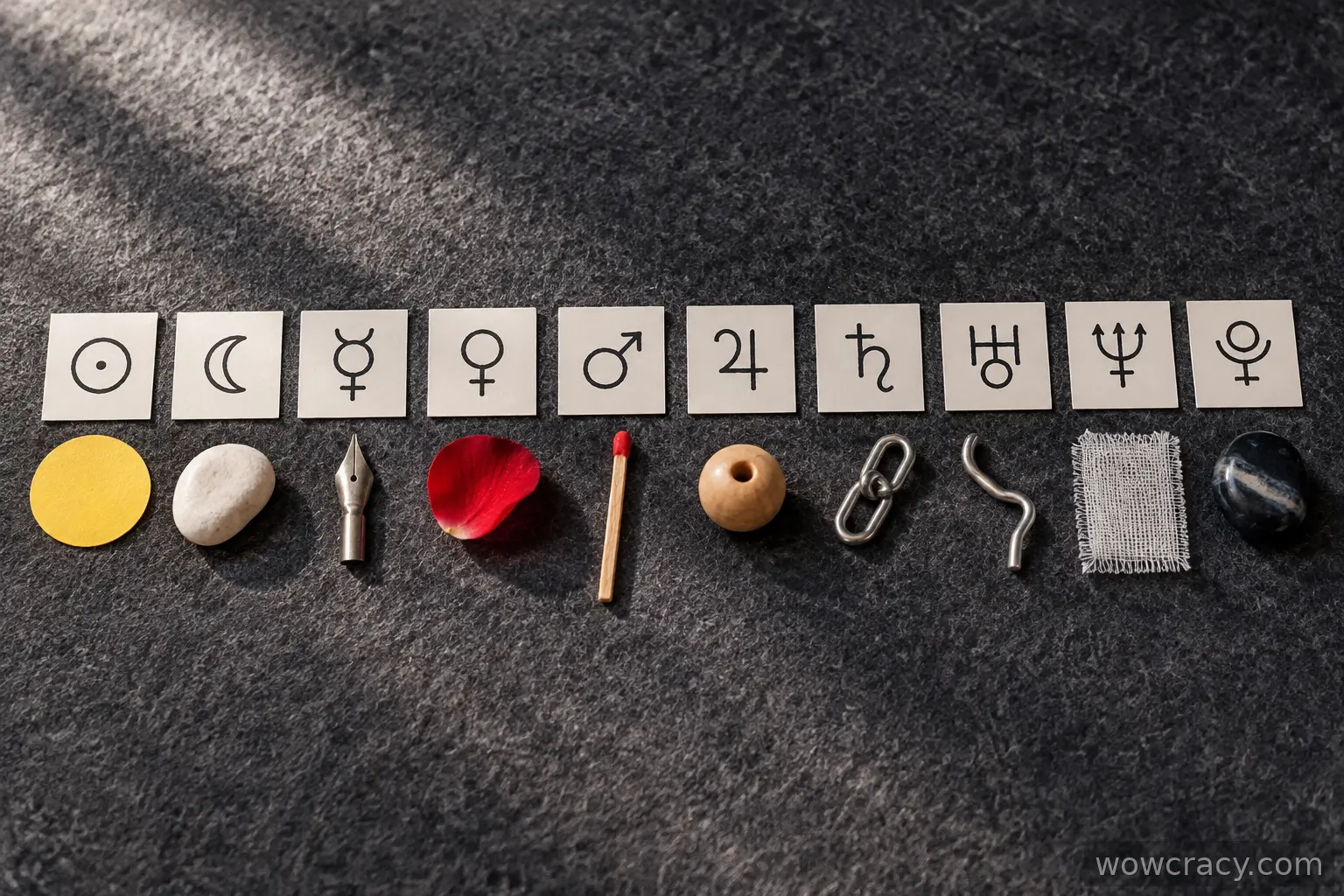
| Planet | Symbol | Key Themes |
|---|---|---|
| Sun | ☉ | Ego, life force, creativity |
| Moon | ☽ | Emotions, intuition, need for security |
| Mercury | ☿ | Thinking, language, learning |
| Venus | ♀ | Love, values, aesthetics |
| Mars | ♂ | Will, energy, conflicts |
| Jupiter | ♃ | Expansion, faith, optimism |
| Saturn | ♄ | Limitations, discipline, lessons |
| Uranus | ♅ | Freedom, sudden changes, innovations |
| Neptune | ♆ | Illusions, spirituality, dissolution |
| Pluto | ♇ | Transformation, power, depth |
Distinguish additional chart labels. Chiron is a small body classified as a centaur, with cometary activity. Lilith often means Black Moon Lilith, a calculated point associated with the lunar orbit’s apogee, rather than asteroid 1181 Lilith. The North Node is an intersection of the Moon’s orbit with the ecliptic. Check which definitions the calculator uses.
Avoid treating planets as inherently good or bad in astrological readings. Saturn, for example, is associated with both restriction and discipline. These are different symbolic readings, not evidence that a planet causes hardship or ensures success.
Zodiac Signs: Style and Quality of Energy
The zodiac divides the ecliptic into twelve 30° signs; these differ from the unequal astronomical constellations. Astrology groups signs into four elements (fire, earth, air, water) and three modalities (cardinal, fixed, mutable). Behavioural styles are attributed to these groups, but they are not a psychological classification with demonstrated accuracy.
Do not reduce a person to a sign. An astrologer might read a Leo Sun and Pisces Moon as themes of self-expression and sensitivity, or a Virgo Sun and Sagittarius ascendant as order and exploration. Even a complex combination of symbols does not establish someone’s actual traits; consider their words and actions.
Astrological Houses: Spheres of Life
Houses are twelve sectors assigned areas of life in astrological tradition. In Placidus, the first house begins at the ascendant; in Whole Sign, it begins at the start of the sign containing the ascendant. Standard chart drawings number them counterclockwise. The following are traditional themes, not predictions:
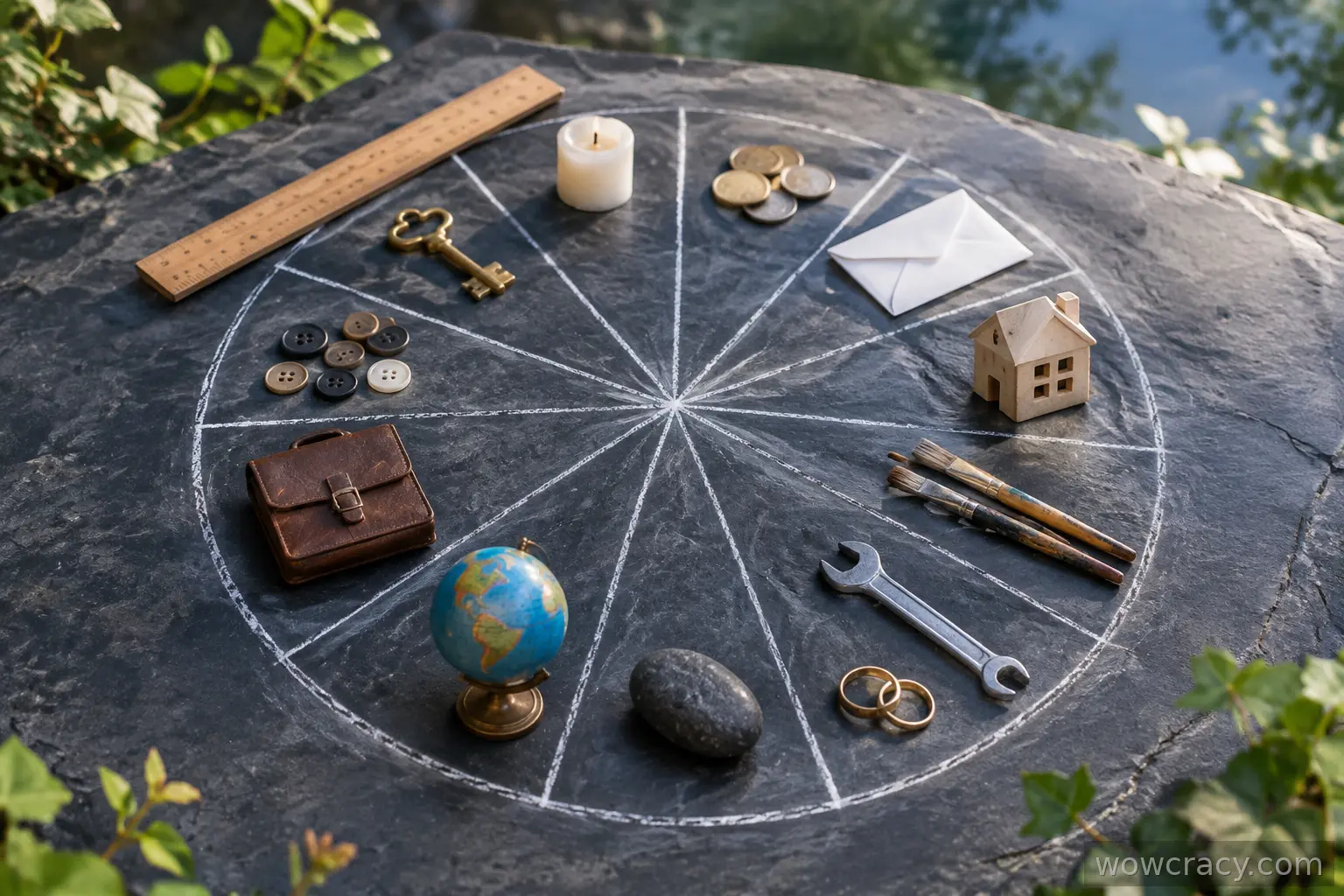
- 1st house — self-presentation, body, first impression.
- 2nd — finances, material values, self-respect.
- 3rd — communication, learning, brothers and sisters.
- 4th — home, family, roots.
- 5th — creativity, romance, children.
- 6th — work, health, everyday affairs.
- 7th — partnership, marriage, business unions.
- 8th — transformation, shared resources, crises.
- 9th — worldview, travel, higher education.
- 10th — career, public status.
- 11th — friends, communities, dreams.
- 12th — the subconscious, solitude, spirituality.
In a traditional reading, Venus in the tenth house may be associated with aesthetics or relationships in professional life. It does not establish that someone appeals to employers or should work in the arts. Career choices require attention to interests, skills and actual opportunities.
Astrologers also connect houses through their rulers: planets assigned to the signs at house beginnings in a chosen school. The tenth-house ruler in the fourth, for example, may suggest a symbolic theme of career and home. It is not evidence of a future family business.
Why a Single Placement Does Not Describe a Person Completely
“My Mars is in Aries, so I am aggressive” is an unsupported conclusion. Adding a Saturn aspect or a house position makes an astrological reading more complex, but does not make it a validated assessment of behaviour. Avoid using charts to label yourself or others.
Natal charts have no scientifically established ability to describe personality or predict a person’s future. In Shawn Carlson’s double-blind study, for example, astrologers did not match charts to psychological profiles better than chance. Symbols may be used as a cultural or personal reflection exercise, but a feeling of recognition does not establish the method’s accuracy.
In addition, there are many astrological schools with different approaches. What one astrologer considers a crisis, another interprets as an opportunity. Therefore, for a beginner it is important not so much to learn dogmas as to learn to see interconnections and ask questions.
Practical Tips and Common Mistakes
Here are a few recommendations that will help avoid disappointments:
- Do not try to interpret the chart in a state of severe stress or bias.
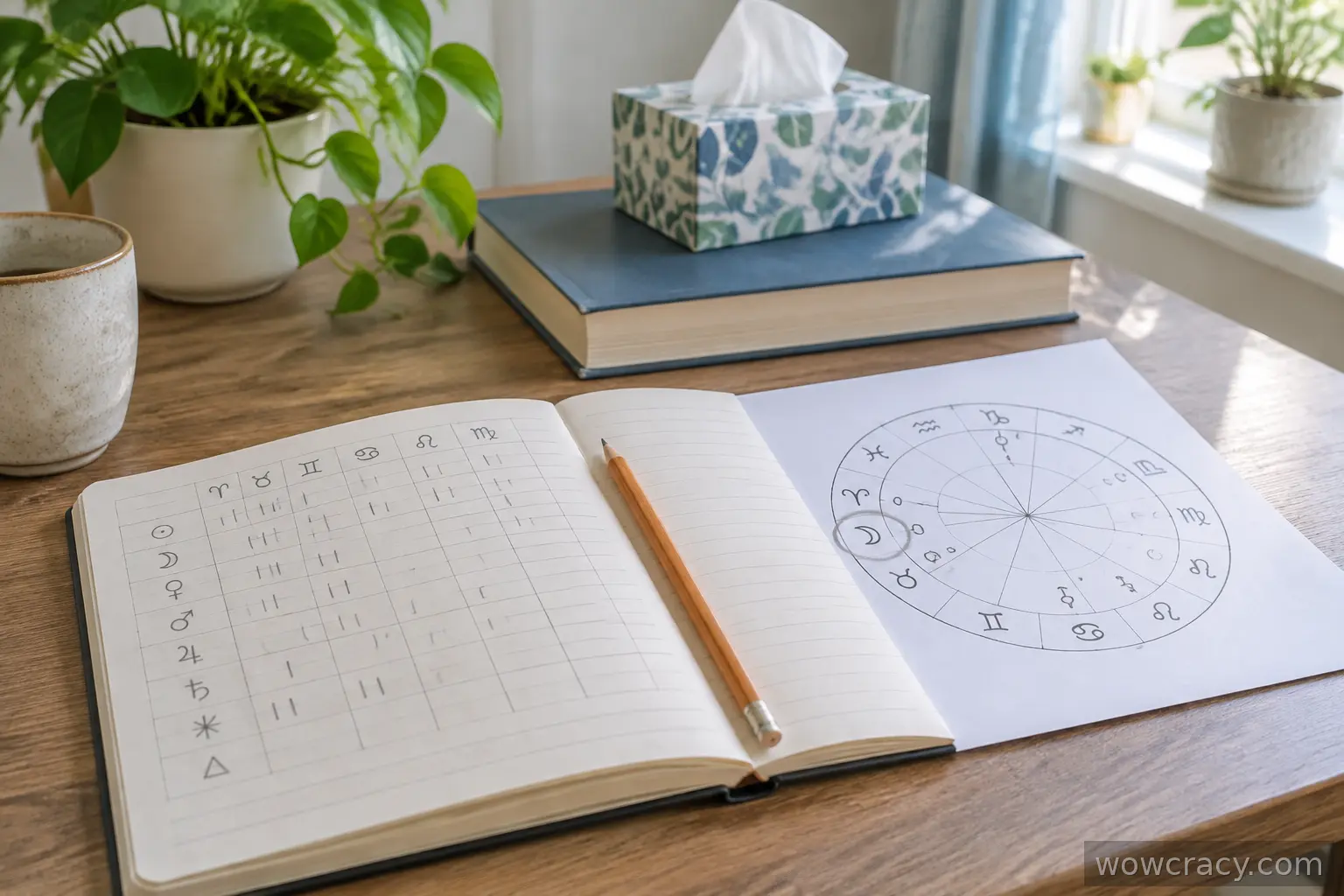
- In a journal, record contradictions as well as matches; a feeling of recognition does not test astrology’s accuracy.
- Do not compare your chart with the charts of other people, especially if you do not know their life context.
- Avoid fatalism: astrology does not predict the future but offers symbols for reflection.
- Do not ignore professional help in difficult life situations — an astrologer does not replace a psychologist or a doctor.
Another mistake is mastering the outer planets and asteroids too quickly. First master the basic ten planets, twelve signs and twelve houses. Only then add Chiron, Lilith, the North Node, and so on.
Frequently Asked Questions
Can a natal chart be read without an exact time of birth?
You can examine coordinates, signs and aspects only to the extent they have been checked across the entire possible birth interval. Leave the ascendant and time-dependent houses unknown. Even an accurate astronomical calculation does not validate psychological interpretations.
Which house system is better for a beginner?
Start with the system explained by your chosen guide. The Swiss Ephemeris documentation describes Placidus, Koch, Whole Sign and other systems. Record the settings: house boundaries may differ, and no system has a scientifically established advantage for assessing personality.
Can astrological forecasts be trusted?
Astrological forecasts have no scientific confirmation. They can serve as a tool for self-knowledge or entertainment, but you should not make important life decisions based on them. Always compare symbolic interpretations with real circumstances and common sense.
What to Do Next
For practice, write a short description of the symbols: Sun, Moon and a known ascendant, elements, houses when the time is known, and a few aspects. Separate calculated coordinates from interpretations. If keeping a journal, record contradictions as well as apparent matches: selective memory and broad descriptions can easily create an impression of accuracy.
If you feel that astrology causes anxiety or pushes you toward risky decisions, take a pause. Remember: a birth chart is only one way to look at yourself, and you always retain freedom of choice.