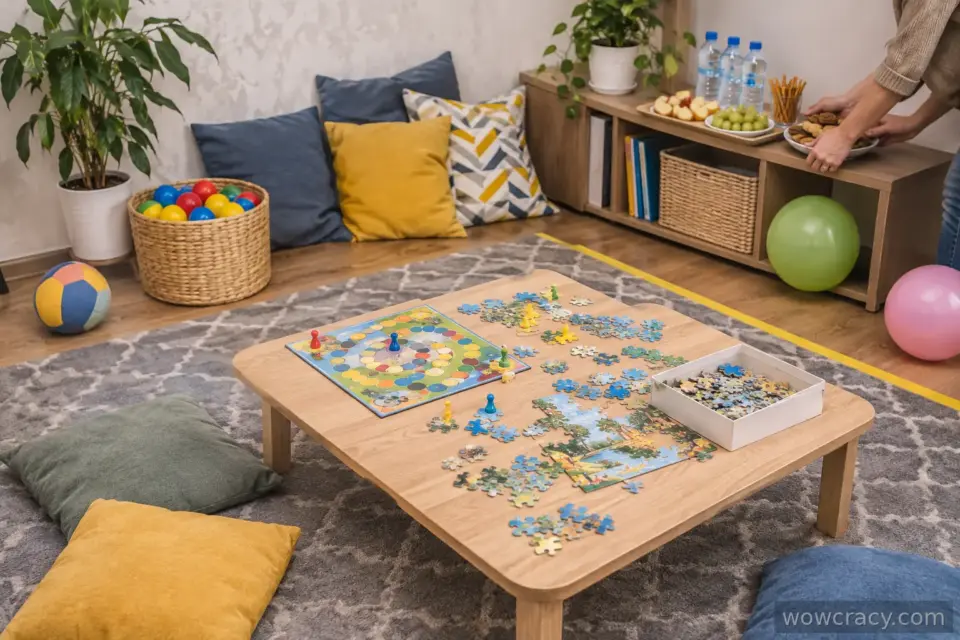
A birthday party at home does not need a packed schedule. Combine a few games, social time, food and chances to rest, allowing children to opt out. Having an entertainer does not determine the party’s quality; suitable pacing, supervision and a flexible plan matter.
- How long should the party last and how many games are needed
- How to take guests’ ages and the apartment space into account
- How to alternate active and quiet activities
- What to prepare for safety and rest
- How to shorten the program if the children get tired
- Example of a flexible party plan for children aged 6–8 (2 hours)
- Frequently asked questions
- Is it necessary to have an adult host?
- What if a child is shy about taking part?
- How many sweets are acceptable?
- Can cartoons be used as a break?
- A quick checklist before the party
How long should the party last and how many games are needed
Choose the length around age, naps, individual needs and guests’ preferences. For preschoolers, consider starting with about an hour to 90 minutes; for school-age children, a two-hour plan can be shortened as needed. These are planning options, not a required endurance target. Tell parents the start and finish times and agree the format with teenagers.
Prepare a few main games and one or two backups rather than a mandatory list. A 5–15-minute activity can run longer or end sooner depending on interest. Allow time for water, food and rest; breaks alone cannot guarantee that nobody gets tired.
Do not try to fill every minute. If the children are absorbed in a game and do not want to stop, let them finish. If a game doesn’t “catch on” within two minutes, calmly move on to the next one. Flexibility is the main advantage of a party without an entertainer.
How to take guests’ ages and the apartment space into account
For different ages and abilities, offer simple shared activities and alternatives: drawing, passing a large soft toy around a circle, or a board game with suitable age guidance. If groups split up, arrange supervision for each; one adult cannot watch children in different rooms at the same time.
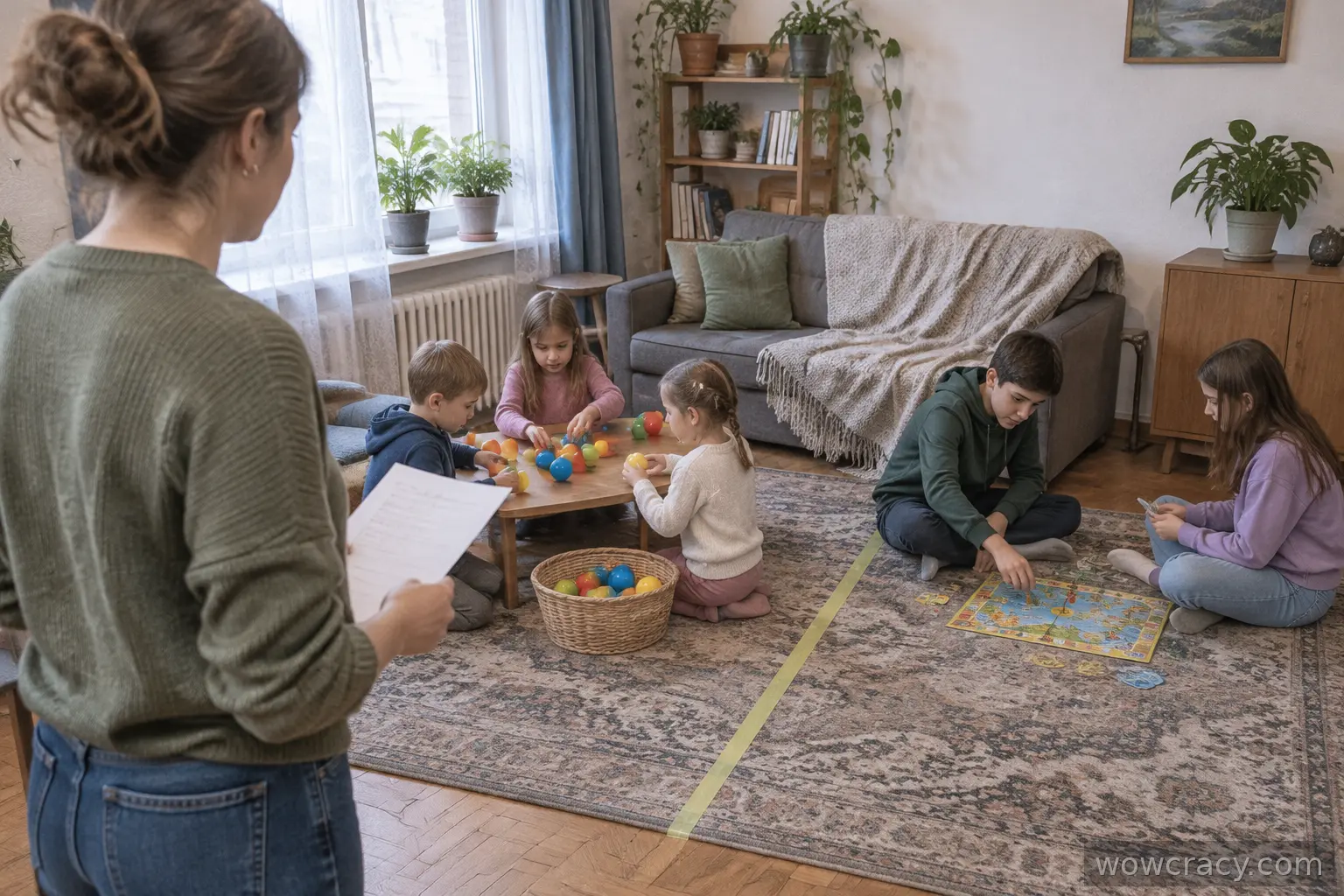
In a small room, choose activities without running: drawing, riddles, charades or table games. Active games need clear space and supervision. Remove fragile objects, trailing cables and trip hazards; mats should not slip. Marking a boundary does not replace restricting access to unsafe areas.
Set up a quiet chair or cushion area where a child can take a break from noise while remaining in an adult’s sight. It is not a punishment or isolation. Explain that resting does not depend on agreeing to join the next game.
How to alternate active and quiet activities
The principle is simple: after an active game, have a quiet one; after a quiet one, take a break or have a snack. This is not a strict rule, but a guideline. For example: the active game “The Sea Is Stirring” (10 min), then drawing a shared birthday card for the birthday child (10 min), followed by a snack (15 min), then a ball relay race (10 min), followed by a board game or puzzles (10 min).
Alternating activities lets you vary the pace, but children respond differently. Some need quiet after dancing; others want more movement. Observe the guests and offer choices rather than attributing every disagreement or refusal to an overstimulated nervous system.
Here are a few examples of activities for each type:
- Active: freeze dancing or passing a large soft toy around a circle, without elimination or speed pressure.
- Quiet: shared drawing, riddles, taking turns telling a story or charades; use puzzles and games with age-appropriate pieces.
- Transitions: quiet music, looking at a book or an unstructured break without a compulsory exercise.
Not all children enjoy active games. Some are shy or tire quickly. Offer an alternative: being a “judge,” the “host’s assistant,” or simply an observer. The main thing is not to force them. A child who declines a game should not feel guilty.
What to prepare for safety and rest
Secure unstable furniture and keep hot drinks, glass, medicines and cleaning products out of reach. Check floors, windows, balconies and any outdoor area. Choose props for the youngest guests: small balls, loose parts and uninflated or broken balloons pose choking risks. Prefer large soft items without small detachable parts.
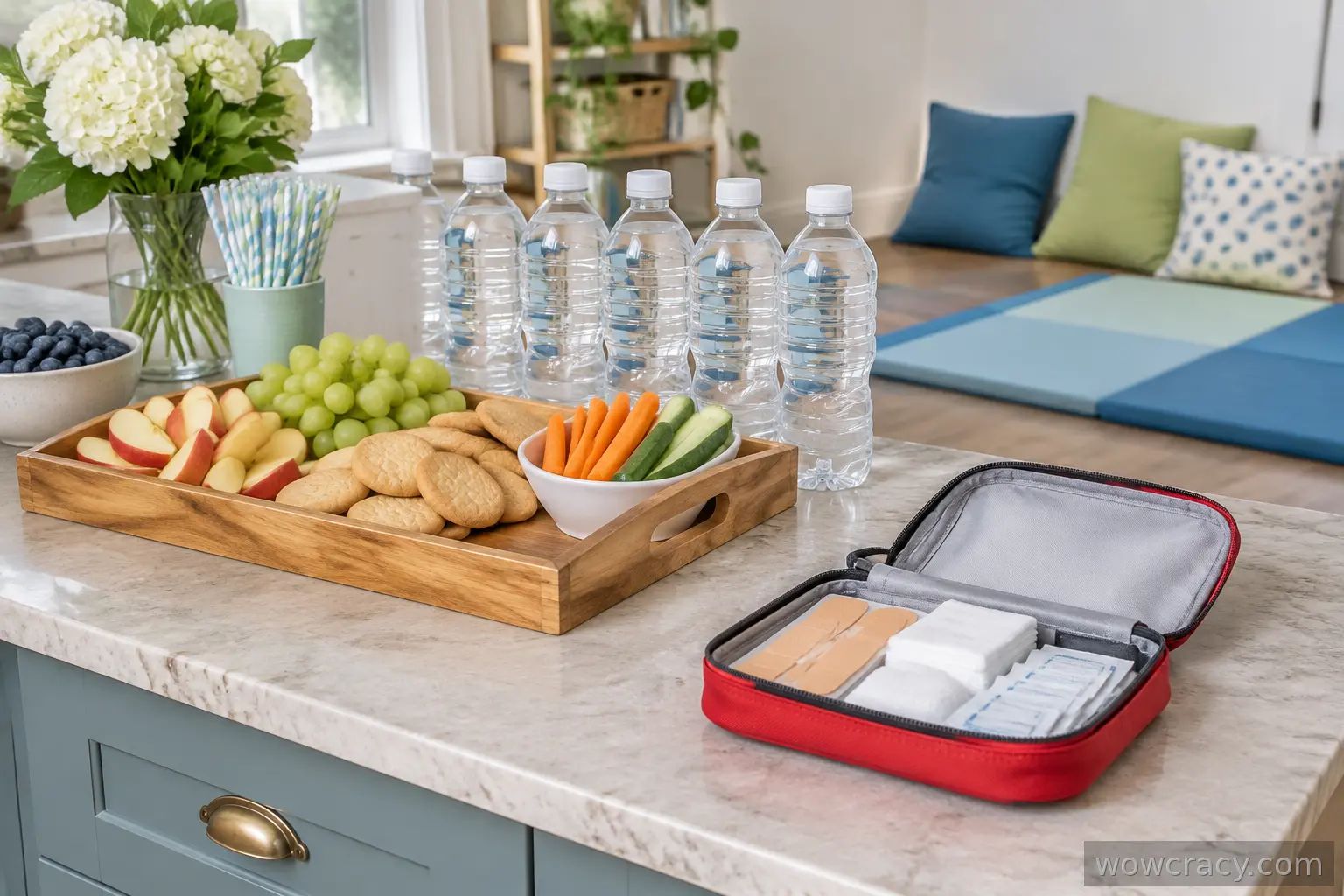
An adult should know where the closed, child-inaccessible first-aid kit is and how to obtain emergency help. Check its contents and expiry dates beforehand. Agree any guest’s personal medication and instructions with their parents; do not give children medicine “just in case.”
For rest, prepare:
- drinking water in individual cups or bottles;
- food prepared to a suitable shape and texture: whole grapes, hard raw carrots, nuts and small hard sweets are hazards for younger children;
- napkins and a waste area out of toddlers’ reach;
- spare clothing as agreed with parents;
- a quiet, supervised rest area.
Ask parents in advance about dietary restrictions and any individual allergy action plan. Keep ingredient packaging and avoid food cross-contact. For a known severe allergy, agree access to prescribed medication and written instructions with the responsible adult; a general first-aid kit is not a substitute.
How to shorten the program if the children get tired
Arguing, tears, opting out or seeking a familiar adult can signal fatigue, but also hunger, noise, discomfort or another need. Pause, ask the child calmly and offer help. There is no need to finish the schedule at all costs.
What you can do:
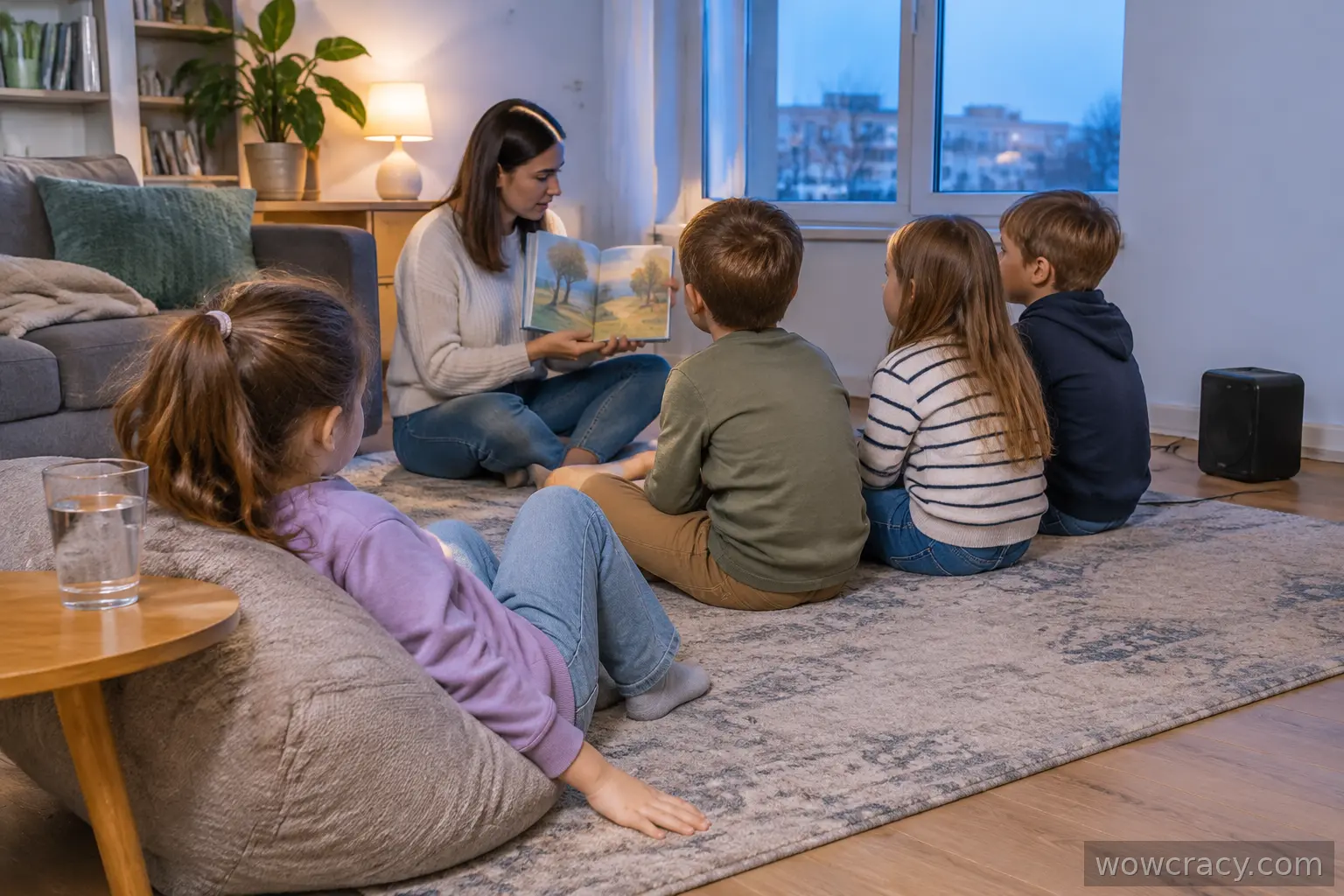
- Reduce noise and offer water and rest without making everyone sit together.
- Offer reading or another welcome quiet activity.
- Do not keep an exhausted child waiting for cake or presents; arrange a calm ending.
- Contact parents if needed and agree an earlier pickup.
The main thing is not to see shortening the program as a failure. On the contrary, it is a sign of attentiveness to the children. Fewer games with positive emotions are better than a full script and tears at the end.
Example of a flexible party plan for children aged 6–8 (2 hours)
Here is a rough plan that you can adapt to your situation. It does not require an entertainer and leaves room for improvisation.
| Time | Stage | Activities |
|---|---|---|
| 0:00–0:15 | Greeting guests | Free socializing, children get used to the space, and the adult suggests a simple get-to-know-you game (“Say your name and your favorite animal”). |
| 0:15–0:35 | Active block | The active game “The Sea Is Stirring” (10 min), a short water break (5 min), and passing a large soft ball (5 min). |
| 0:35–0:50 | Quiet block | Drawing a shared birthday card for the birthday child, with everyone adding something of their own. |
| 0:50–1:10 | Snack | Children eat at the table while the adult makes sure no one rushes. |
| 1:10–1:30 | Active block | Dancing to music with pauses (“Freeze”), then collecting large soft toys together without a race. |
| 1:30–1:50 | Quiet block | A board game or puzzles; anyone who is tired can lie down in the rest corner. |
| 1:50–2:00 | Finale | Bringing out the cake, congratulations, and giving gifts. Adults hand children over to the people agreed with their parents. |
This plan is easy to shorten: if the children are tired after the snack, you can skip the active block and go straight to the quiet one or the finale. If, on the contrary, the children are full of energy, add another game from the list.
Frequently asked questions
Is it necessary to have an adult host?
Continuous adult supervision matters, not just leading games. Agree who watches the children while another adult prepares food or greets arrivals. Support depends on ages, needs, numbers and separate areas; reduce the group or activities if supervision is insufficient.
What if a child is shy about taking part?
Do not insist. Offer observation, helping or another quiet activity near an adult. The child may join later, but there is no set time limit and participation is optional.
How many sweets are acceptable?
Offer modest dessert portions alongside ordinary food and water, accounting for age and dietary needs. Do not explain behaviour by sugar alone: AAP guidance does not support the popular claim that sugar causes hyperactivity. Excitement, noise and fatigue can also affect how a child feels.
Can cartoons be used as a break?
A short cartoon (10–15 minutes) can serve as a quiet block, but it should not be the main activity. The children came to socialize, not to watch a screen.
A quick checklist before the party
- Agree timing and parent contacts, accounting for guests’ needs.
- Assign supervision and safe handover to adults.
- Check the space, props and access to unsafe areas.
- Prepare main and backup activities without requiring every game.
- Agree food, allergies and any necessary individual instructions.
- Keep first-aid supplies accessible to adults and inaccessible to children.
- Be ready to pause or finish early.
The main thing is to observe the children and respond to how they are feeling. Flexibility and attentiveness are worth more than the best script.