Pancakes fall, turn out flat or raw inside most often not because of one “secret” ingredient, but because of a combination of small deviations: runny batter, excess baking soda, an insufficiently heated frying pan. Instead of trying a new recipe every time, it is worth learning to read the signals that the batter and the finished product give. Below is a practical diagnosis that will help you understand what exactly went wrong and fix it already during the next mixing.
- What the consistency of the batter tells you
- How the leavening agent and acidity affect it
- Why pancakes are golden outside and raw inside
- Frying temperature: how to check without a thermometer
- Pancake batter mistakes: what else causes them to sink
- What can be fixed during frying
- How to check the batter before frying: a short algorithm
- Frequently asked questions
- Why do pancakes fall when I add more soda?
- Can I use only soda without a fermented milk product?
- Why do pancakes come out fluffy in the pan but fall on the plate?
- What frying temperature is considered optimal?
- Practical summary
What the consistency of the batter tells you
The first and most reliable indicator is how the batter holds its shape. If it runs off the spoon too quickly, forming a thin stream, the pancakes will spread in the pan and come out thin. After frying, they quickly fall because the structure lacks enough flour to hold the gas bubbles.
Batter that is too thick also does not guarantee fluffiness: it cooks poorly inside, and the outside may burn while the center remains raw. The ideal consistency resembles thick sour cream: the spoon leaves a trace on the surface that slowly levels out rather than spreading instantly.
Water absorption depends on flour type, milling and composition. Bread flour, wholemeal flour and durum flour are not equivalent substitutions. Use guidance for the flour in your recipe and adjust liquid gradually after a substitution.
Bubbles may show gas release, but a smooth surface does not prove that baking powder has failed. Part of a double-acting powder’s reaction occurs during heating. Check its date, storage and the result of a test pancake.
How the leavening agent and acidity affect it
Baking soda and baking powder cannot be swapped in equal amounts. Soda reacts with acidic ingredients such as kefir or yogurt to produce gas. An unsuitable balance can leave an alkaline taste; match the acid and dose to the recipe.
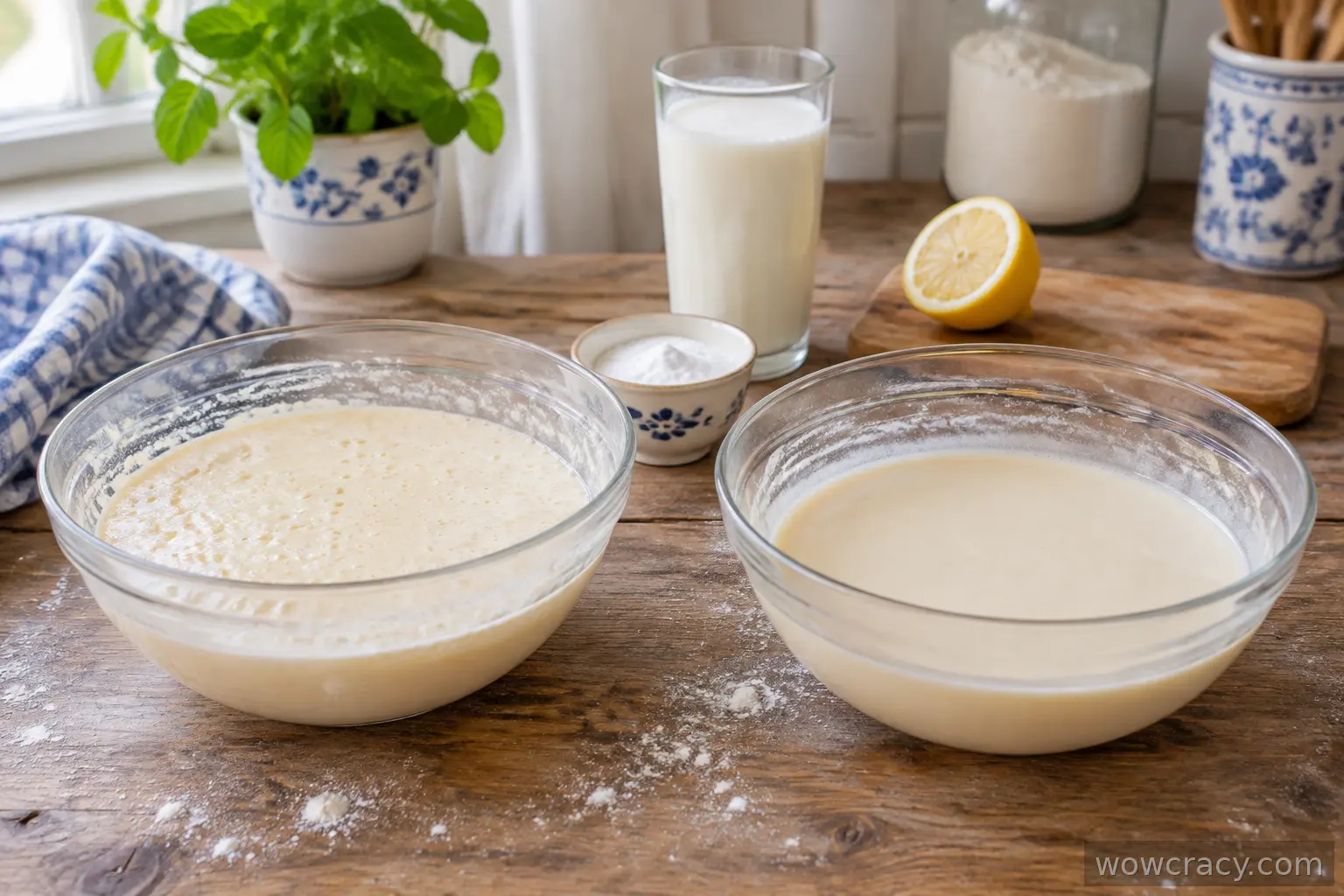
Baking powder already contains alkaline and acidic components. Common double-acting powders release gas when moistened and again when heated. A short batter rest may be part of the recipe; a long delay does not suit every mixture.
Do not try to correct an unknown balance with a few drops of lemon; the required amount depends on the whole mixture. For the next batch, use a recipe designed for your liquid and leavener. Do not taste raw flour-and-egg batter to check flavour.
Measure a level spoonful as the recipe specifies and check the powder’s packaging. There is no universal interchangeable dose of soda and powder for 200–250 g flour. Excess can cause off-flavours, over-expansion and a weak structure.
Why pancakes are golden outside and raw inside
This is a classic problem that indicates an imbalance between the pan temperature and the thickness of the batter. If the pan is too hot, the crust sets instantly, and the heat does not have time to reach the center. As a result, the pancake looks done but remains runny inside.
An oversized portion may brown before its centre cooks. Try a smaller or slightly thinner test pancake and compare. Thickness depends on the recipe; a 1–1.5 cm layer of raw batter is not a required standard.
For this pan-frying method, lightly oil the base and use moderate heat without smoke. Oil needs also depend on the pan; a suitable surface may need very little fat. More oil is not an automatic fix for an uncooked centre.
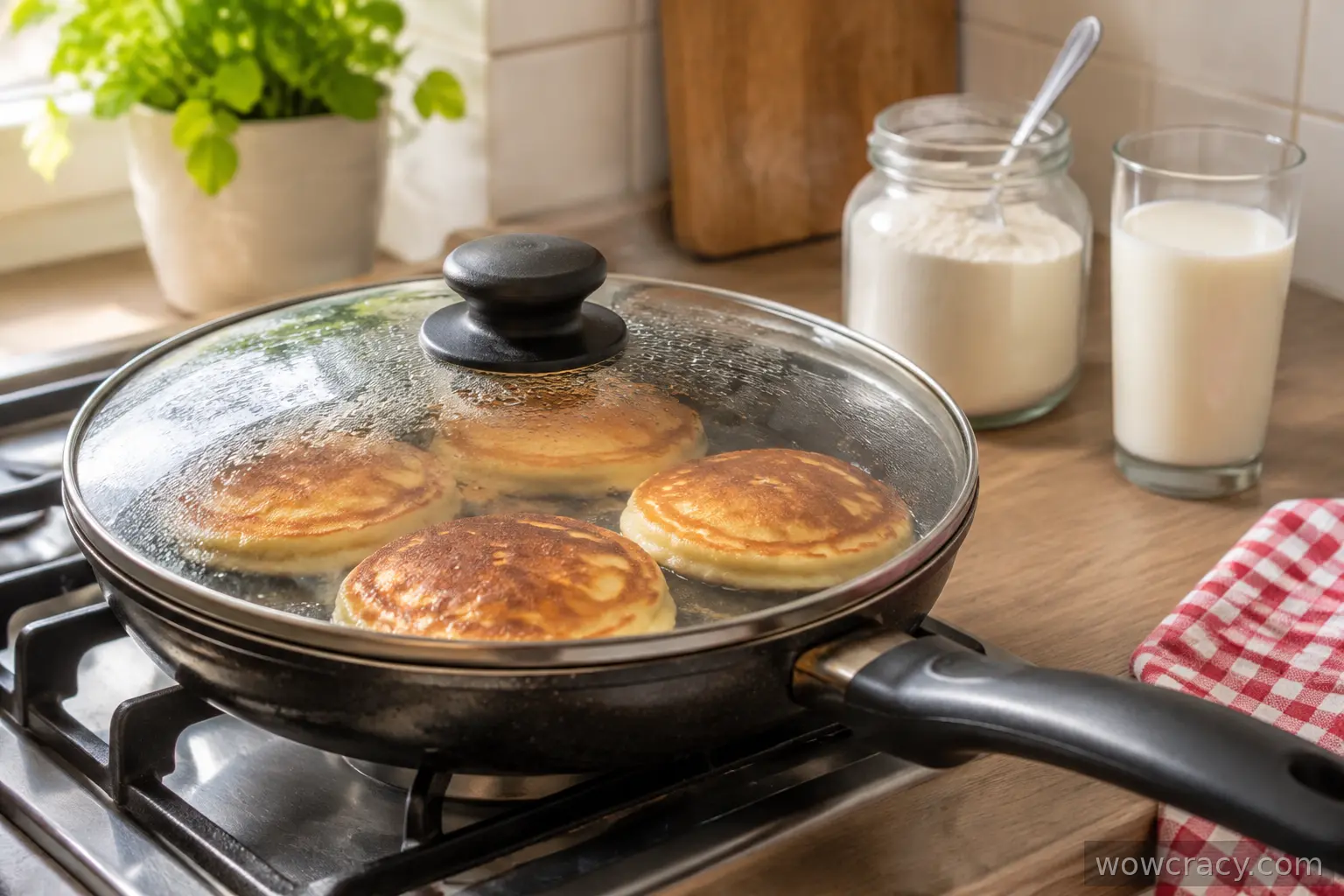
If the surface darkens too quickly, reduce heat and portion size. A lid may help a thicker pancake cook through, but does not replace sufficient time. Flip when the underside is golden, edges have set and the top begins to lose its wet sheen.
Frying temperature: how to check without a thermometer
Start over medium heat with a small test pancake. Timing depends on the cooker, pan, batter and size. A surface temperature or two to three minutes per side cannot guarantee that every pancake’s centre is cooked.
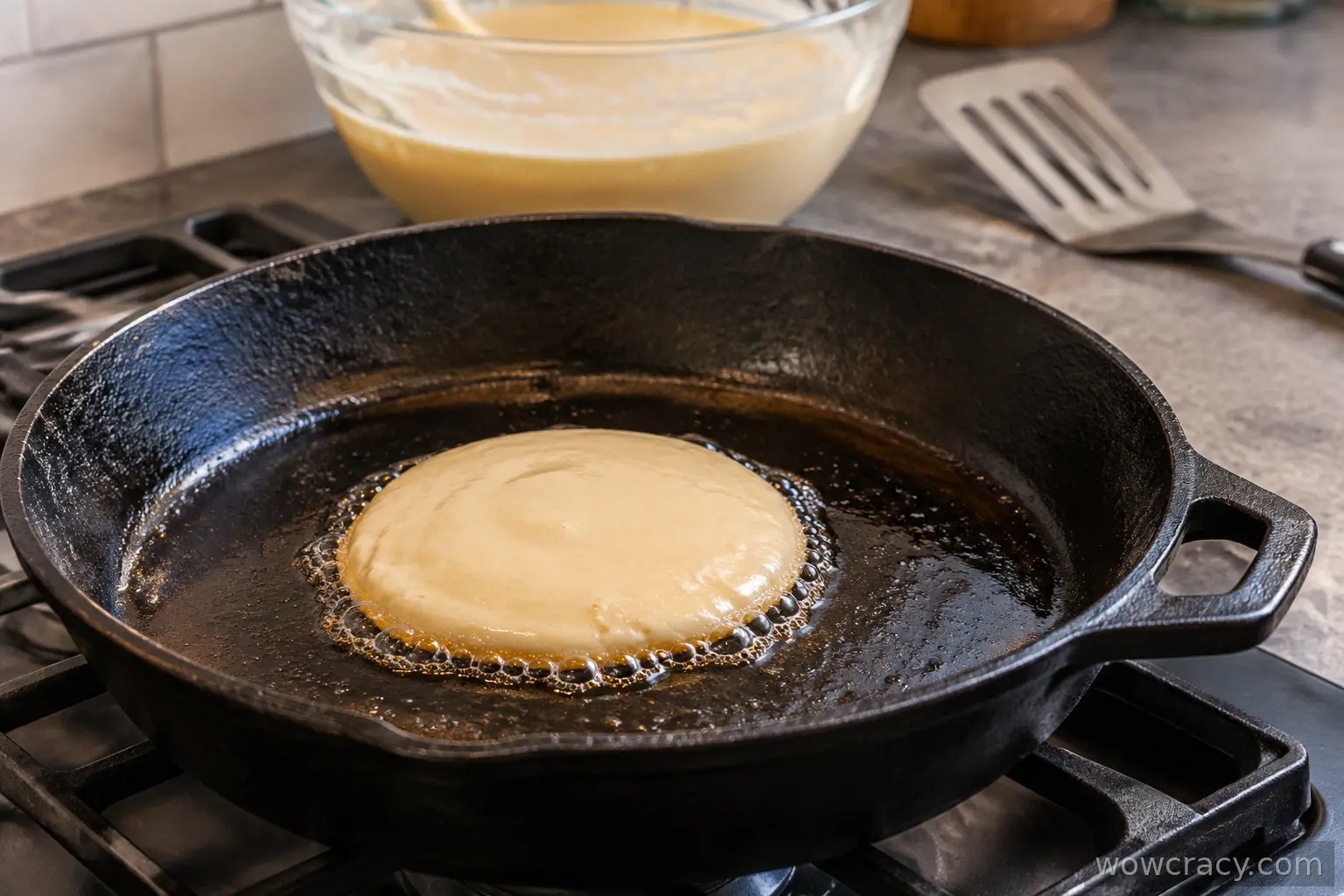
Without a kitchen thermometer, you can use a simple test: drop a drop of batter onto the heated pan. If it sets quickly and bubbles appear around it, the temperature is sufficient. If the batter sits motionless and does not form bubbles, the pan is still cold. If the drop instantly burns and smokes, you have overheated it.
Do not drop water into hot oil; it can splatter. Test with a little batter and adjust the heat gradually. Avoid overheating an empty non-stick pan and follow its instructions.
If oil smokes, stop heating and let the pan cool safely. Do not wipe out hot oil or pour it into a sink. Replace it once cool if needed and restart at lower heat.
Pancake batter mistakes: what else causes them to sink
In addition to consistency and the leavening agent, there are several less obvious mistakes that lead to pancakes not being fluffy.
- Overmixing. Excess mixing after adding flour develops gluten and can toughen pancakes. Mix until dry patches disappear; small lumps are often fine.
- Egg method. Follow the recipe: some call for simple mixing, others separately whipped whites. Whisking is not a universal cause of collapse.
- Excess sugar. It makes the batter runnier and contributes to rapid burning of the crust, because of which the center does not cook through.
- Resting. Follow the recipe’s timing: a short pause hydrates flour, but soda and different baking powders behave differently.
- Unsifted flour. Lumps will not break up evenly, and the texture will be uneven.
Another common mistake is adding soda “by eye.” Excess soda makes the batter darker and denser, and the finished pancakes may have an unpleasant aftertaste. It is better to measure with a level spoon.
What can be fixed during frying
After an unsuccessful test pancake, change one variable: heat, size or consistency. Adjust the remaining batter in the bowl, not by adding dry flour or liquid to the pan. Do not try to rescue batter that has been stored unsafely.
Add small amounts of flour to overly thin batter, or the recipe’s liquid to overly thick batter. The amount depends on batch size. Mix only until combined, rest if directed and cook another test pancake.
Do not serve a browned pancake with a runny centre. Lower the heat and finish cooking, using a lid if needed; make the next ones smaller. Cut the test pancake open and check for wet raw batter inside without tasting an undercooked centre.
Starch is not a universal fix: replacing flour with it changes structure and needs recipe guidance. For troubleshooting, keep the ingredient types unchanged and adjust consistency in small increments.
It is important not to stir the batter after each batch; this destroys the bubbles. It is better to leave it in the bowl and scoop from the edge.
How to check the batter before frying: a short algorithm
- Look at the consistency: it should resemble thick sour cream and run off the spoon slowly.
- Check leavener type, dose and date; rest according to the recipe rather than bubbles alone.
- If you used soda, make sure there is an acidic component in the batter (kefir, yogurt, whey).
- Heat the pan over medium heat and drop in a little batter: it should set with bubbles.
- Try frying one pancake. If it turned out fluffy and cooked through, proceed with the rest.
This algorithm takes a few minutes but helps avoid the disappointment of a whole mountain of flat pancakes.
Frequently asked questions
Why do pancakes fall when I add more soda?
Extra soda can leave an alkaline taste and change browning. Excess gas does not guarantee a stable structure either. Do not automatically add soda to mixed batter; review its dose and acidic ingredients for the next batch.
Can I use only soda without a fermented milk product?
The acidic ingredient need not be dairy, but soda and acid must be balanced for the recipe. For water or ordinary milk, choose a suitable baking-powder recipe. Do not substitute the leaveners spoon for spoon.
Why do pancakes come out fluffy in the pan but fall on the plate?
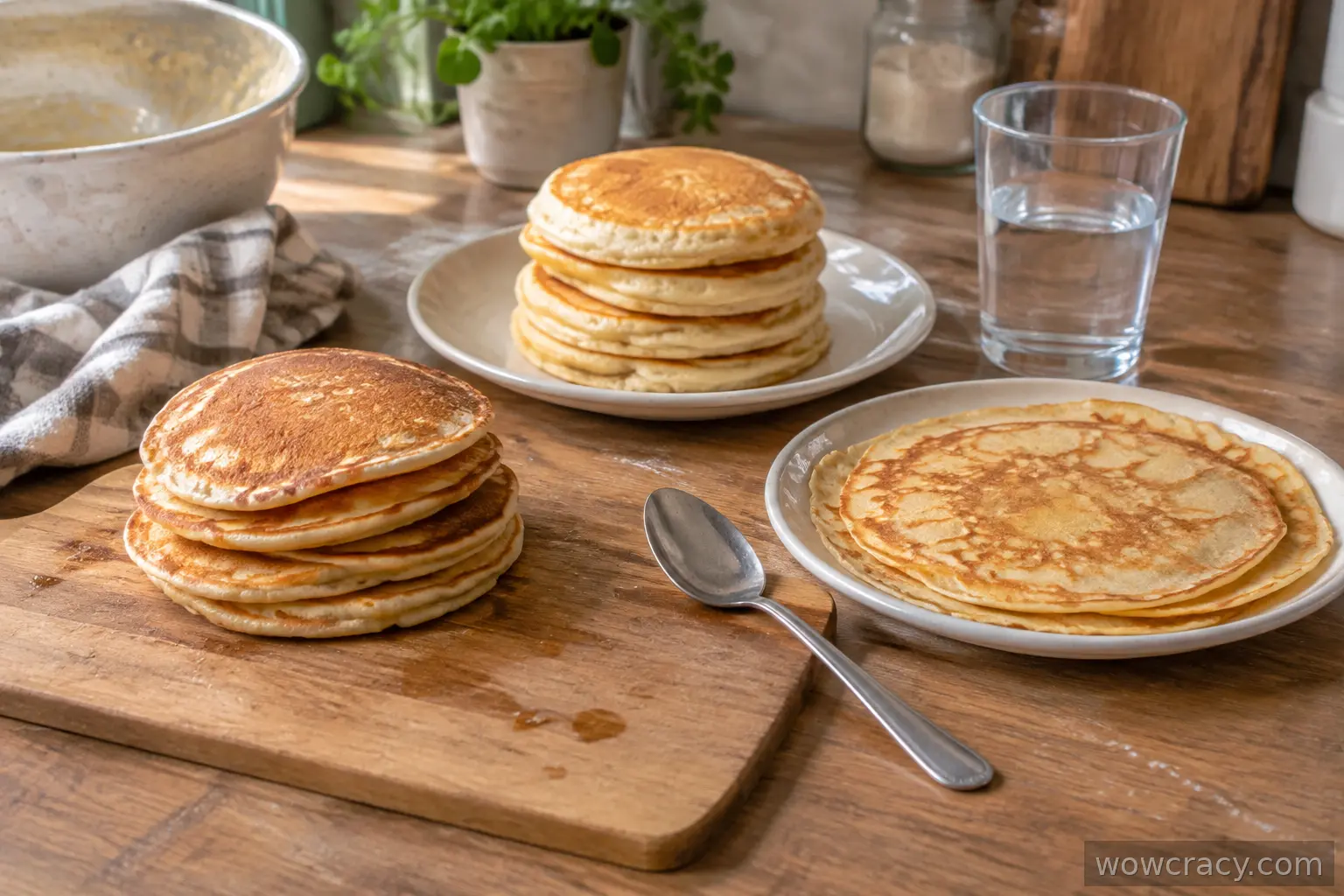
Pancakes may lose a little volume as they cool. For pronounced collapse, check the centre, consistency and leavener dose. Avoid tightly stacking very hot pancakes; steam softens the surface but does not explain every case of collapse.
What frying temperature is considered optimal?
There is no single optimum for every recipe. Start over medium heat, assess a test pancake and lower the heat if browning outruns cooking at the centre. A surface thermometer reading does not replace checking the pancake itself.
Practical summary
The fluffiness of pancakes is not magic but a balance between the thickness of the batter, the activity of the leavening agent and the temperature of the pan. Start by checking the consistency: it should resemble thick sour cream. Then make sure that the soda has acid for the reaction and that the batter is not overmixed. And finally, heat the pan to medium heat and fry a test pancake. If it turned out fluffy, you are on the right track. If not, use the adjustments given above. The main thing is not to be afraid to experiment with one batch to understand which factor exactly failed.