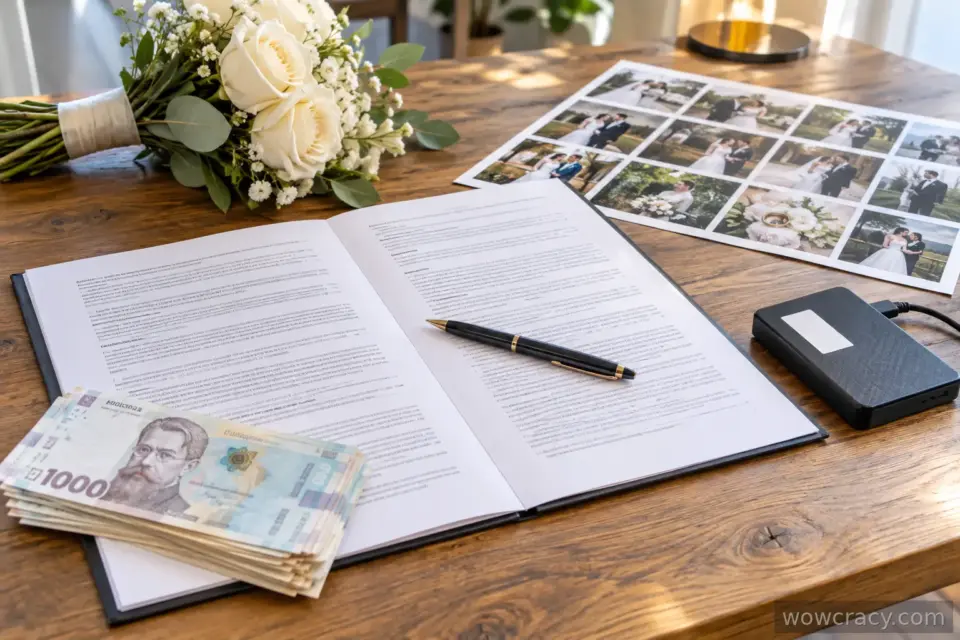
Before paying, agree the service, date booking and change-of-plan terms in writing. Payment alone does not automatically determine the contract’s form or refund rights. Read the document as an account of who will shoot, what you will receive and when, not just a payment record.
Below is not a template to be copied word for word, but a list of questions to which the document should give a clear answer. The wording may differ; what matters is the essence: who, what, when and under what conditions does it.
- First, find out with whom exactly you are concluding the contract
- Scope of work and duration of the shoot
- What should be recorded in writing
- Advance payment to the photographer: amount, purpose and refund conditions
- Postponing the date
- Deadlines for wedding photos and the method of delivery
- Format and medium
- Publication of photos and rights of use
- Backup storage of the archive
- What else should be agreed before the advance payment
- How to check the photographer before payment
- A practical checklist before signing
- Frequently asked questions
- Can the contract be signed remotely?
- Is it mandatory to pay the advance immediately?
- What should I do if the photographer missed the delivery deadline?
First, find out with whom exactly you are concluding the contract
Before reading the fine print, check the party to the contract. It may be an individual entrepreneur, a photographer as a private individual, or a studio that hires several specialists. This determines whom you will turn to in case of a problem.
If the person who met with you was one photographer, but the document names a studio, clarify who exactly will be at the shoot. Sometimes a studio reserves the right to replace the contractor due to illness or other circumstances. This is normal practice, but then the contract must describe how you will be informed about it and whether the replacement will be agreed with you.
Pay separate attention to the payment details. If the contract names one person, but you are asked to transfer the money to the card of a completely different person, that is a reason to ask questions. The payment must be linked to the party that signed the document.
Scope of work and duration of the shoot
One possible cause of misunderstandings is different ideas about how many hours the shoot lasts. For some it is “the whole day”, for others it is a specific interval from the bride’s preparations to the first dance. The contract must clearly state how many hours of work are included in the price and from what moment the count begins.

A practical example: the photographer writes “8 hours”. This may mean arriving at the preparations location at 10:00 and finishing at 18:00, when the party is just getting into full swing. Or the count may start from the first official ceremony. A difference of two or three shooting hours is a significant part of the day that may be left without photographs.
What should be recorded in writing
- the start and end time of the shoot or the rule by which it is determined;
- whether travel to the location and between locations is included in the price;
- how many photographers will work at the wedding;
- whether a separate price is provided for additional hours and what it is;
- approximately how many finished photographs you will receive.
Clarify whether “all photos” means an edited selection, a minimum number, an estimated range or original RAW files too. These are different deliverables, and RAW files are not necessarily included. Agree a realistic scope and what happens if it is not met; do not casually replace an existing promised minimum with a vague estimate.
Separately clarify whether processing is included in the price. Sometimes the photographer delivers all frames with basic processing, and some with detailed retouching. If portraits in a certain style are important to you, agree on how many such shots there will be.
Advance payment to the photographer: amount, purpose and refund conditions
Establish the purpose of the initial payment: part of the service price, a specific booking service or another agreed arrangement. Calling it an “advance” or “deposit” does not by itself make the entire amount non-refundable. Cancellation consequences depend on applicable law and valid contract terms, not only the photographer’s explanation.
The contract must state the amount of the advance payment, the date of payment, the method of payment and the deadline for the final settlement. Often the balance is paid the day before or on the wedding day — clarify this in advance so you do not have to look for cash in the middle of the celebration.
| Situation | What must be stipulated |
|---|---|
| You cancel the wedding several months in advance | Whether the advance payment is refunded in full, in part, or not at all |
| You postpone the date | Whether the booking is retained and whether there is an additional payment |
| The photographer cannot come | Who replaces them, how the funds are refunded, what the deadlines are |
| The wedding was scaled down | Whether the price is recalculated and on what principle |
For a contract governed by Ukrainian law, distinguish an advance from the security payment known as a zavdatok under Civil Code articles 570–571. Not every initial payment has that status. Other countries use different terms and refund rules; assess disputed wording under the particular contract and applicable local law.
Postponing the date
Before paying, establish whether postponement is possible, how often, the notice period and what happens if the new date is unavailable. Agree any surcharge, retention of payment or refund rather than assuming a free date change is guaranteed.
For circumstances outside the parties’ control, check notice, evidence, rescheduling and payment provisions. Do not treat force majeure as automatic cancellation or a full refund in every case. Applicable law, the event’s actual effect and the contract terms matter.
Deadlines for wedding photos and the method of delivery
After the wedding begins the longest wait. So that it does not turn into endless questions of “well, when?”, the contract must state the deadline for delivering the finished materials. It is best when this is a specific number of weeks from the wedding date, and not a vague “within a reasonable time”.
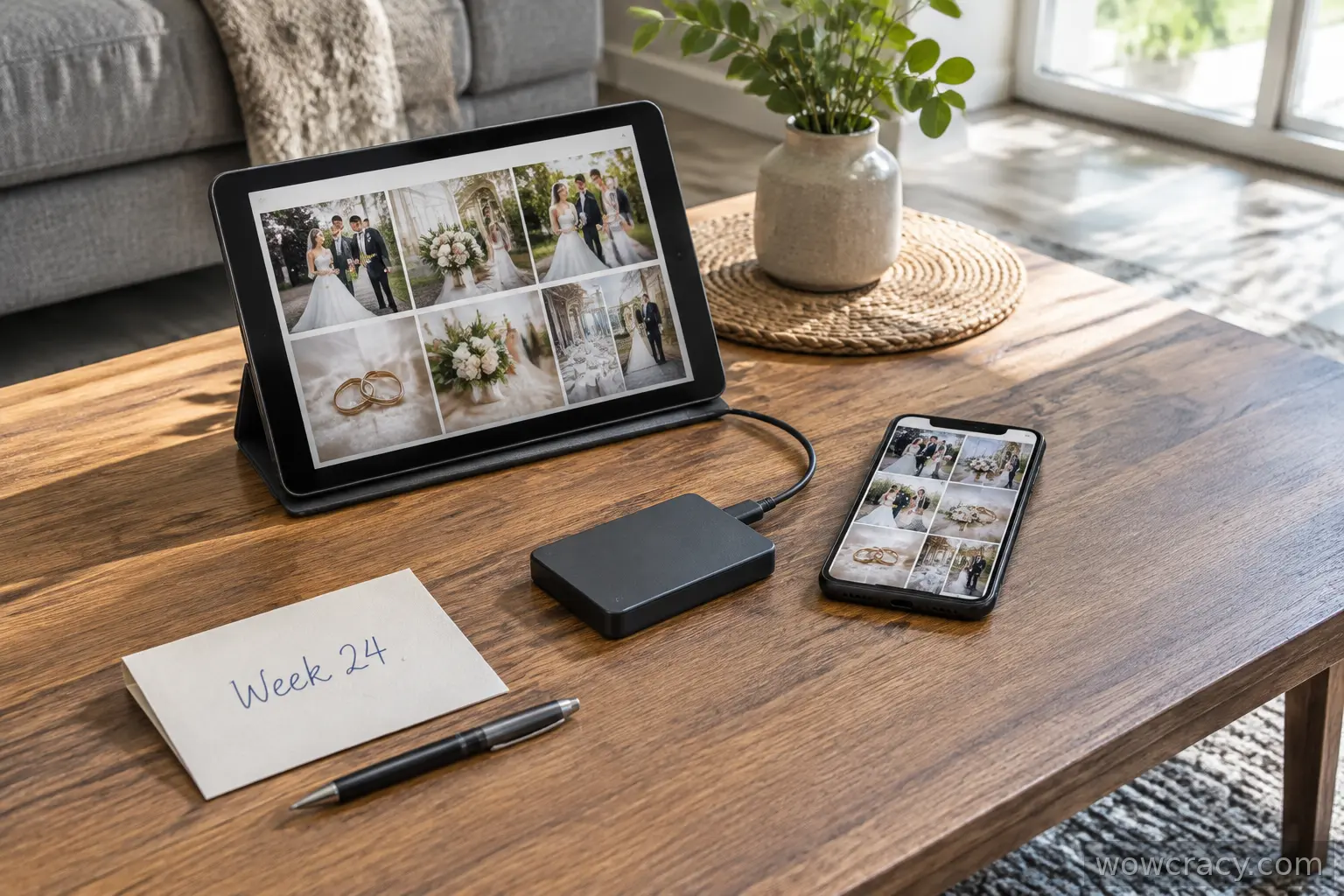
Clarify whether this means all photographs at once or whether stages are provided for. Some photographers first send a short series for social media, and the full archive later. If such a schedule is important to you, ask for it to be recorded.
Format and medium
Ask in what form you will receive the files: a link to cloud storage, a flash drive, a disk or an online gallery. Clarify the resolution, the file format and whether there will be separate versions for printing. If you plan to print a large portrait, it needs a high-quality file, not a reduced copy for the web.
Separately find out how long the gallery link is available. Sometimes it works for several months, after which the archive is deleted. This is normal, but you should know about it in advance and have time to save the files.
Publication of photos and rights of use
Portfolio display, advertising and social-media publication are separate uses. Agree them before paying, including any wish to keep the wedding private. Copyright in a photograph and the interests of people depicted are distinct issues.
Do not assume publication permission “by default.” Agree images, channels, advertising uses and restrictions under applicable law. The couple’s consent does not substitute for every guest’s or children’s legal representatives’ consent. For Ukraine, consider Civil Code article 308 separately; do not automatically apply its rules and exceptions to other countries.
Define your own permitted uses: downloading, printing, social-media posting, editing and sharing with third parties, plus attribution. Payment does not provide a universal answer about transfer of all rights: commissioned-work rules differ by country. Record the licence or rights transfer you need clearly in the contract.
Backup storage of the archive
Agree retention periods for source and finished files and any redelivery terms, fees and cutoff dates. Online-gallery access and internal backup retention can have different deadlines. The photographer retaining RAW files does not mean they will be delivered to you.
Your task is not to rely only on the photographer. As soon as you receive the files, make several copies: on an external drive, in cloud storage and, if desired, on a physical medium that is stored separately. This is not distrust of the photographer, but ordinary practice for any important archive.
What else should be agreed before the advance payment
In addition to the main points, there are details that affect comfort during the shoot. Discuss them at the meeting, and put the key agreements into the contract or an annex to it.
- Meals and breaks for the photographer during the day.
- Whether other photographers or a videographer who will not interfere with the shoot may be involved.
- How the list of mandatory shots is agreed — family, friends, details.
- Whether there is equipment insurance and what will happen if the equipment fails.
- Who is responsible for the shoot if the photographer falls ill.
Do not be shy about asking questions, even if they seem too detailed. An experienced professional usually already has ready answers and does not perceive this as distrust. If, however, the questions cause irritation or evasive answers, that is also information.
How to check the photographer before payment
Review a coherent series rather than only highlights: preparations, ceremony, groups and evening lighting. Ask for material the photographer has permission to show or an agreed private viewing. Refusing to expose another client’s private gallery is not itself evidence of poor work.

Read reviews, but pay attention not to general praise, but to mentions of deadlines, communication and behavior during the event. If possible, ask acquaintances who have already gotten married about their experience.
At the meeting it is important to feel whether you are comfortable communicating. You will spend many hours with this person on an intense day, and mutual understanding here is no less important than equipment.
A practical checklist before signing
- Check who is the party to the contract and whether the details match the payment data.
- Find the exact start and end time of the shoot, the number of photographers and the price of additional hours.
- Clarify what is included in the price: travel, processing, the number of finished shots.
- Read the terms of the advance payment, postponement of the date and cancellation.
- Find the deadline for delivering the finished photos and the method of receiving them.
- Check the clause on publication of photos and rights of use.
- Find out how long the archive is stored and what will happen in case of the photographer’s illness.
- Ask for a copy of the signed contract for yourself.
If some point raises doubts, it is better to ask a question now than to clarify the details after the wedding. A contract is not needed so as not to trust someone — it is needed so that both parties feel at ease.
Frequently asked questions
Can the contract be signed remotely?
Yes, this is common practice. It is important that you receive the full text of the document, can read it without haste and have confirmation of signing by both parties. If you are unsure about the legal force of a particular format, clarify this with a specialist.
Is it mandatory to pay the advance immediately?
You can ask for time to read and raise questions before committing. Clarify how long the offer lasts and whether the date is held without payment; that is not guaranteed. Pressure to pay without access to the terms is a reason to defer the decision.
What should I do if the photographer missed the delivery deadline?
First, contact them in writing and clarify the situation. Then act in accordance with the terms of the contract. If you cannot reach an agreement, you can seek advice from a lawyer who will assess the specific circumstances.